Sunday, 19 November 2023

Black Friday


SHOPPING

Idioms

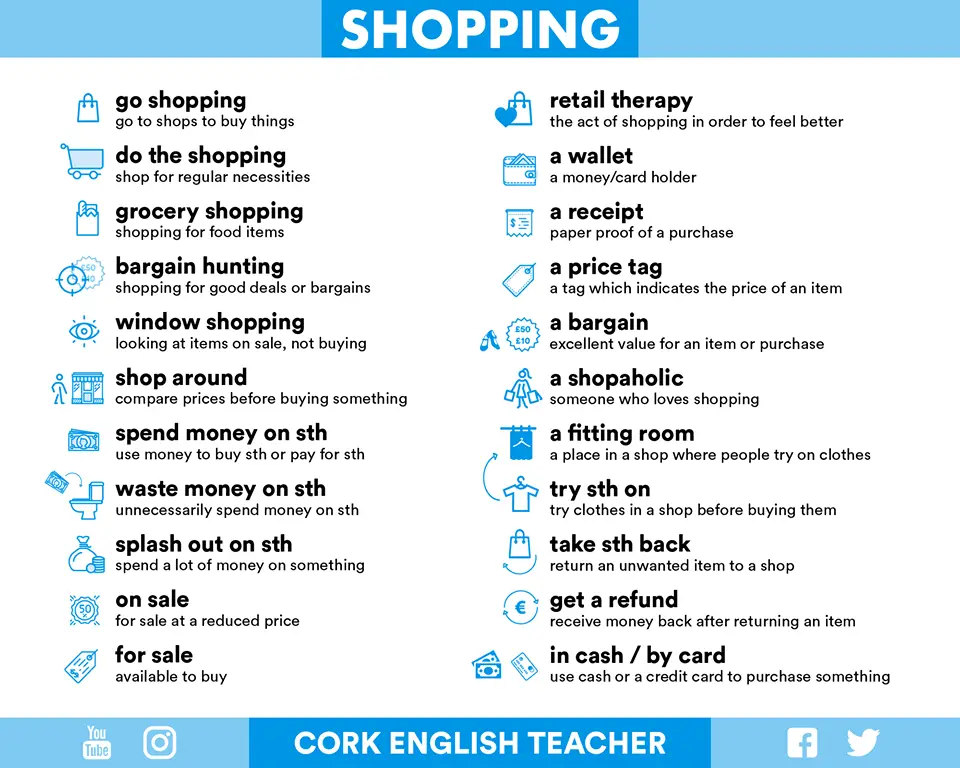
  • bargain hunting. If you spend time in the shops looking for items to buy at the lowest price, you go bargain hunting.
    • "During the sales I go bargain hunting with my friends!"
  • it's a bargain. Said when an article is well below the usual price.
    • "That handbag goes beautifully with the dress, and at that price it's a bargain!"
  • I can't afford it. If you can't afford something you don't have enough money to buy it.
    • "I'd love that jacket but I can't afford it!"
  • it costs an arm and a leg. If an article or service costs an arm and a leg, it is very expensive indeed.
    • "The diamond engagement ring cost an arm and a leg!"
  • it costs a fortune. Something that costs a fortune is very expensive.
    • "Look at the price of that bag - it costs a fortune!"
  • it's a steal.The expression 'it's a steal'' means that something is so cheap that it’s almost as if you haven't paid anything for it.
    • "At that price it's a steal. You won't find it cheaper in any other shop."
  • it's good value for money. Something that is good value for money is worth the money spent on it.
    • "The quality is excellent so it's good value for money."
  • it's a bit pricey. The expression a bit pricey means that something is a bit expensive.
    • "Their clothes are a bit pricey but they have a wonderful selection"
  • it's a rip-off. Something that costs much more than it should is called a rip-off.
    • "$10 for an orange juice? That's a rip-off!"
  • shop around. If you shop around, you visit a number of shops selling similar articles in order to compare the prices.
    • "You can usually save money by shopping around."
  • shop till you drop. If you shop till you drop, you go shopping for a very long time, until you are exhausted.
    • "If you go to London with Ashley, you'll shop till you drop, so take comfortable shoes!"
  • shopping spree. If you go on a shopping spree, you enjoy a lively outing, usually with much spending of money.
    • "Liza is planning to go on a shopping spree as soon as she gets her bonus."
  • shopping therapy. The term shopping therapy refers to the idea that buying things can make you feel better.
    • "A little shopping therapy can usually cheer up bored teenagers."
  • splash out. If you splash out on something, you buy it even though it costs a lot of money.
    • "When he got a promotion Andy splashed out on a brand new car."
  • window shopping. When people go window shopping, they look at things in shop windows, without actually purchasing anything.
    • "I haven't been paid yet, so I can only go window shopping."

Conversation Questions:

●      Do you like shopping? For what kinds of things?
●      Have you ever spent too much? What did you buy? How did you feel afterwards?
●      How long do you usually shop for? Do you try to get your shopping done as fast as possible?
●      Do you shop online? What kinds of things do you buy online? What would you rather buy in person?
●      Think about the most expensive thing you have ever bought. Was it worth what you paid for it?
●      Do you prefer to shop alone or with other people? What are the advantages and disadvantages of each?
●      Who does the grocery shopping in your household? How often do they do it?
●      Are you a bargain hunter? Do you get excited about sales and discounts? When are the best sales in your country?
●      Which do you prefer? Buying things for yourself or for other people?
●      Do you collect points or stamps at any stores? Which loyalty programs are worthwhile?
●      In the United States, the Friday after Thanksgiving is known as Black Friday and is famous for big sales and aggressive behaviour by shoppers. Have you ever had any problems with other shoppers?
●      Shoplifting is when someone takes something from a shop without paying. How common is this crime in your country? How do shops try to prevent shoplifting?
●      Have you ever worked in a shop? What was the store selling? Does that kind of job suit you?
●      If you were to open your own shop, what kinds of things would you like to sell?
●      Have you ever returned something to the shop you bought it from? Why did you return it? Did you get a refund?
●      Do you care where products are made? Do you prefer to buy things which are made in your own country? Why or why not?
●      Some countries have late-night or all-night shopping. What time of day do you like to shop?
●      Have you been shopping abroad? Which are the best cities for shopping?


Every year in November, people look for bargains on Black Friday. But did you know that the same day is also Buy Nothing Day?

Thanksgiving

 The history of Thanksgiving

Thanksgiving combines the traditions of different groups of people. Travellers and migrants brought different religious traditions from Europe to the United States and Canada. Several celebrations are claimed as the first Thanksgiving. The best known is the celebration held by the pilgrims in what is now Plymouth, Massachusetts after their journey across the Atlantic Ocean on the famous Mayflower ship. Like the pilgrims, many groups held days of prayer, fasting or feasting to give thanks for successfully making the long boat journey. Later, settlers celebrated their successful harvest in a new land by holding feasts with their Native American neighbours. Over time, the Canadian and American traditions have become similar and developed into the modern holiday of Thanksgiving.

Thanksgiving today

In Canada, Thanksgiving is celebrated on the second Monday in October. In the United States, it is on the fourth Thursday in November. Although its origins are religious, today, Thanksgiving is a largely secular holiday. For most Americans and Canadians, it is a day for coming together with family and friends to share a large meal. It is an occasion to spend time with loved ones and express gratitude for the year that has passed. In many households there is a tradition of everyone seated at the table sharing what they are most grateful for.

Thanksgiving food

Thanksgiving is also about food. Thanksgiving dinner traditionally includes roast turkey, mashed potatoes, cranberry sauce and, for dessert, apple, pumpkin or pecan pies. Every family has its own recipes, sometimes secret recipes handed down through generations. Turkey, a bird native to North America, is the unofficial mascot of Thanksgiving, with roast turkey on the menu and turkey decorations on the wall. In the United States, a tradition of gifting turkeys to the President has more recently evolved into a humorous turkey ‘pardoning’. At this light-hearted ceremony, the President issues an official pardon for one or two turkeys, saving them from being cooked for supper.

More than food: football, parades and traffic jams!

Beyond food and gratitude, there are some unexpected sides to the American and Canadian holiday. One of these is football. This popular sport is an important part of the holiday, when families gather around to cheer on local or national teams. American football and Canadian football are both similar to rugby, played primarily not with the feet but with the hands.

Parades are another common part of the festivities. In the United States, the Macy’s Thanksgiving Day Parade takes place in New York City on the morning of Thanksgiving. It’s one of the world’s largest parades and is broadcast nationwide. A similar Thanksgiving parade happens in Canada as part of the Kitchener–Waterloo Oktoberfest, a multi-day autumn festival.

Unfortunately, heavy traffic is also common at Thanksgiving. In both countries, the week of Thanksgiving is one of the most popular travel times of the year, as everyone heads home to visit their extended family. So try to avoid any road trips if you’re visiting North America during this holiday!


https://learnenglish.britishcouncil.org/general-english/magazine-zone/thanksgiving


Thnksgiving webquest. Reading


Activity 1: The history of the Thanksgiving celebration

Visit http://www.history.com/topics/thanksgiving and read the article. Look for the answers to these questions.
1. Who travelled on board the Mayflower and why?
2. Was their journey comfortable?
3. What route did their journey take?
4. What problems did the Pilgrims experience during their initial few months in New England?
5. Why was Squanto, a Native American, able to communicate in English with the Pilgrims?
Now, go to http://www.history.com/topics/thanksgiving/first-thanksgiving-meal and read the article to answer the remaining questions.
6. Who were the Wampanoag and what is their connection to Thanksgiving?
7. How long did the event last?
8. What kind of food was probably eaten at the first Thanksgiving meal?
9. What differences are there between the Thanksgiving meal eaten by the Pilgrims and the one people eat today?

Activity 2: A traditional Thanksgiving meal

Visit: www.organicauthority.com/live-grow/history-of-thanksgiving-table. Read the descriptions of typical Thanksgiving dishes and find the answers to these questions.
1. Which dish with an exotic background got a sweet addition in the twentieth century?
2. Which sweet nut dish has ancient origins?
3. Which food helped make a brand of soup more popular?
4. Which food is made from different ingredients, depending on the origins of the people cooking it?
5. Which food is very good for you and can be stored for a long period?
6. Which food made one woman very rich?
7. Which food got its name by mistake?
8. Which food probably wasn’t eaten at the first Thanksgiving meal because of lack of technology?

Activity 3: Thanksgiving traditions

Read about some typical traditions in North America at Thanksgiving. Visit: people.howstuffworks.com/culture-traditions/holidays-other/thanksgiving5.htm Before you read the information on the website, decide whether you think the statements below are true (T) or false (F).
1. Many people watch tennis at Thanksgiving every year.
2. Shops often sponsored Thanksgiving parades.
3. Washing neighbours’ cars is the most popular way to help others in the community at Thanksgiving.
4. The White House is given three turkeys each Thanksgiving – two are dead and one is pardoned and not cooked.
5. The turkey that is kept is given a name chosen by the president’s family.
6. The president announces the official date of Thanksgiving every year.
COPY AND PASTE THE QUESTIONS WITH THE RIGHT ANSWERS AND SEND IT BY MAIL TO YOUR TEACHER (javier.martinez@educantabria.es) BEFORE SUN 26TH NOV. 

Wednesday, 15 November 2023

Future forms

Ways of Expressing the Future in English


Despite what you will find in some course books and student’s grammars, and hear from some teachers, there is no future tense in English. If we want to refer to future-time situations we can do this in several ways. In these notes, we look at seven ways.
The first five of these are commonly used in both speech and writing:
1. Emma is seeing Luke tomorrow – the present progressive, also known as the present continuous.
2. Emma is going to see Luke tomorrow – BE + going to, sometimes referred to as the “(BE) going to future”.
3. Emma sees Luke tomorrow – the present simple.
4. Emma will see Luke tomorrow - this modal form is sometimes, unhelpfully, called the “future simple”.
5. Emma will be seeing Luke tomorrow – this modal progressive (or continuous) form is sometimes, unhelpfully, called the “future progressive/continuous”.
The last two are used in more restricted contexts:
6. Emma is to see Luke tomorrow – BE + to  + infinitive.
7. Emma to see Luke tomorrow –  to- infinitive.
There are also some so-called ‘future perfect’ constructions, which we will consider at the end of these notes:
8. Emma will have seen Luke …
9. Emma will have been seeing Luke …
10. Emma is going to have seen Luke …
1. the present progressive (also known as the present continuous)
This form usually refers to a situation that began before the moment of speaking, continues at or around, andafter, the present moment, and into the future, and is of limited duration:
I am writing these notes on the future. (At this moment).
Lindsay is driving to work this week. (She normally goes by bus).
The present progressive can refer to a future situation that has been arranged before the present time. The arrangement continues through the present until the situation occurs:
Emma is seeing Luke tomorrow, (They arranged this meeting yesterday)
Note that only the context or co-text (in the last example the word tomorrow) can tell us which time-period a present progressive verb form refers to.
Also note that it is simply not possible to make arrangements for some future situations. It is therefore not normally possible to say XIt is raining tomorrow. X
2. BE + going to
Although you may hear or read that this form indicates ‘present intention’, this is not always true. It is hard to imagine any intention in this sentence: “Look at those black clouds; it is going to rain soon.”
BE + going to refers to a future situation for which there is present evidence. In the previous example, the present evidence is the black clouds. In the following example, the present evidence may simply be the speaker’s knowledge that Emma and Luke have arranged the meeting:
Emma is going to see Luke tomorrow.
When the present evidence is an arrangement, then there is, practically speaking, no real difference in meaning between the present progressive and BE + going to.
3. the present simple
The present simple is frequently used for situations that often or regularly happen.  It can therefore be used for a future situation that is part of a regular series of happenings:
The train for Berlin leaves at midnight tonight.
It is also used for something that is seen as part of a fixed timetable:
The sun rises at 07.34 tomorrow. (We can imagine the speaker thinking of a table of sunrise and sunset times.)
Emma sees Luke tomorrow. (We can imagine the speaker mentally looking at Emma’s diary).
4. the modal will + bare infinitive
The modal auxiliary verb will has a number of possible meanings. Four of the more common are:
a. certainty – John left an hour ago, so he will be home by now. (The speaker is certain that John is home)
b. habitual characteristic: Andrea will sit at her desk for hours without saying a word. (This is what she often does.)
c. volition (willingness): I’ll carry your bag for you. (The speaker is offering to carry the bag.)
Fred will carry your bag for you. (The speaker is offering Fred’s services.)
d. instant decision: What will I do tomorrow? I know! I’ll go to the zoo. (The speaker decides to go to the zoo at the very moment of speaking – no plans had been made for this visit.)
Context tells us whether the certainty (a) is about the present, as in the example above, or the future: Prince Charles will become King when the present Queen dies.
Habitual characteristic (b) is something that is shown regularly. It was observed in the past, can be observed in the present, and will presumably be observed in the future. It is not possible to know of a future habitual characteristic, so we do not use this form for purely future reference.
Volition (c), denoting an offer, can refer only to a future situation. Will is normally contracted to ‘ll.
Instant decisions (d) can be made only about a future situation and, usually, only reported by the person making the decision. We therefore usually encounter this meaning only with I or we as the subject. Will is normally contracted to ‘ll. 
The word tomorrow in the following sentence tells us that the seeing (meeting) is in the future:
Emma will see Luke tomorrow.
Only context can tell us whether the speaker is certain of the occurrence of the future meeting, or reporting that Emma is willing to see Luke.
Note that other modals, which have different meanings, can also can also refer to future situations, for example:
Peter might come over next week. (It is possible that this will happen)
You must finish the report before you go home tonight. (You are obliged to finish the report.) )
You may read in some books that shall is used instead of will when the subject is I or we. Only a small minority of native speakers use shall other than in questions, and then only for certainty and instant decision, never for volition or habitual characteristic. Shall is used commonly in questions:
e) making a suggestion: Shall we go to the pub this evening?
f) asking if the person addressed wants the speaker to do something: Shall I arrange the publicity?  
5. The modal will + be + -ing form
Progressive forms usually refer to a situation that began before a time point continues through and after that time point, and into the future, and is of limited duration. The combination of this idea with the modal will, expressing certainty, leads to the modal will + be + -ing form referring to a situation beginning before a future time point and continuing through that time point:
Sally’s plane takes off from Heathrow at 9 o’clock tomorrow, so by about midday she will be flying over Istanbul.
It is also possible that the speaker is more concerned with the pure certainty of the action happening than with volitional aspect that might be implied by the use of WILL by itself:
Emma will be seeing Luke tomorrow.
Some writers claim, with some justification, that this use of modal will + a progressive implies, by its lack of reference to intention, volition or arrangement, a 'casual' future. Depending on the context and co-text, the speaker may be intending a ‘casual’ futurity, or may be indicating a situation in progress at a particular time.
6. BE + to  + infinitive
This form is not common in informal conversation. It refers to something that is to happen in the future as a plan or decree, normally by some authority other than the subject of the sentence, and  is common in television and radio news reports Thus we are unlikely to hear the first of the following examples (unlessEmma and Luke are the names of well-known singers, actors, etc) . We might well hear the second:
Emma is to see Luke tomorrow.
Downing Street announced this morning that the Prime Minister is to fly to Washington this evening for urgent talks about the current crisis.
7. to- infinitive
This form is common only in newspaper headlines, where editors want to announce the news as briefly as possible. Once again, we are unlikely to see the first of the following examples (unless Emma and Luke are the names of well-known singers, actors, etc). We might well see the second:
Emma to see Luke tomorrow.
PM to fly to US.
8. will + have + past participle (third form)
When we refer to a future action completed before a later future time, or a future state continuing up to that later future time, we use will + have + a past participle (third form). This is sometimes known as the ‘future perfect’:
I will have lived here for just over thirteen years when I celebrate my 66th birthday next March. (At the moment of speaking, six months before ‘next March’, the speaker has lived ‘here’ for twelve and a half years.)
By the time she leaves Paris tomorrow, Emma will have seen Luke and told him the news. (When Emma leaves Paris tomorrow, the seeing and telling will be, for her, in the past.)
This form is sometimes known as the ‘future perfect’.
9.  BE + going to + have + past participle (third form)
It is possible, though not very common, for a speaker to suggest that there is present evidence of  a future action completed before a later future time, or a future state continuing up to that later future time, using BE +going to + have + a past participle form (third form):
By the time Emma leaves Paris tomorrow, She is going to have seen Luke and told him the news.
Learners may see/hear this usage, but are recommended to use only 8. will + have + a past participle (third form), which has practically the same meaning, and is far more commonly used.
10. will + have + been + -ing form
When we refer to a future action begun before a later future time and continuing through that later future time, we use will + have + been + -ing form. By the end of next week, Emma will have been seeing Luke for three months. (She has now, one week before ‘the end of next week’ been seeing him for a week less than three months.) This form is sometimes known as the ‘future perfect continuous’.

https://youtu.be/RGh2vcDxIvo?si=yG1UjvWRLyfDENIf  Future in songs.
EXERCISES: Future