Showing posts with label current affairs. Show all posts

Wednesday, 11 November 2026

General Strike in Spain.


https://www.youtube.com/watch?v=LRvSRV4WeOg

Spain's first general strike in 14 years brings clashing social and political desires to the fore

Spain’s first general strike in 14 years brings clashing social and political desires to the fore ahead of a national election on Nov. 29

https://abcnews.com/Business/wireStory/spains-general-strike-14-years-brings-clashing-social-138035789 

Millions of Spain’s workers are striking Wednesday to demand that the government remedy the nation’s housing crisis less than three weeks before a national election that could catapult the far right to power. Spain’s first general strike in 14 years is expected to cause delays to the widely used public transport system and lead to the slowdown or shuttering of businesses, factories and shops across the eurozone’s fourth largest economy. Minor incidents were reported in the first hours, including roadblocks — some of them with burning tires — in Barcelona, the second-largest city in the country, and scuffles between picketers and police near the country’s main wholesale market on the outskirts of the capital, Madrid. Striking workers set off fireworks on the stroke of midnight as they gathered in public squares in Barcelona. The two main unions calling for the strike, UGT and CCOO, reported widespread participation in the early hours “with significant work stoppages in strategic sectors” — 90% in the automotive and port sectors, 85% in the meat industry, 82% in waste collection, and 75% in the energy sector — according to a statement posted on social media.

Between workers, activists, politicians and ordinary Spaniards, the groups have very different interests in Wednesday's walkout. The average rent in Spain has almost doubled in the last 10 years, eating into household budgets and angering voters. Public anger over housing reached a boiling point following the nationally televised eviction of an 87-year-old woman from her home in Madrid last month. The subsequent death of Maricarmen, as the woman became known, caused even more indignation and solidified her as a symbol of Spaniards who feel they pay too much on rent and can’t even dream of homeownership. Housing activists leveraged the uproar over Maricarmen's eviction to call for the general strike. They soon won the backing of Spain's two main unions, UGT and CCOO. The housing activists want several measures, including the elimination of tourist apartments, a crackdown on real estate speculation and protection for renters in the form of automatic renewals of leases. The UGT and CCOO unions are demanding more government intervention in the housing market and a new minimum wage agreement through talks with the business owners' association.

The strike’s official slogan is “Salaries. Housing. Prices.”

Monday, 9 November 2026

American politics. Midterm elections guide.

Illustration of the US Capitol with red and blue campaign-style stripes and stars representing the two main political parties.

https://www.bbc.com/news/articles/c6wyz223j19po

The midterm elections were under way in the US, as voters took part in a ballot that could have a major impact on the rest of Donald Trump's presidency.

Thursday, 29 October 2026

Train accident

Europa Press via Getty Images Emergency services personnel are working with torches at the scene of the incident, on 28 October, 2026 in Urda, Toledo, Castilla-La Mancha, Spain.

Europa Press via Getty Images
Emergency teams worked through the night to find victims and clear debris

Nine months after the Adamuz accident in Córdoba that claimed 46 lives, the Spanish rail system has suffered another fatal accident. Two trains traveling from Madrid to Seville — one operated by state rail company Renfe and the other by the private company Iryo — collided Wednesday morning between the towns of Mora, Orgaz, and Urda, in Toledo province. The collision has left at least 30 people dead among the 544 passengers traveling on the two trains. Renfe has reported that services between Madrid, Ciudad Real, and Andalusia are currently suspended.

Sources within the ministry indicate that the Renfe train involved in the accident had stopped and slowed down minutes earlier due to a traffic problem on the line. The explanation points to human error, because when the safety system failed, about eight trains in the area came to a stop; they were then ordered to proceed, but the Iryo train was unable to do so and remained stationary. An operator at the Atocha control center in Madrid mistakenly gave the Renfe train the order to proceed even though the Iryo was blocking the track, and this ultimately led to a rear-end collision — at a speed yet to be determined — between the Renfe train and the Iryo. Investigations are ongoing, but these are the initial findings from the technicians, according to government sources.

 https://www.bbc.com/news/articles/cmqxnl312v34o

Monday, 19 October 2026

Current affairs. Protests around Europe


Listening: Schools closed in France as students clash with police

Why are people protesting across Europe?

Amid a wave of diverse local grievances, protests have erupted across Southern and Western Europe this week, sweeping through France, Albania, Italy, Portugal, Spain, and Greece.

Demonstrations against living costs and school conditions have rocked France since late September, with many turning violent. Meanwhile, Albania has entered its fifth day of anti-government riots and protests over general economic conditions have taken place in Milan and in several cities in Portugal.

Spanish protests targeted housing affordability and the right to housing, while motor oil refinery workers in Greece gathered over demands for better workplace safety.

Thursday, 28 May 2020

Is it in the news? Or just fake news?

Key vocabulary

no news is good news
everything is OK, probably
that's news to me
I didn't know that
breaking news
new news
to break the news
to pass on news to someone

"Fake news" was not a term many people used 18 months ago, but it is now seen as one of the greatest threats to democracy, free debate and the Western order. It has been named the word of the year, raised tensions between nations, and may lead to regulation of social media. And yet, nobody can agree on what it is, how much of a problem it is, and what to do about it.

Governments and powerful individuals have used information as a weapon for millennia, to boost their support. From a campaign of disinformation to aid victory in the final war of the Roman Republic to the 20th century, different forms of communication have been by governments. Added to that, as populations became more used to mass communication, they could more easily see through it.
 Before the internet, it was much more expensive to distribute information, building up trust took years, and there were much simpler definitions of what constituted news and media, making regulation or self-regulation easier. But the rise of social media has broken down many of the boundaries that prevented fake news from spreading in democracies. In particular it has allowed anyone to create and disseminate information.

Facebook and Twitter allowed people to exchange information on a much greater scale than ever before, while publishing platforms like WordPress allowed anyone to create a dynamic website with ease. In short, the barriers to creating fake news have been undone.

After widespread criticism that the companies are failing to deal with fake news, Twitter, Facebook and Google have all announced measures to crack down on misinformation online. Facebook, which has faced the most scrutiny, says it is enlisting fact checkers to flag stories, cutting off advertising to fake news sites, and better reviewing adverts on the site. Twitter says it has become better at dealing with bots, and Google has promised better algorithms to police YouTube.

However, critics continue to argue that not enough is being done, and that the tech companies are reluctant to take action, for fear of being seen as biased.

Spotting fake news isn't easy: a Stanford study last year found that students were shockingly bad at distinguishing between different types of material online, whether paid for, fake or legitimate. Facebook has a useful list of ways to spot fake news, which include checking other sources and a site's URL.

Adapted from The Telegraph

Sunday, 17 November 2019

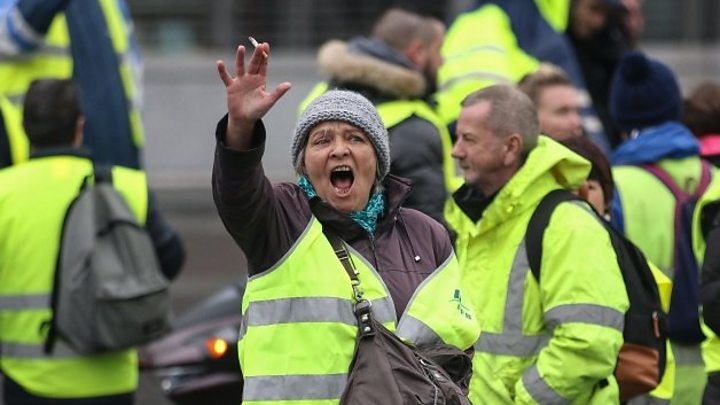
Yellow Vests Protest in France

https://www.bbc.com/news/world-europe-50447733
Police in Paris arrested more than 100 people as protests to mark the first anniversary of the anti-government yellow vest movement turned violent.
Yellow vest (gilets jaunes) rallies took place nationwide on Saturday, a year after they first erupted.
Tear gas and water cannon were used by police in Paris, where thousands of protesters thronged the streets.
Rioters unleashed some of the worst violence the city has seen in months.
With many clad in black and wearing masks to hide their faces, rioters in parts of the city burned barricades, vandalised banks, set rubbish bins on fire and hurled cobblestones at police.
By Saturday evening, Paris police said 147 people had been arrested across the capital.
The nationwide protests were intended to send a message to French President Emmanuel Macron, whose government has been accused of ignoring the needs of ordinary citizens.


Media captionFrance fuel protests: Who are the people in the yellow vests?

The protests first erupted in November last year over fuel price rises, but grew to cover wider grievances, including stagnating wages, living costs and economic inequality.
Mr Macron attempted to quell the protests with promises of tax cuts, higher pensions and reforms, but many still feel he has not done enough.
"We're here even if Macron doesn't like it," demonstrators chanted as they marched through Paris on Saturday.

Yellow Vest- protests in France...

France is experiencing social unrest it has not experienced for generations. The country famous for its revolutions and protests has been rocked by a serious of nationwide, violent demonstrations. Hundreds of thousands of people have taken to the streets for the past four weekends and have brought chaos to businesses, transport and the French economy. The protests are being led by the Yellow Vests Movement, so called because protestors don high-visibility yellow jackets usually worn by the emergency services. The protests are motivated by rising fuel prices, the high cost of living, and claims that an unequal burden of new tax reforms were falling on the working and middle classes.

France's President Emmanuel Macron has declared "a state of social and economic emergency". The violence has caused over a billion dollars in damages so far. This figure is set to rise as more demos are planned. Paris has suffered the brunt of the protests and authorities are closing famous sites like the Eiffel Tower and the Louvre. To quell public anger, Mr Macron has promised to cancel his proposed rise in fuel prices, deliver tax relief for the poor and cancel a tax on retired people. He called for the havoc and mayhem to end and for calm and order to return. He said: "No anger justifies attacking a police officer...or damaging a shop or public building. When violence is unleashed, freedom ends."

For more information, check on this site from the BBC: 
https://www.bbc.co.uk/news/resources/idt-sh/yellow_vests

Audio: