Showing posts with label past. Show all posts

Thursday, 20 October 2022

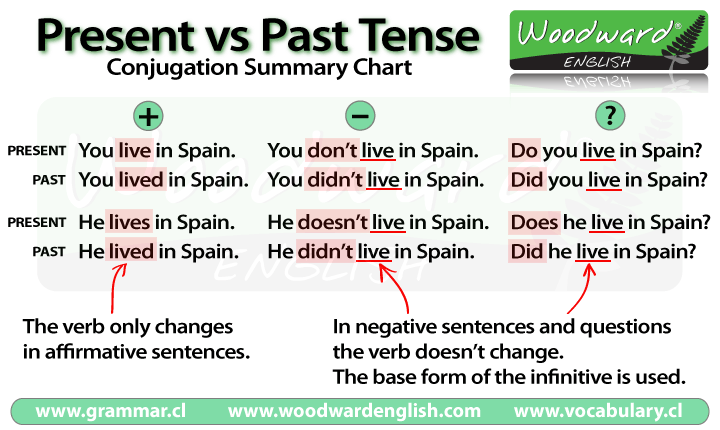
Grammar revision. Past tenses

PAST TENSES.

Use

Simple PastPast ProgressivePast PerfectPast Perfect ProgressivePresent Perfect**Present Perfect Progressive**
action finished in the pastaction was in progress at special time in the pastthe past equivalent of Present Perfecthow long something had been happening before something else happened
  • result of an action in the past is important in the present
  • recently completed action
  • state beginning in the past and still continuing
action beginning in the past and still continuing (focus is on the action)

Signal words

Simple PastPast ProgressivePast PerfectPast Perfect ProgressivePresent Perfect**Present Perfect Progressive**
  • last ...
  • ... ago
  • in 2010
  • yesterday
whileno unambiguous ones
  • just
  • yet
  • never
  • ever
  • already
  • so far
  • up to now
  • since
  • for
  • recently
  • all day
  • the whole day
  • how long
  • since
  • for

Form

Simple PastPast ProgressivePast PerfectPast Perfect ProgressivePresent Perfect**Present Perfect Progressive**
regular:
infinitive + ed
irregular:
2nd column of the irregular verbs
waswere + infinitive + -inghad + past participle*had + been + infinitive + inghave/has + past participle*have/has + been + infinitive + -ing

past participle:

  • regular verbs → infinitive + -ed
  • irregular verbs → 3rd column of the table of the irregular verbs

English uses three principal forms of the past, the Simple Past, the Present Perfect (or compound past), and the Past perfect.  There is also a special tense called the future perfect.

Forms of past tenses:
1. Simple active forms
Iyouhe she it oneweyouthey
Simple pastmade
Present perfecthave madehas madehave made
Past perfecthad made
Future perfectwill have made
2. Progressive active forms
Iyouhe she it oneweyouthey
Simple pastwas makingwere making
Present perfecthave been makinghas been makinghave been making
Past perfecthad been making
Future perfectwill have been making

Simple past.

This is used to relate past events in a historic context. Often, you will know that it must be used, because the sentence also contains an adverb (or adverb phrase) of time, such as yesterday,  a date or time as in example 1, or an implied but unstated moment, as in example 3.

Examples:
1) Queen Victoria died in 1901.
2) The Titanic sank when it hit an iceberg.
3) I told you not to drink too much
4) Next, they went and cooked dinner.

1.1. Simple past - progressive or continuous forms:

Here are some examples with a progressive or continuous form too: both of the events in each sentence are "historic", but one took place while another longer-lasting situation was true:

Examples:
5) John Lennon died while he was living in New York.
6) The students shouted as the President was speaking.

1.2. Used to and would - the past of finished situation or finished habit

To express a finished habit, or terminated situation or action, there are two additional possible structures, one with used to, the other with would.  To express a terminated situation, only the structure with used to can be used. Terminated situation can also be expressed using the simple past often reinforced by an adverb of duration or of time.
Examples: 
   1) I used to go to Brighton when I was a child. But I don't any longer.
   2) He would call her every day when she was younger, but he doesn't now
   3) This street used to be very quiet; but nowadays it's full of traffic.
   4)  This street was once very quiet, but nowadays it's full of traffic.
For more on this, see: Problem words - Used to.

The Present Perfect (or compound past)

In British English, the present perfect (which Samuel Johnson called, perhaps more appropriately, the compound preterite)  is used to situate past events, or the consequences of past events, in relation to the present situation (that's why it is called the "present" perfect). Americans do not always use the present perfect in this situation.

Examples:
1. I have ordered a new refrigerator, darling!
    (i.e., the speaker means "A new refrigerator is coming and will be here soon").
2. I've eaten too much!
     (i.e. the speaker implies: "At this moment now, I do not feel very well; I have a funny feeling in my stomach!)
3.  Manchester United have won the Cup
      (i.e. Manchester United are now, at this moment , football champions).

You do not usually find adverbs of time used with verbs in the present perfect, but there are some exceptions:
1. already:
2. adverbs of frequency:
3. adverbs or adverb phrases of duration related to the present:
1. Come on, we've already started eating !
2. I've often seen people driving too fast down that road.
3. I've lived in London for ten years.
  (Contrast with: I lived in London for ten years (but I don't live there now) - a historic statement)
4. I've lived in London since 1985. 
5. I've been living in London since 1985.    (Both of these forms are acceptable)
6. Up to now, I've always refused to eat fish.

2.1. Present-perfect progressive or present-perfect continuous:

These progressive forms are used when we want to imply that an event / events in the past have been continuing until the present point in time, or have taken place over a period of time in the past

I've been waiting for you since three o'clock.
The doctor has been seeing patients for most of the afternoon.
( Cross reference: since and for)

The past perfect or pluperfect.

The past perfect tense, or pluperfect, as in He had seen,  is normally only used in English when one past event (either a specific action, or a contuous condition) has to be situated in a more distant past than another past event.  In some situations, the progressive or continuous form is necessary.
 
 Examples:
  I had just put the phone down, when the doorbell rang.
  The man had been drinking before the accident happened.
  He had worked in the company for five years before he got promotion.
There are some other uses too, but they are less common. Note, for example, the use of the past perfect (and inversion) after hardly :
Hardly had I put the phone down, than the phone rang.

The future perfect 

The future perfect, as in They will have finished ,  is used to situate a moment or situation thatwill be in the past by the time (a) another event occurs, or (b) a point in time is reached, or (c) another situation is true.
 Examples:
  a)  I will have  finished reading the book before I go to bed.
  b1)   I think that the boss will have interviewed all the new candidates by 6 p.m.
  b2)   By next Monday, I will have been living here for a month.
  c) If you get all the answers right, you will have done better than anyone e

Wednesday, 13 November 2019

Simple Past practice

Adele - Someone Like You 


I heard that you're settled down
That you found a girl and you're married now
I heard that your dreams came true
Guess she gave you things, I didn't give to you
Old friend, why are you so shy?
Ain't like you to hold back or hide from the light

I hate to turn up out of the blue, uninvited
But I couldn't stay away, I couldn't fight it
I had hoped you'd see my face
And that you'd be reminded that for me, it isn't over
Never mind, I'll find someone like you
I wish nothing but the best for you, too
"Don't forget me, " I beg
"I'll remember, " you said
Sometimes it lasts in love, but sometimes it hurts instead
You know how the time flies
Only yesterday was the time of our lives
We were born and raised in a summer haze
Bound by the surprise of our glory days
I hate to turn up out of the blue, uninvited
But I couldn't stay away, I couldn't fight it
I had hoped you'd see my face
And that you'd be reminded that for me, it isn't over
Never mind, I'll find someone like you
I wish nothing but the best for you, too
"Don't forget me, " I begged
"I'll remember, " you said
Sometimes it lasts in love, but sometimes it hurts instead
Nothing compares, no worries or cares
Regrets and mistakes, they're memories made
Who would have known how bittersweet this would taste?
Never mind, I'll find someone like you
I wish nothing but the best for you
"Don't forget me, " I beg
"I'll remember, " you said
Sometimes it lasts in love, but sometimes it hurts instead
Never mind, I'll find someone like you
I wish nothing but the best for you, too
"Don't forget me, " I begged
"I'll remember, " you said
Sometimes it lasts in love, but sometimes it hurts instead

Autores de la canción: Adele Laurie Blue Adkins / Daniel Dodd Wilson

Monday, 4 November 2019

Past tense practice.

Past Simple, Past Progressive Games

https://www.gamestolearnenglish.com/past-tense-game/

In these games you try to match the regular verb -ed endings with the /Id/, /d/ and /t/ sounds.

Thursday, 21 February 2019

REGULAR PAST PRONUNCIATION


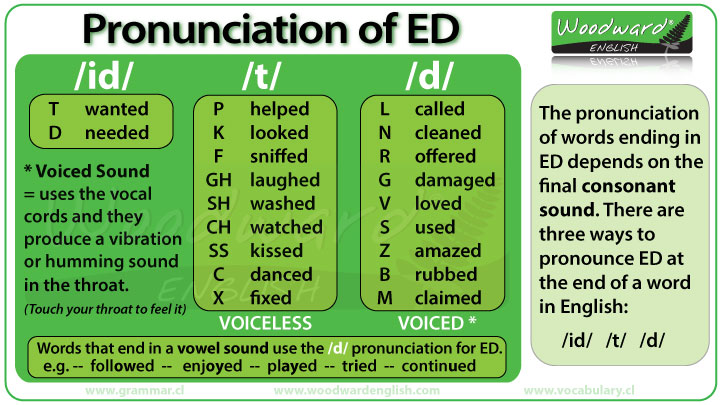
ED appears at the end of regular verbs in the past tense (e.g. wanted, helped, lived) sometimes in adjectives ending in ED (e.g. tired, embarrassed, relaxed) as well as in some Past Participles.
However the pronunciation of ED sometimes causes problems for non-native speakers because it can be pronounced in three different ways: as / id /, as / t / or as / d /
(Note: whenever you see letters or symbols between two slash marks (/ /), it refers to the pronunciation of that letter or sound)
Before we learn the difference ways to pronounce ED, we must first know what voiced and voiceless consonants are.

Voiced Consonants vs. Voiceless Consonants

voiced consonant (or sound) means that it uses the vocal cords and they produce a vibration or humming sound in the throat when they are said. Put your finger on your throat and then pronounce the letter L. You will notice a slight vibration in your neck / throat. That is because it is a voiced sound.
voiceless sound (sometimes called an unvoiced sound) is when there is no vibration in your throat and the sound comes from the mouth area. Pronounce the letter P. You will notice how it comes from your mouth (in fact near your lips at the front of your mouth). The P sound doesn't come from your throat.
Try this with the other letters and you will "feel" the difference between a voiced and a voiceless consonant (or sound).
Now we know the difference between voiced and voiceless sounds we can look at the following rules for the correct pronunciation of ED in English:

1. The /id/ sound

If the last letter of the word is spelled with D or T, the ED is pronounced as a separate syllable with an /id/ sound (it rhymes with kid and lid).
  • wanted (sounds like "want-id")
  • waited
  • needed
  • folded

2. The /t/ sound

If the last consonant of the word is voiceless, then the ED is pronounced as a T. Be careful not to create an extra syllable or "id" sound.
  • talked (sounds like "talkt")
  • kissed (the S sound comes from the front of mouth so it would sound like "kisst")
  • parked
  • helped
NOTE: As an example, with the word "helped", if you say "help-id" as a two syllable word, then it is very likely that people will NOT understand the word or what you are saying. (It is pronounced like "helpt")

3. The /d/ sound

If the last letter of the words ends in a voiced consonant (or sound), then the ED is pronounced like a D (without creating another syllable)
  • played (sounds like "playd")
  • closed (the S sounds like a vibrating Z so the word would sound like "clozd")
  • opened
  • lived

An easy way to remember how to pronounce ED words

The most important thing to remember is that there are two main divisions:
  1. The words that end in T or D
    - the ED is pronounced as a syllable /id/
  2. and the REST of the words
    - you can pronounce the ED as /t/ and people will understand.
In time you will learn when to pronounce the ED as /t/ or /d/.
Summary Chart
This is the chart that appears in the video.
Pronunciation of ED in English