Showing posts with label ebau. Show all posts

Saturday, 5 March 2022

EBAU Practice: Cycling

Cycles for cigarretes:

Question1: [2 POINTS] Indicate whether the following statements are TRUE or FALSE and write down which part of the text justifies your answer.

1. Kilis is not currently a very easy city for cyclists.

TRUE It’s certainly not the most bicycle-friendly city,

2. It is not very common to hear Arabic spoken in Kilis.

 FALSE Arabic is heard as much as Turkish

3. The projects proposed by Hasan Kara aim to make the city a better place for residents.

TRUE ...projects aimed at creating a liveable environment.

4. Any child who gets a relative to stop smoking will receive a bike.

. FALSE To get a bike, children must meet three requirements: (they must get a smoker relative to quit, maintain strong grades while improving a weak area of study, and promise to ride for an hour a day.)


Question 2:[ 2 POINTS] Answer the following questions in your own words according to the text.  

1. What is the traffic in the city of Kilis currently like?

The traffic in Kilis sounds quite hectic and dangerous. There are a lot of cars and motorbikes already, and traditionally, fewer bicycles. The use of the motorbikes seems particularly risky as they rarely use safety equipment and often carry too many passengers.

2. What different things is the proposed project trying to do?

The project is trying to improve the traffic situation by encouraging children to use bikes and giving them the equipment and infrastructure they need to do this. It is also trying to improve people’s health by getting people to stop smoking and to motivate children to study more.

 Question 3: [1,5 POINTS]Find words or phrases in the text that correspond to the words given.

1. constant (paragraph 1) steady

2. flow (paragraph 1) stream

3. objective (paragraph 3) target

4. unusual (paragraph 4) rare

5. effort (paragraph 5) attempt

Question 4:[1,5 POINTS]Choose the correct option, a, b, c or d for each question and COPY the sentence onto your answer sheet.

Se otorgará 0,5 pts. a cada respuesta

1. According to the text, the majority of the Syrian refugees in Kilis...

c. choose not to live in special camps.

 2. The text says that...

a. some of the children have already started using the bikes they have been given.

3. Unless a child does well in school...

b. he/she will not get a bike.

MODALS-REVISION: 

https://kahoot.it?pin=2810807&refer_method=link

Saturday, 22 January 2022

EBAU practice- Travelling and adventure

Go it alone: solo trip on the rise as travellers opt for “me time”

More Britons are choosing to travel on their own, using apps and social media, as it means a holiday without compromises.

Solo travel is on the rise as a growing number of holidaymakers opt for trips that allow them to “do what they want”. Around 15% of travellers took a trip on their own in the last year, according to the Association of British Travel Agents (Abta). The figure is up from 12% last year.

The age range that showed the biggest increase was that of 35-44 year olds, with more than 16% taking a trip alone: the figure for 2017 was just 5%. Having the opportunity to do whatever they wanted was the most common reason given by three-quarters of people surveyed in all age groups, while taking time out and meeting new people have become less important, according to the report.

The upward trend over the last decade is attributed to improved technology and a growing number of apps (alongside social media) that enable travellers to navigate the world with more ease and confidence alone: from instant language translation, free global messaging and other roaming options, to apps that connect people with other solo travellers or local hosts for dinner, tours or a bed for the night.

Travel companies have responded to demand by offering a range of options for people booking by themselves. Tour operators, such as Intrepid Travel, have doubled its offering of independent trips this year and says “solos” now represent 50% of its customers. Its small group tours for solo travellers aim to offer a “ready-made group of friends”

Abta reported that, overall, the number of British people taking a holiday remained high, with 86% of respondents taking a holiday at home or abroad in the 12 months to August 2018. Package holidays remain a popular choice for holidays abroad and city breaks were still the most popular type of trip: 48% of those surveyed having taken one this year, closely followed by beach holidays (40%).

Despite the positive figures from Abta, the British tourist authority chairman Steve Ridgway’s response had a note of caution, in light of Brexit: “We face a number of significant challenges, the most important, the UK’s departure from the European Union. We want to ensure that the future relationship keeps our borders as frictionless as possible for visitors, our aviation as connected as ever and our economic stability on track, because tourism depends on this.”

 Adapted from The Guardian 9th October 2018


Question 1: [2 POINTS] Indicate whether the following statements are true or false and write down which part of the text justifies your answer.

a)       More and more travellers want to feel free when choosing their holiday activities.

b)      TRUE “Solo travel is on the rise as a growing number of holidaymakers opt for trips that allow them to “do what they want” OR “Having the opportunity to do whatever they wanted was the most common reason given”

        Agents have had no reaction to solo travelling.

c)     FALSE “Travel companies have responded to demand by offering a range of options for people booking by themselves”

       British people no longer choose holidays which include everything they need to travel.

a)       FALSE “Package holidays remain a popular choice for holidays abroad”

d)      Future political changes may affect the tourist industry.

 TRUE “Despite the positive figures from Abta, the British tourist authority chairman Steve Ridgway’s response had a note of caution, in light of Brexit”


Question 2 [2 POINTS] Answer the following questions in your own words.

a)       Why are more and more people taking a holiday on their own?

b)     There is a growing number of people travelling alone since this way of travelling offers them the freedom to choose what they can do; whereas before they wanted to have time for themselves or just meet new friends.

        How does technology help solo travelers?

Technology helps solo travellers as they feel they can rely on it if they have problems with the language and can communicate easily with other people travelling on their own; what’s more, they can even contact locals, who they can meet for dinner or for accommodation.

Question 3: [1,5 POINTS] Find words or phrases in the text that correspond to the words and definitions given.

a)       to choose (par.2) to opt for

b)      chance (par.3) opportunity

c)       ascending (par.4) upward

d)      variety (par.5) range

e)      to confront (par.7) to face


Question 4: [1,5 POINTS] Choose and write the most suitable answer (a, b, c or d) according to the text and write the sentence onto your worksheet

 1. The British tourist authority is cautious...

a) although the positive figures from Abta.

b) however, Abta gave positive figures.

c) even though Abta gave positive figures.

d) due to the positive figures from Abta.


2. Solo travellers would not feel so confident...

a) unless they have apps to help them.

b) if they used apps to help them.

c) whether they used apps to help them.

d) if they did not have apps to help them.


3. Social media and apps help solo travellers...

a) to contact their local agent.

b) talk to their group partners.

c) with the language barrier in foreign countries.

d) book a table at a restaurant.


LISTENING: ADVENTURE HOLIDAYS: https://es.liveworksheets.com/yx130287em

MASS TOURISM: https://www.bbc.co.uk/bitesize/guides/zpfd4qt/revision/1

Wednesday, 27 October 2021

EBAU Practice


 OPTION 2 STREET ART FINDS PERMANET HOME IN BERLIN

Question1:[2 POINTS] Indicate whether the following statements are TRUE or FALSE and write down which part of the text justifies your answer.

1. The importance of street art in Berlin is a very recent phenomenon.

FALSE “For decades, street art has been an essential part of Berlin’s cultural DNA”

2. The new museum only displays exhibits from Germany.

FALSE “of urban contemporary art from around the globe”

3. Graffiti is the only type of exhibit on display in the new museum.

FALSE “to now include digital works, hyper-realistic paintings, sculpture and more”

4. Some of the exhibits at the new museum are outside the actual building.

TRUE “The art isn’t limited to the inside of the museum”

Question 2:[2 POINTS] Answer the following questions in your own words according to the text

1. Why is Berlin known for street art?

Different reasons:

• It has been culturally important for a long time.

• Before reunification it was used to express political ideas.

• After reunification, this was also true.

• Many tourists have visited the city to see the graffiti.

• The new museum is another reason to visit the city.

Model answer:

Berlin has been famous for its graffiti for a long time, as both before and after reunification, it is a way that people used to express their political ideas. Nowadays a lot of people specifically visit the city to see the street art and the new museum is also encouraging this trend.

2. What different things make the new museum special?

Different things:

• There are a lot of exhibits from around the globe.

• The history and evolution of graffiti is also presented.

• There are different types of exhibit: painting, sculpture and digital.

• The museum took a long time to plan and organize.

• There are also exhibit outside the actual museum building.

Model answer:

The new museum is special because of the range of different origins of the exhibits – there are works from all over the world, and also because there are different formats, such as drawings, sculptures and digital exhibits. It also uses the buildings around the museum to display some of the works, so the art is both inside and outside the building.

Question 3:[1,5 POINTS]Find words or phrases in the text that correspond to the words given.

1. vital (paragraph 1) essential

2. famous (paragraph 2) well-known

3. generally ( paragraph 3) commonly

4.to keep ( paragraph 4)(to) preserve

5.what`s more ( paragraph 5 ) additionally

Question 4:[1,5 POINTS]Choose the correct option, a, b, c or d for each question and COPY the sentence onto your answer sheet.

1. The text says that…

a. many people visit the city of Berlin because of its street art.

b. many people visit the city of Berlin despite its street art.

c. many people visit the city of Berlin in order to create new street art.

d. many people will not visit the city of Berlin unless more street art is created.

2. Yasha Young …

a. worked completely on her own to choose the works for the new museum.

b. worked with a small team of museum staff to choose the works for the new museum.

c. worked with a very large group of artists to choose the works for the new museum.

d. worked with a group of more than one hundred museum staff to choose the works for the museum.

3. Various artists…

a. have asked to create artwork in the Schoenberg neighbourhood.

b. have been asked to create artwork in the Schöenberg neighbourhood.

c. have to be asked to create artwork in the Schoenberg neighbourhood.

d. have to ask to create artwork in the Schoenberg neighbourhood.


Question 5:[3 POINTS]Write a short essay (about 120-150 words) on the following topic: Do you think government should spend/invest more money to make art more attractive to younger people? Justify your opinion.


Many people’s lives are richer because of art. However, some people feel that governments should spend money on housing, medical care, or defence, instead of on art. It is clear this is not a waste of resources but a way of support and promote culture.
From my point of view, there are several reasons why governments should not finance artists. First of all, artists should have to follow the same rules as the rest of the market. If there is a demand for their music or sculpture, then they will get benefits. Secondly, I believe that politicians generally do not have good taste, so they may waste public money on popular art or on their own preferences. In my opinion, there are more important areas like housing, roads, hospitals, and factories which need the money first.
On the other hand, it would be wrong to say that governments should not spend any money at all on art. I think that everybody needs some beauty in their life, but not everyone can afford a Picasso or attending a music opera or concert.  As I see it, governments should provide money for museums or concert halls for everyone. Another point is that art allows people to express themselves and this is good for society, culture and thought. However, I do not agree with the fact that artists can be good for the economy by producing music, films, and attracting tourists.

All in all,  I strongly believe that governments should prioritize their spending carefully, but they should also allocate some of their budget for art as it is part of their duty to society and to future generations.  I have no doubt that this might promote arts to young people.

Friday, 1 October 2021

EBAU PRACTICE

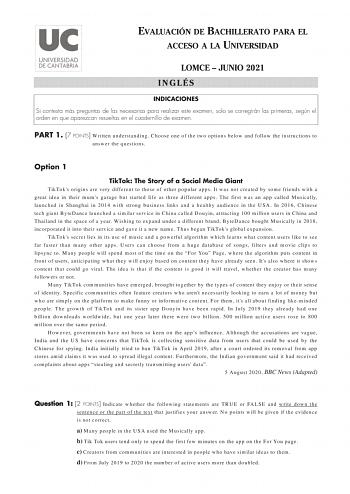
EVALUACIÓN DE BACHILLERATO PARA EL ACCESO A LA UNIVERSIDAD LOMCE  JUNIO 2021 INGLÉS INDICACIONES Si contesta más preguntas de las necesarias para realizar este examen solo se corregirán las primeras según el orden en que aparezcan resueltas en el cuadernillo de examen PART 1 7 POINTS Written understanding Choose one of the two options below and follow the instructions to answer the questions Option 1 TikTok The Story of a Social Media Giant TikToks origins are very different to those of other p…

Examen de Inglés de Cantabria (EBAU de 2021)

Comunidad AutónomaCantabria
AsignaturaInglés
ConvocatoriaOrdinaria de 2021
https://www.bbc.com/news/technology-53640724

Thursday, 11 March 2021

EBAU Practice

https://www.theguardian.com/lifeandstyle/2017/dec/04/is-owning-a-dog-good-for-your-health#:~:text=A%20study%20of%203.4%20million,12%20years%20of%20the%20study.

Dogs really are our best friends, according to a Swedish study that says canine ownership could reduce heart disease. A study of 3.4 million people between the ages of 40 and 80 found that having a dog was associated with a 23% reduction in death from heart disease and a 20% lower risk of dying from any cause over the 12 years of the study. Previous studies have suggested dogs relieve social isolation and depression – both linked to an increased risk of heart disease and early death.

The solution

Dog owners show better responses to stress (their blood pressure and pulse rates don’t soar), have higher levels of physical activity and slightly lower cholesterol levels. The American Heart Association was sufficiently swayed by a review of dozens of studies to release a statement in 2013 saying that owning a dog “was probably” associated with a reduced risk of heart disease. Their reluctance to more strongly endorse dog ownership is because most studies are what is called observational – researchers note an association, but can’t prove causation. This means that other factors might explain why dog owners are healthier than, say, goldfish owners – for example, perhaps only people who are fit in the first place buy pets that need daily walkies.

Tove Fall, an epidemiologist and the lead author of this latest study, says they tried their best to allow for any differences in education, existing ill-health and lifestyles between those with and without dogs. The study found the biggest positive impact of having a dog was on people living alone. “It seems that a dog can be a substitute for living with other people in terms of reducing the risk of dying,” says Fall. “Dogs encourage you to walk, they provide social support and they make life more meaningful. If you have a dog, you interact more with other people. If you do get ill and go into hospital and you have a dog, there’s a huge motivation to try to get back home.”

Of course, getting a dog and watching it from your sofa while you eat fatty food is not going to reduce your risk of heart disease. And a toy dog may look cute, but won’t have any effect either. Fall’s study showed the most health benefits came from having retrievers or pointers. Until her German shorthaired pointer died last year, she ran 10km with her most days. “In Sweden, we have one of the lowest rates of dog ownership in Europe,” says Fall, who has recently got a new puppy. “Maybe this will increase the acceptance that dogs are important to people.”

Thursday, 15 October 2020

Wednesday, 20 March 2019

EBAU Practice- Reading

TAKING OLD CARS OFF THE ROAD
Barcelona will ban cars that are older than 20 years from the road during the week to cut traffic emissions by 30% over 15 years. The measure will come into force on January 1, 2019 and will cover Barcelona and the 39 neighbouring municipalities. Under the terms of the agreement, it will be prohibited to drive private cars registered before January 1997 and vans registered before October 1994 on working days. 
Although the ban will not be fully effective for two years, those same vehicles will already be banned from the roads during periods of high pollution from 1st December this year. The aim is to first reduce emissions by 10% over the next five years to gradually reach the levels recommended by the World Health Organisation. Then the adoption of the stricter measures will be implemented in order to reach the level set by the European Union before 2020. 
Janet Saiz, the city’s deputy for the environment said, “The people of Barcelona have told us clearly in surveys that they want to fight against air pollution because it is a health problem of the first order.” The city hopes to convince people to cooperate by offering free public transport to those who give up their vehicles. 
In a similar move last January, the Norwegian city of Oslo banned diesel cars from the road for two days in one particular week to combat rising air pollution. Many motorists were angered because they had been encouraged to purchase diesel cars by the state government just a few years before, when they were considered a better environmental choice than petrol cars. Drivers who did not obey the ban were fined around €200. A city councillor said at the time, “In Oslo, we can't ask children, the elderly, and those suffering from respiratory problems to stay at home because the air is too harmful to breathe.” 
Some Norwegians, however, were happy with the idea, like Kenneth Tempel, who wrote on Facebook, “Very good measure. We should introduce a permanent ban on diesel vehicles in all big cities. The fines should also be doubled.” According to the Norwegian Institute of Public health, air pollution causes 185 premature deaths in Oslo each year. 16 January 2017 and 7 March 2017, 

The Guardian (Adapted).

Question 1: Indicate whether the following statements are true or false and write down which part of the text justifies your answer. 
a) The ban will happen in Barcelona immediately. 
b) Cars registered before 1997 will not be banned at weekends. 
c) The people of Barcelona feel this is an important issue. 
d) The Barcelona authorities will not offer any incentive to make people comply with the ban. 
e) Kenneth Tempel believes the fines should be lower than they were.

Question 2: Find words or phrases in the text that correspond to the words and definitions given. 
a) Surrounding, closest (paragraph 1) 
b) Conditions (paragraph 1) 
c) More severe (paragraph 2) 
d) Without a charge (paragraph 3) 
e) Option (paragraph 4)

Question 3: Choose the correct option, a, b or c for each question and COPY the option chosen onto your answer sheet. 
1. The people of Barcelona... 
a) were not told to give their opinion about the air pollution problem by the government. 
b) were asked their opinion about the air pollution problem by the government. 
c) were not asked their opinion about the air pollution problem by the government. 
2. Tempel believed that... 
a) a permanent ban on diesel vehicles should be introduced in all big cities. 
b) a permanent ban on all vehicles would not be beneficial in all big cities. 
c) a permanent ban on some vehicles should be beneficial in his city. 
3. A Norwegian driver caught ignoring the ban last January... 
a) had to pay a €200 fine. 
b) must not have paid a €200 fine. 
c) was paid a €200 fine. 
4. The Norwegian authorities... 
a) are used to believing that diesel cars were better for the environment. 
b) didn’t use to believe diesel cars were better for the environment. 
c) used to believe diesel cars were better for the environment. 

Question 4: Write a short essay (about 120-150 words) on the following topic: – In your personal opinion, what are the advantages and disadvantages of owning a car?

Tuesday, 26 February 2019

Food for thought

Spain is the world’s healthiest nation, according to Bloomberg index

Country takes the crown from Italy, while Japan ranks fourth, Britain comes in 19th, and the US takes 35th place, five spots below Cuba.


After climbing six rungs from 2017 and pushing Italy from first spot, Spain now ranks at the top of the Bloomberg Healthiest Country Index, which considers several factors that contribute to overall health, such as life expectancy at birth, sanitation and health services.

Four other European countries made it into the top 10: Iceland (third), Switzerland (fifth), Sweden (sixth) and Norway (ninth). France was 12th, Britain 19th, Portugal 22nd, Germany 23rd and Belgium 28th. Japan, which ranks fourth globally, is the healthiest nation in Asia.
The index classifies nations according to variables such as life expectancy, tobacco use and obesity. Environmental factors like access to clean water and sanitation are also taken into account.
Spain has the highest life expectancy at birth among European Union nations, and trails only Japan and Switzerland globally, United Nations data show. Spain by 2040 is forecast to have the longest lifespan, at almost 86 years, followed by Japan, Singapore and Switzerland, according to the University of Washington’s Institute for Health Metrics and Evaluation.
The Bloomberg index underscores the impact of the Spanish public health system and Spanish eating habits.

Spain has the highest life expectancy at birth among European Union nations

“Primary care is essentially provided by public providers, specialized family doctors and staff nurses, who provide preventive services to children, women and elderly patients, and acute and chronic care,” according to the European Observatory on Health Systems and Policies 2018 review of Spain, noting a decline the past decade in cardiovascular diseases and deaths from cancer.
Researchers say eating habits may provide clues to health levels enjoyed by Spain and Italy, as a “Mediterranean diet, supplemented with extra-virgin olive oil or nuts, had a lower rate of major cardiovascular events than those assigned to a reduced-fat diet,” according to a study led by the University of Navarre Medical School.
Meanwhile in North America, Canada’s 16th-place ranking far surpassed the US and Mexico, which both dropped slightly to 35th and 53rd position respectively.
Cuba placed five spots above the US, making it the only nation not classified as “high income” by the World Bank to be ranked that high. Sub-Saharan economies accounted for 27 of the 30 unhealthiest nations in the ranking. Haiti, Afghanistan and Yemen were the others.

Tuesday, 19 February 2019

EBAU practice


Brain scans to unlock mystery of shoppers' behaviour


Shoppers will have their brains scanned in an attempt to discover whether spending too long in a supermarket really does lead you to make bad and impulsive decisions. Researchers will scan people's brains to examine how they react to promotions and special offers, and how their behaviour changes as they browse the aisles.
The mystery of consumers' behaviour, and how it can be influenced by anything from the layout of a shop's shelves to the music piped through its tannoys, is of crucial importance to retailers who spend millions trying to gain a competitive edge.
According to previous research there appears to be a point about 23 minutes after a customer begins shopping that they cease making decisions rationally and begin acting more on impulse.
Researchers from Bangor University and the shopping behaviour specialists SBXL will ask retailers to simulate a normal £80 grocery shop while having their brain imaged by an MRI scanner.
Because the participants need to be inside the 20-tonne machine, they will choose items from a list of products rather than browsing the shop on foot.
Experts will analyse changes in blood flow brain activity as the participants go through the shopping process, to identify any changes in attention span, and their ability to ignore brands surrounding those on offer.
Their theory is that after about 23 minutes of shopping customers will begin to tire and will start making decisions with the emotional part of their brain, which cannot accurately calculate value for money, rather than the cognitive part which governs logical decision-making.
Some studies have shown that a fifth of shoppers will buy items on special offer even if they are more expensive than the usual product, while nearly half ignore buy-one-get-one free labels and only take one item.
Dr Paul Mullins, a psychologist at Bangor University, said: "We are really excited about this new research opportunity. Using advanced brain-imaging techniques we hope to get a better understanding of how shoppers respond to special offers."

Question 1- Indicate whether the following statements are true or false and write down which part of the text justifies your answer.
a. The result of this study is decisive for shopkeepers.
a) True. The mystery of consumers' behavior …. is of crucial importance to retailers who spend millions trying to gain a competitive edge
b. When people start their shopping, they often act logically.
b) True. Their theory is that after about 23 minutes of shopping customers will begin to tire and will start making decisions with the emotional part of their brain, which cannot accurately calculate value for money, rather than the cognitive part which governs logical decision-making.
c. More than half of the shoppers buy buy-one-get-one free labels
c) False. Some studies have shown that a fifth of shoppers will buy items on special offer even if they are more expensive than the usual product, while nearly half ignore buy-one-get-one free labels and only take one item.

Question 2-Answer the following questions in your own words.
a. What is the purpose of the study?
 a) The purpose of the study is to find out if shoppers change their way to decide about their shopping once they have been at the shop for a long time.
b. How will the research be carried out?
b) There will be a virtual grocery shop where customers will choose products from a list. While they are doing this, their brains will be examined by a scanner and later researchers will study the changes in the blood flow in their brains.

Question 3 - Find words or phrases in the text that correspond in meaning to the words and definitions given.
a. look around (par.1)                      a)  To browse
b. sellers (par.2)                               b)  retailers
c.  pretend (par. 4)                           c)  simulate
d. exactly (par.7)                             d)  accurately

Question 4 - Complete the following sentences without changing the meaning.
  • Supposing the participants went through the shopping process, experts would analyse changes in in blood flood brain activity.
  • If shoppers didn´t stay longer than 23m, they wouldn´t stop making rational decisions.  If shoppers stay longer than 23m, they will stop making rational decisions. (stayed/would stop making/wouldn´t make rational decisions)
  • Unless items are on special offer, 1/5 of shoppers won´t buy them.
  • Provided that customers had a list of items, they would choose products from the list

Online shoppers splash out
https://www.walesonline.co.uk/news/wales-news/537m-total-expected-online-shopping-1888497

Online shoppers are set to spend a total of £537m today in what is predicted to be the busiest internet shopping day of the year. Total spending on the day called Manic Monday is forecast to hit £22.4m an hour, according to shopping comparison website Kelkoo. The cold weather and a strike by London Underground workers are also expected to boost the number of shoppers choosing to buy online.
Visa Europe said the busiest online shopping day in the previous two years had been on the last Monday in November. It predicted transactions would peak in the lunch hour between 1pm and 2pm and again at around 7pm as shoppers go online after returning home from work.
A study found 74% of consumers planned to buy presents online this Christmas, with 30% looking to do more shopping on the internet than last year. Visa Europe commercial director Steve Perry said: "Shopping online is now a natural part of the gift-buying process for consumers and a key part of Christmas sales strategy for retailers.
The combination of monthly salaries being paid and people taking delivery times into consideration should combine to deliver a record day for internet shopping."
Retailer Argos also said it was predicting today to be the busiest for online delivery orders, falling after the last pay day before Christmas but still allowing time for delivery and wrapping before December 25. The busiest day on the high street is expected to be December 18.

Question 1 (3 points). Indicate whether the following statements are true or false and write down which part of the text justifies your answer.
a) More money is usually spent on buying items online on the last Monday in November.
True …… the busiest online shopping day in the previous two years had been on the last Monday in November
b) The number of people shopping for Christmas presents online will grow by 30% this year.
False. 74% of consumers planned to buy presents online this Christmas, with 30% looking to do more shopping on the internet than last year.
c) If you buy something online today, it will arrive before Christmas.
True. (…) still allowing time for delivery and wrapping before December 25.

Question 2 (3 points) Answer the following questions in your own words.
a) Why will there be even more people shopping online this year?
 The freezing temperatures and the fact that the people who work in the London Underground will be taking industrial action today as well as the fact that people have just received their monthly salaries will mean that there will be an increase in the number of people shopping online this year on this day.

b) What times of the day will most people buy things online today?
There will be two busiest times today: when people stop to have lunch between 1 and 2pm and later in the evening when workers arrive home.

Question 3 (2 points) Find words or phrases in the text that correspond in meaning to the words and definitions given.
a) to increase (Paragraph 1)       to boost 
b) predict (paragraph1)  (to) forecast
c) reach the highest point (Paragraph 2)  (to) peak 
d) important, crucial (Paragraph 3)   key 

Question 4 (2 points). Complete the following sentences without changing the meaning.
a) Cold weather and the underground strike will boost total spending.
Total spending wouldn´t boost/be boosted if the weather was good/if there was no strike.
b) People have just been paid and they will want their gifts to be delivered in time for Christmas.
If people hadn´t been paid, they wouldn´t have wanted/have got their gifts delivered.


Thursday, 7 February 2019

Reading-EBAU practice

Oxford University Considering French Campus After Brexit 

Oxford University is considering opening its first foreign campus in direct response to the UK leaving the European Union. The former director of the French ministry for education, Jean-Michel Blanquer, confirmed that French authorities and institutions were working to bring the UK’s most revered universities to France and said officials had also spoken to representatives from the University of Warwick. According to The Daily Telegraph, Oxford University has been informed that such a campus would automatically obtain French legal status and would therefore continue to receive EU funding after Brexit. If the plans come to fruition, then construction of a new Oxford University campus in the French capital could begin as early as 2018. 

A decision has yet to be reached, but a spokesman for Oxford said: "Oxford has been an international university throughout its history and it is determined to remain open to the world whatever the future political landscape looks like.” The likelihood that Brexit could lead to European research funding being withdrawn from UK universities has been described as a “disaster”, by academics. In addition, universities fear that lack of access to Europe will make them less appealing to potential students and staff members. Last month, Oxford University’s head of Brexit strategy, Professor Alastair Buchan said being in Europe meant the university could “recruit quality people that play in the top league.” 

Speaking to The Daily Telegraph, Monsieur Blanquer said: “We want to say to foreign universities: ‘we want to build bridges’ and ‘academic life is not totally dependent on political problems’. We want to convince the European governments that it is an advantage to have high quality institutions from the UK working in their territory, interacting together in terms of research and collaboration. We are at the beginning of the process, but by 2018, we need to be in a position to guarantee these things.” 

A spokesman for the Department for Business, Energy and Industrial Strategy said: “The UK is home to some of the world’s best universities and research institutions, and we intend to secure the best possible outcome for the UK’s research base as we exit the EU. We have already taken steps to put science and research at the heart of our Industrial Strategy with an extra two billion pound investment per year - and we will seek agreement to continue to collaborate with our European partners on major science, research and technology initiatives.” 

20 February 2017, The Independent (Adapted).


Question 1: [2,5 POINTS] Indicate whether the following statements are true or false and write down which part of the text justifies your answer. 
a) Oxford is the only British university the French authorities have talked to about having a campus in France. 
b) The new campus will definitely be built next year. 
c) UK academics are unhappy about losing money from the EU as a result of Brexit. 
d) Oxford University’s presence in Europe will make it possible to employ the best people. 
e) The British government has already designated more money to science and research following the Brexit vote. 

Question 2: [1,5 POINTS] Find words or phrases in the text that correspond to the words and definitions given. 
a) Financial backing (paragraph 1) 
b) To stay (paragraph 2) 
c) Probability (paragraph 2) 
d) To persuade (paragraph 3) 
e) To leave (paragraph 4) 

Question 3: [2 POINTS] Choose the correct option, a, b or c for each question and COPY the sentence onto your answer sheet. 

1. Oxford University is considering opening a French campus... 
a) despite of the UK’s decision to leave Europe. 
b) because of the UK’s decision to leave Europe. 
c) as soon as the UK’s decision to leave Europe. 

2. The final decision about the new campus... 
a) will be taken in the near future. 
b) will be taking in the near future. 
c) has been taken in the near future. 

3. Monsieur Blanquer... 
a) said the Daily Telegraph wanted to build bridges with British institutions. 
b) told the Daily Telegraph that foreign universities want to build bridges with British institutions. 
c) told the Daily Telegraph that the French wanted to build bridges with British institutions. 

4. As a consequence of Brexit, European research funding for UK universities... 
a) will definitely be withdrawn. 
b) is unlikely to be withdrawn. 
c) will probably be withdrawn.