Showing posts with label grammar. Show all posts

Wednesday, 11 March 2026

Use of English. Conditionals/Inversion


IF, EVEN IF, ONLY IF, AS LONG AS, PROVIDED, SUPPOSING, UNLESS, BUT FOR, IF NECESSARY, IF SO, IN CASE etc.

IF and WHEN

When can replace if in zero conditionals:
If you heat water to 100 degrees Celsius, it boils.
When you heat water to 100 degrees Celsius, it boils.
In the other types of conditionals, we cannot use when instead of if.

EVEN IF

Even if emphasises that something will happen, would happen or would have happened whatever the condition:
Even if we leave right now, we still won't catch the train.
I wouldn't go into the water even if I could swim.
Even if we had booked our flight earlier, it wouldn't have been cheaper.

ONLY IF

Only if makes the condition more restrictive:
Acetaminophen is dangerous to children only if dosage is too high.
If the if-clause is first, the subject and the auxiliary in the main clause are inverted:
Only if you like classical music is it worth coming tonight.

SO/AS LONG AS, PROVIDING/PROVIDED (THAT)

So/As long as and providing/provided (that) can be used instead of if to express a condition. Note that providing/provided (that) is a bit formal:
You can stay here as long as you keep quiet.
Provided/Providing (that) the bills are paid, tenants will not be evicted.

SUPPOSE/SUPPOSING, WHAT IF

Suppose/supposing and what if can replace if, mainly in everyday conversation, and are often used without a main clause:
Suppose/supposing you won the lottery, what would you do?
Suppose/supposing you can't find a job?
What if you are not accepted to university? What will you do then?

UNLESS

Unless is followed by an affirmative verb to express "if ... not":
My leg's broken. I can't stand up unless you help me. (I can't stand up if you don't help me.)

IF IT WEREN'T FOR / IF IT HADN'T BEEN FOR, BUT FOR

These expressions mean "without". They are used in second and third conditionals and are usually followed by a noun phrase:
If it weren't for Miguel, we wouldn't know what to do now. (Without Miguel...)
If it hadn't been for your foolishness, we wouldn't have got lost. (If you hadn't been such a fool...)
But for your help, I would have been in big trouble. (Without your help... / If you hadn't helped me...)

IF IN DOUBT, IF POSSIBLE, IF NECESSARY etc.

We can make the if-clause shorter by omitting the subject and the verb be:
If (you are) in doubt, consult a dictionary.
In certain idiomatic expressions, the subject and be are normally omitted:
If necessary, you can call Jake at home.
I'd like a seat by the window if possible.

IF SO, IF NOT

If so and if not can stand for an if-clause which is understood from the context:
"According to the weather forecast, it might rain tomorrow." "If so, we'll go hiking another day."
I hope Peter gets here soon. If not, we'll have to start without him.

IN CASE and IF

An in case-clause gives a reason while an if-clause describes a condition:
I'll buy a sandwich in case I get hungry. (I'll buy a sandwich because I may get hungry later.)
I'll buy a sandwich if I get hungry. (I'll buy a sandwich when I get hungry.)
We can use should after in case:
Take an umbrella in case it should rain.

Conditionals and inversion

In formal English, the subject and the auxiliary can be inverted in the if-clause with if omitted:
Should you see Kate, say hi from me. (if you should see Kate)
Were he to propose to you now, what would you say? (if he were to propose to you)
Were I you, I would stop smoking. (if I were you)
Were it not for Miguel, we wouldn't know what to do now. (if it weren't for Miguel)
Had we booked our flight earlier, it would have been cheaper. (if we had booked our flight earlier).
Had it not been for your foolishness, we wouldn't have got lost. (if it hadn't been for your foolishness) 

Inversion in conditional sentences

Should you find

In first conditional sentences it’s possible to use should at the beginning of the sentence instead of if. This form is formal and it’s quite common with an imperative form in the main clause.

  • Should you find the answer, please let me know as soon as possible. (=If you find the answer)
  • Should you change your mind, you know where to contact us. (=If you change your mind)

Had we arrived

In third conditional sentences, we can invert the auxiliary verb had and leave if out. Had we arrived = If we had arrived.

  • Had we arrived earlier, we could have prevented the incident. 
  • Had they looked further into the data, they might have realised there was a mistake. 

Were we to announce

We can also find cases of inversion with this structure: were + subject + to. + infinitive. It is used to talk about future improbable events (like the second conditional).

  • Were we to announce the truth, we would receive a lot of criticism. (=If we announced …)
  • Were they to buy a new house, they would need to sell the old one first. (=If they bought …)

Negative forms: should I not, had we not, were we not

When shouldhad or were are negative, contracted forms are not possible, and  not is used after the subject.

  • Should you not wish to retake the test, you must let us know before the end of June. (NOT Shouldn’t you wish)
  • Had you not refused my invitation, we would have had the most incredible time in our lives. (NOT Hadn’t you refused)
  • Were you not my brother, I would call the police. (NOT Weren’t you)

UNREAL TIME AND SUBJUNCTIVES


The past tense is sometimes used in English to refer to an unreal situation. Although the tense is the past, we are usually talking about the present, e.g. in a Type 2 conditional sentence:

If dogs had wings, they would be able to fly.

Although had is in the past tense, we are not referring to the past - we are talking about a hypothetical situation. We call this the unreal past.

Other situations where this occurs are:
§  After other words and expressions like ‘if’ (suppose/supposing, if only, what if, imagine)
§  After the verb ‘to wish’
§  After the expressions I’d rather; I’d prefer; It’s time….

It's (high) time
The above expression is followed by past simple or continuous, though the time referred to is unreal.

It’s time we left. It’s high time I was going.
It's high time you hung up your trainers and started exercising your mind, not your body.


Wishes
  • Present/Future time
The verb to wish is followed by an unreal past tense when we want to talk about situations in the present that we are not happy about and would want to change a present/future state.

      I wish I had a motorbike. (I don’t have one now.) 
      I wish you weren’t leaving. (You are leaving.)

  • Would
Would is used when the speaker wants somebody or something else to change, or to describe an annoying habit.

      I wish he would stop smoking.        
      I wish it would stop raining. 
      I wish you wouldn’t make such a mess.

  • Past time
As with present wishes, when we refer to situations in the past we are not happy about or about actions that we regret, the verb form after wish is one stage further back in the past, so we use wish followed by the past participle. Same is used after if only to express regrets.

I wish I hadn’t said that.(but I did)             If only I hadn’t eaten so much. (but I did)

  • Hope
Wishes about simple future events are expressed with hope.

hope it doesn’t (won’t) rain tomorrow.     
hope you(‘ll) have a lovely time in Portugal (on your holiday next week).         

I’d rather/I’d prefer (followed by a clause)
  • I’d rather is followed by past verb forms in the same way as wishes about the present. It expresses preference about actions.
I’d rather you didn’t smoke in here.

Both I’d rather and I’d sooner are used with normal verb forms when comparing nouns or phrases.
I’d rather be a sailor than a soldier. (present)
I’d rather have lived in Ancient Greece than Ancient Rome. (past)

  • I’d prefer can be used in the same way, but note that prefer in this type of sentence has an object it.
                  I’d prefer it if you didn’t go.

      However, I’d prefer is not followed by an unreal verb form in other situations.
                  I’d prefer tea to coffee.
                  I‘d prefer you to go swimming (rather than go jogging).

As if, as though – Real and unreal
The verb form used with as if/as though depends on whether the situation is true or unreal.
                  You look as if you’re having second thoughts. (True. He is having second thoughts.)
                  He acts as if he were in charge. (Unreal. He isn’t in charge)

Note, however, that the more colloquial like does not require this verb form change. Compare:
                  You look like you have just seen a ghost.
                  You look as if you had just seen a ghost.

Suppose and imagine – Understood conditions
The conditional part of these sentences is often understood but not stated.
                  Imagine we won the lottery!
                  Suppose/supposing someone told you that I was a spy!
                  Imagine we had never met! (we have met)

As with conditional sentences, if the event referred to is a real possibility, rather than imaginary, a present verb form is possible:
                  Suppose it starts raining, what’ll we do?

Formal Subjunctives - Insisting, demanding, etc.
After verbs such as demand, insist, suggest, require which involve an implied obligation, the subjunctive may be used in formal style. This has only one form, that of the infinitive, and there is no third person –s, or past form. The verb be has be for all forms.

They demanded that he leave at once.
The school Principal suggested that he be awarded a scholarship.

Formulaic Subjunctives
These are fixed expressions all using subjunctive. Typical expressions are:
                  God save the Queen!
                  Be that as it may …
                  Come what may ….
                  Suffice it to say ….
                  Far be it from me …but

be that as it may: (formaldespite that. Synonym nevertheless. E.g. I know that he has tried hard; be that as it may, his work is just not good enough. 

come what may: despite any problems or difficulties you may have. E.g. He promised to support her come what may. 
  
suffice (it) to say (that)… used to suggest that although you could say more, what you do say will be enough to explain what you mean. E.g. I won't go into all the details. Suffice it to say that the whole event was a complete disaster. 

Far be it from me to do somethingsomething that you say when you are giving advice or criticizing someone and you want to seem polite. It is not really my place to do something. (Always followed by but, as in the example.) Far be it from me to tell you what to do, but don't you think you should apologize? Far be it from me to tell you what to do, but I think you should buy the book.

Monday, 26 January 2026

Use of English. Relatives & connectors

We use relative clauses to give additional information about something without starting another sentence. By combining sentences with a relative clause, your text becomes more fluent and you can avoid repeating certain words.

How to Form Relative Clauses Level 2

Imagine, a girl is talking to Tom. You want to know who she is and ask a friend whether he knows her. You could say:
A girl is talking to Tom. Do you know the girl?
That sounds rather complicated, doesn't it? It would be easier with a relative clause: you put both pieces of information into one sentence. Start with the most important thing  – you want to know who the girl is.
Do you know the girl …
As your friend cannot know which girl you are talking about, you need to put in the additional information  – the girl is talking to Tom. Use „the girl“ only in the first part of the sentence, in the second part replace it with the relative pronoun (for people, use the relative pronoun „who“). So the final sentence is:
Do you know the girl who is talking to Tom?

Relative Pronouns Level 2

relative pronounuseexample
whosubject or object pronoun for peopleI told you about the woman wholives next door.
whichsubject or object pronoun for animals and thingsDo you see the cat which is lying on the roof?
whichreferring to a whole sentenceHe couldn’t read which surprised me.
whosepossession for people animals and thingsDo you know the boy whosemother is a nurse?
whomobject pronoun for people, especially in non-defining relative clauses (in defining relative clauses we colloquially prefer who)I was invited by the professor whom I met at the conference.
thatsubject or object pronoun for people, animals and things in defining relative clauses (who or which are also possible)I don’t like the table that stands in the kitchen.

Subject Pronoun or Object Pronoun? Level 2

Subject and object pronouns cannot be distinguished by their forms - who, which, that are used for subject and object pronouns. You can, however, distinguish them as follows:
If the relative pronoun is followed by a verb, the relative pronoun is a subject pronoun. Subject pronouns must always be used.
the apple which is lying on the table
If the relative pronoun is not followed by a verb (but by a noun or pronoun), the relative pronoun is an object pronoun. Object pronouns can be dropped in defining relative clauses, which are then called Contact Clauses.
the apple (which) George lay on the table

Relative Adverbs Level 3

A relative adverb can be used instead of a relative pronoun plus preposition. This often makes the sentence easier to understand.
This is the shop in which I bought my bike.
→ This is the shop where I bought my bike.
relative adverbmeaninguseexample
whenin/on whichrefers to a time expressionthe day when we met him
wherein/at whichrefers to a placethe place where we met him
whyfor whichrefers to a reasonthe reason why we met him

Defining Relative Clauses Level 2

Defining relative clauses (also called identifying relative clauses or restrictive relative clauses) give detailed information defining a general term or expression. Defining relative clauses are not put in commas.
Imagine, Tom is in a room with five girls. One girl is talking to Tom and you ask somebody whether he knows this girl. Here the relative clause defines which of the five girls you mean.
Do you know the girl who is talking to Tom?
Defining relative clauses are often used in definitions.
A seaman is someone who works on a ship.
Object pronouns in defining relative clauses can be dropped. (Sentences with a relative clause without the relative pronoun are called Contact Clauses.)
The boy (who/whom) we met yesterday is very nice.

Non-Defining Relative Clauses Level 4

Non-defining relative clauses (also called non-identifying relative clauses or non-restrictive relative clauses) give additional information on something, but do not define it. Non-defining relative clauses are put in commas.
Imagine, Tom is in a room with only one girl. The two are talking to each other and you ask somebody whether he knows this girl. Here the relative clause is non-defining because in this situation it is obvious which girl you mean.
Do you know the girl, who is talking to Tom?
Note: In non-defining relative clauses, who/which may not be replaced with that.
Object pronouns in non-defining relative clauses must be used.
Jim, who/whom we met yesterday, is very nice.

How to Shorten Relative Clauses? Level 3

Relative clauses with whowhichthat as subject pronoun can be replaced with a participle. This makes the sentence shorter and easier to understand.
I told you about the woman who lives next door. – I told you about the woman livingnext door.
Do you see the cat which is lying on the roof? – Do you see the cat lying on the roof?

Exercises on Relative Clauses

Relative Pronouns and Relative Adverbs

OTHER LINKS AND EXTRA INFO:


CONNECTORS:

Expressing contrast and concession

Connectors are very important to make the texts we write more cohesive.
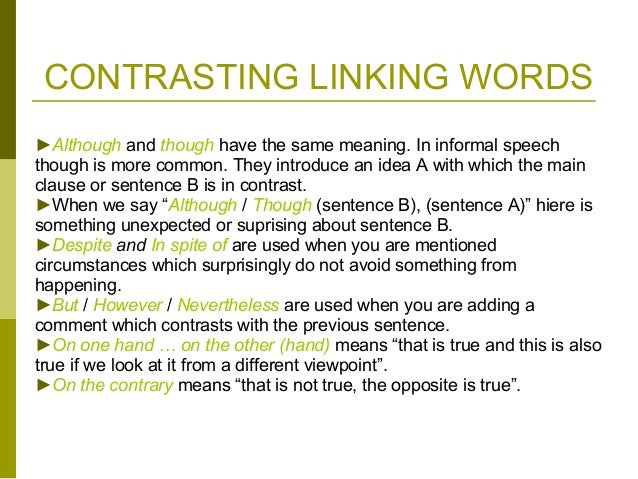
There are many different types, but today we are simply going to sonsider the ones used to express contrast or concession, that means when ideas seem to diverge.
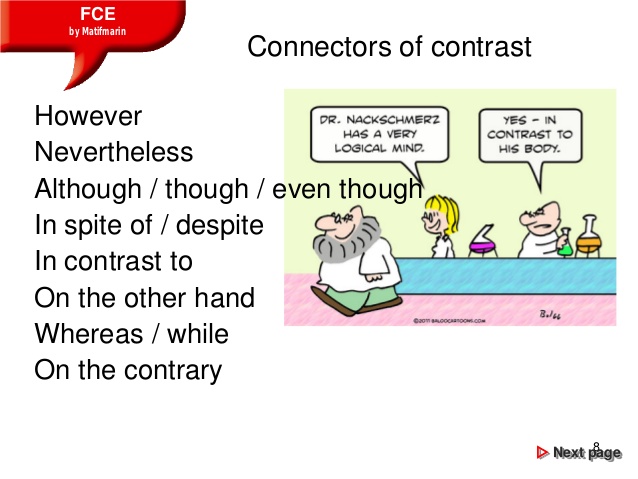
Look at the list below:
using-connectors-and-unit-8-contents-8-638
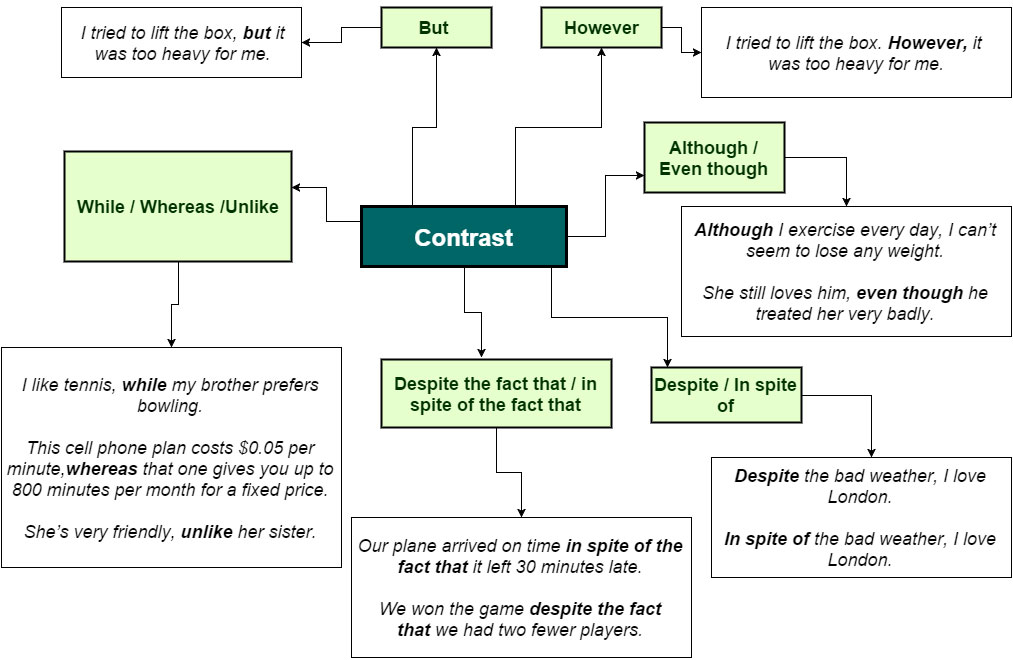
They all introduce a note of  contrast and disagreement, but they have different ways of being used in the sentences. For example their placement may vary. Some are more often used at the beginning, some at the end and others in the middle.Besides their position, they also require different types of completion. Note the differences in the explanation below:
contrast
Although / though / even though  (need a full clause (subject + verb).
Despite /In spite of  – take a Gerund (ing form) or noun
Despite the fact that… / In spite of the fact that …. – full clause (subject + verb)
Yet / Still /However / Nevertheless – need a comma (,) and come in the middle of two clauses.
contrast_connectors


Exercises.  Exercise 1     Exercise 2     Exercise 3     Exercise