Showing posts with label politics. Show all posts

Monday, 26 September 2022

Analysisng current affairs. A look at the European politics

 Nationalism has always been a feature across Europe's political spectrum but there has been a recent boom in voter support for right-wing and populist parties.

It is visible from Germany, where the AfD has become the biggest opposition party in the Bundestag, to Spain, where Vox has become the third largest force in parliament. In part, voters are frustrated with the political establishment, but they also have concerns about globalisation, immigration, a dilution of national identity and the European Union. In the European Parliament, nine far-right parties have formed a new bloc, called Identity and Democracy (ID).

So where in Europe's political landscape do right-wing nationalists hold sway?
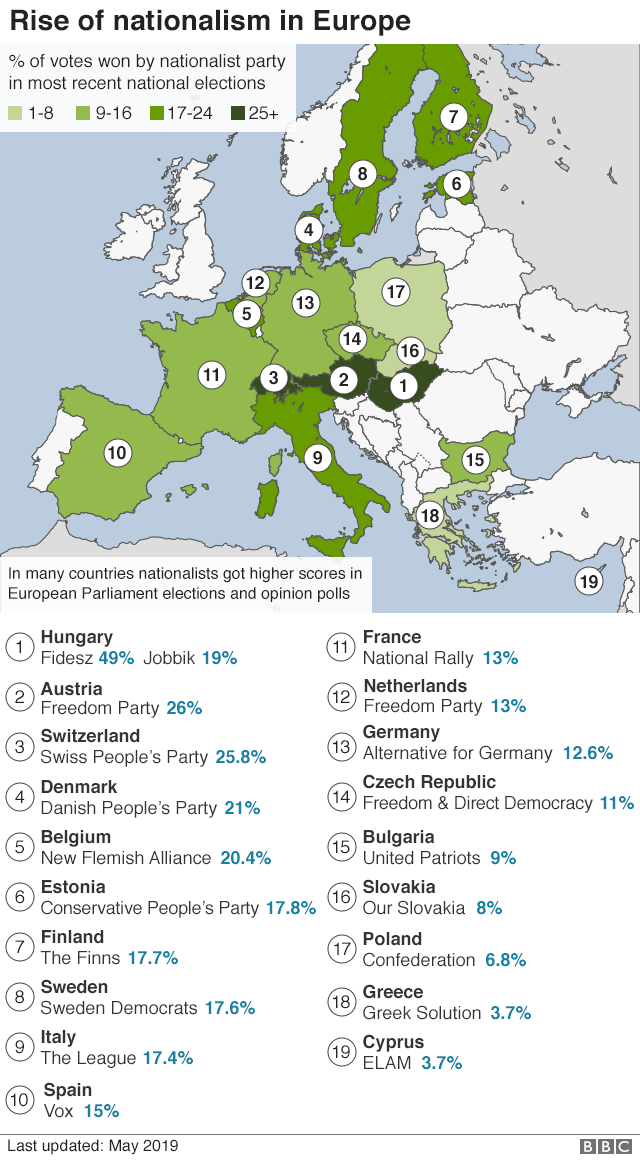
Europe nationalist parties - graphic
Presentational white space
line

Italy


Far-right leader Giorgia Meloni has claimed victory in Italy's election, and is on course to become the country's first female prime minister.

Ms Meloni is widely expected to form Italy's most right-wing government since World War Two. That will alarm much of Europe as Italy is the EU's third-biggest economy.

However, speaking after the vote, Ms Meloni said her Brothers of Italy party would "govern for everyone" and would not betray people's trust.

"Italians have sent a clear message in favour of a right-wing government led by Brothers of Italy," she told reporters in Rome, holding up a sign saying "Thank you Italy".

She is predicted to win up to 26% of the vote, based on provisional results, ahead of her closest rival Enrico Letta from the centre left.

Ms Meloni's right-wing alliance - which also includes Matteo Salvini's far-right League and former PM Silvio Berlusconi's centre-right Forza Italia - now looks to have control of both the Senate and the Chamber of Deputies, with around 44% of the vote.

Her own party's dramatic success in the vote disguised the fact that her allies performed poorly, with Mr Salvini's party slipping below 9%, and Forza Italia even lower. Four years ago, Brothers of Italy won little more than 4% of the vote but this time benefited from staying out of the national unity government that collapsed in July.

The decision on who becomes Italy's next leader is up to the president, Sergio Mattarella, and that will take time.

Although Giorgia Meloni has worked hard to soften her image, emphasising her support for Ukraine and diluting anti-EU rhetoric, she leads a party rooted in a post-war movement that rose out of dictator Benito Mussolini's fascists.

Earlier this year she outlined her priorities in a raucous speech to Spain's far-right Vox party: "Yes to the natural family, no to the LGBT lobby, yes to sexual identity, no to gender ideology... no to Islamist violence, yes to secure borders, no to mass migration... no to big international finance... no to the bureaucrats of Brussels!"
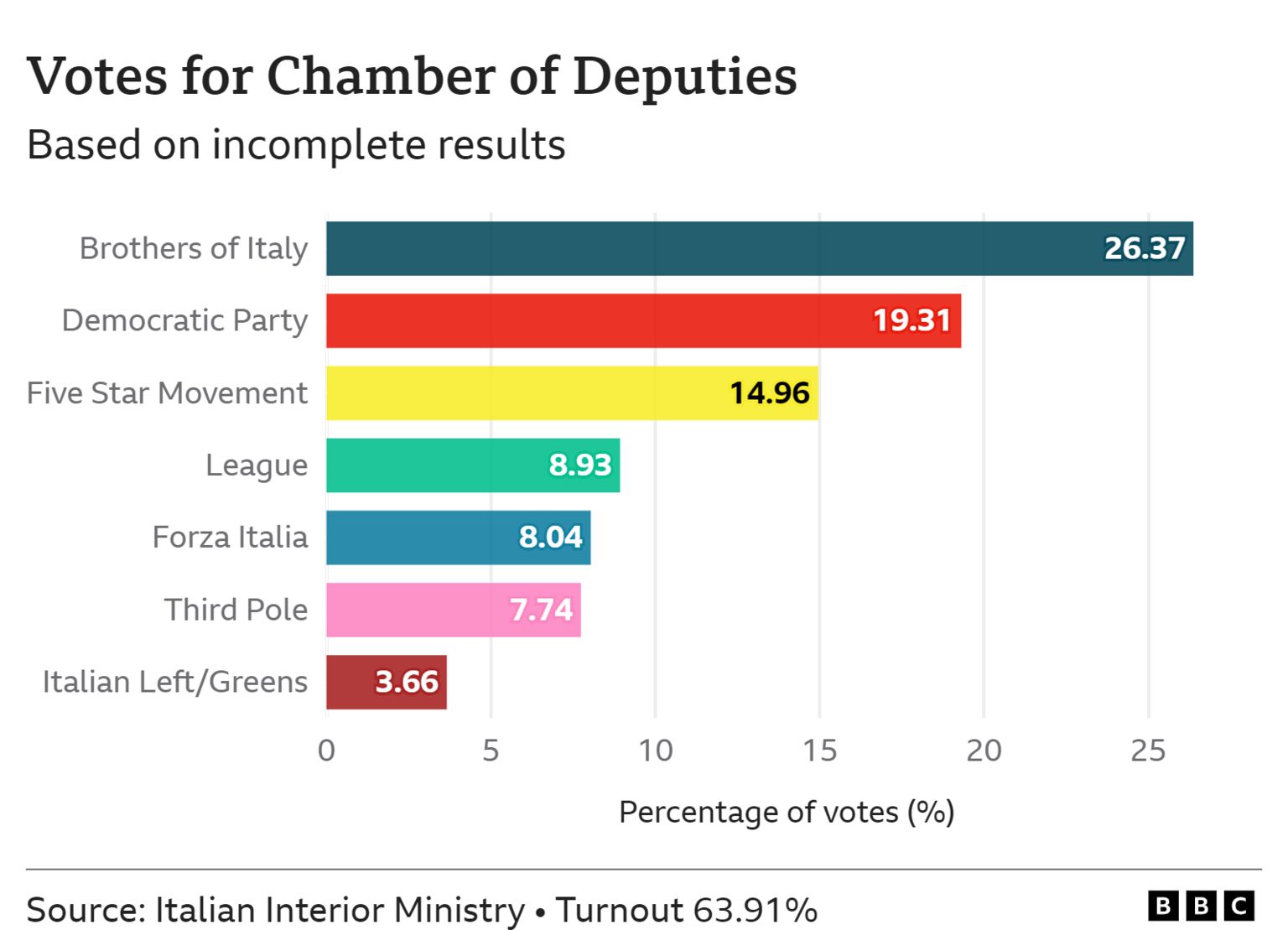

Chamber of Deputies graphic
1px transparent line

Sunday, 17 November 2019

Yellow Vests Protest in France

https://www.bbc.com/news/world-europe-50447733
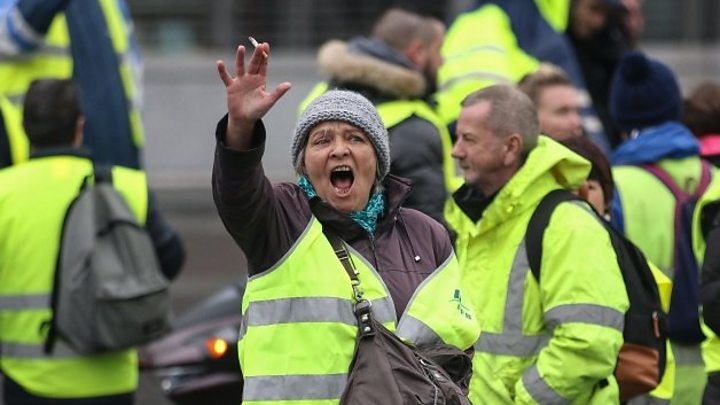
Police in Paris arrested more than 100 people as protests to mark the first anniversary of the anti-government yellow vest movement turned violent.
Yellow vest (gilets jaunes) rallies took place nationwide on Saturday, a year after they first erupted.
Tear gas and water cannon were used by police in Paris, where thousands of protesters thronged the streets.
Rioters unleashed some of the worst violence the city has seen in months.
With many clad in black and wearing masks to hide their faces, rioters in parts of the city burned barricades, vandalised banks, set rubbish bins on fire and hurled cobblestones at police.
By Saturday evening, Paris police said 147 people had been arrested across the capital.
The nationwide protests were intended to send a message to French President Emmanuel Macron, whose government has been accused of ignoring the needs of ordinary citizens.


Media captionFrance fuel protests: Who are the people in the yellow vests?

The protests first erupted in November last year over fuel price rises, but grew to cover wider grievances, including stagnating wages, living costs and economic inequality.
Mr Macron attempted to quell the protests with promises of tax cuts, higher pensions and reforms, but many still feel he has not done enough.
"We're here even if Macron doesn't like it," demonstrators chanted as they marched through Paris on Saturday.

Yellow Vest- protests in France...

France is experiencing social unrest it has not experienced for generations. The country famous for its revolutions and protests has been rocked by a serious of nationwide, violent demonstrations. Hundreds of thousands of people have taken to the streets for the past four weekends and have brought chaos to businesses, transport and the French economy. The protests are being led by the Yellow Vests Movement, so called because protestors don high-visibility yellow jackets usually worn by the emergency services. The protests are motivated by rising fuel prices, the high cost of living, and claims that an unequal burden of new tax reforms were falling on the working and middle classes.

France's President Emmanuel Macron has declared "a state of social and economic emergency". The violence has caused over a billion dollars in damages so far. This figure is set to rise as more demos are planned. Paris has suffered the brunt of the protests and authorities are closing famous sites like the Eiffel Tower and the Louvre. To quell public anger, Mr Macron has promised to cancel his proposed rise in fuel prices, deliver tax relief for the poor and cancel a tax on retired people. He called for the havoc and mayhem to end and for calm and order to return. He said: "No anger justifies attacking a police officer...or damaging a shop or public building. When violence is unleashed, freedom ends."

For more information, check on this site from the BBC: 
https://www.bbc.co.uk/news/resources/idt-sh/yellow_vests

Audio: 

Monday, 14 October 2019

Politics. About independence issues again....


Catalan protests: Why is Barcelona burning?

A general strike has been called in Catalonia on Friday, marking the end of a week of protests following the ruling of Spain’s Supreme Court on Monday.
The court sentenced nine Catalan pro-independence leaders to jail for sedition.
At the heart of the mobilisation are the Catalan youth.
Protesters have been clashing with the police and setting fires in the streets of Barcelona.
Demonstrators have descended on El Prat airport in Barcelona, where there have already been police charges and disruption for passengers.
https://youtu.be/KslSfyTEpD4


Debating Europe has been taking a look at the question of independence for Catalonia recently, and we’ve collected our various posts on the subject here on this page. You can find links and videos below, as well as a fact-sheet that sets out some of the principle arguments from either side.
catalonia_def