https://cantabria-elt.blogspot.com/2022/04/reported-speech-direct-speech.html
European Parliament Ambassador School
Thursday, 25 May 2023
Thursday, 11 May 2023
Writing. Opinion Essays
Practice makes perfect. Try these activities and then write your own composition. Rememeber the structure, linking words, vocabulary, etc...
https://wordwall.net/es/resource/28871847/opinion-essay-connectors
https://wordwall.net/es/resource/52733708/opinion-essay-vocabulary
https://wordwall.net/es/resource/5600697/writing/label-the-paragraphs-of-an-opinion-essay
USE OF ENGLISH-EXPLAINING HOW TO WRITE
https://cantabria-elt.blogspot.com/2020/10/opinion-essays-writing.html
https://cantabria-elt.blogspot.com/2022/02/guided-writing-opinion-essays.html
Structure of the Opinion Essay:
- Introduction – introduces the topic and state your opinion clearly
- Body - consists of three or more paragraphs each presenting a separate viewpoint supported by reasons/examples
- Conclusion – summarizes/restates your opinion using different words
Useful Language
Watching movies
at home can be better than the cinema (Opinion essay: 150-180w)
Many people consider that watching movies is a relaxing activity. While some prefer going
to the cinema, others
think that staying at home is much more comfortable. Although TV streaming
offer might be wider, I still
prefer the cinema.
Firstly,personally, a bigger screen and better sound are certainly more enjoyable. Besides, going to the cinema is an opportunity to go out and
meet friends, which makes the films even more attracting than at home. In addition, you can
watch the latest movies which have recently been released instead of waiting for months.
However, the price should
also be considered. Although there are discounts to
encourage people to go to the cinema, it is cheaper to download the
films. At home, films can be watched whenever you want
or even stopped, and not being disturbed by people eating crisps.
To sum up, all these reasons make
the cinema the best option for me. The atmosphere drives you to enjoy the plot
and the special effects. In my opinion, what matters is
not the place, but the people you are watching the movie with.
Wednesday, 10 May 2023
School audio tour guide
1- Welcome-entrance/hall
2-Janitor´s office/communication
3-Conference room
4-Canteen/café
5-Photocopy service
6-Secretary
7-Directing board (Principal/Head of Studies)
8-Playground/Gym/Vegetable garden
9-Library
10-Departments
11-Laboratories (Science(Chemistry)
12-Music rooms/Computer rooms
13-Programmes/Types of studies
14-School rules & useful tips (timing/restrictions)
15-Out and about
16-Website information
Monday, 8 May 2023
Europe Day. May 9th.
Europe Day 2023
Europe Day celebrates Europe’s achievements and unity, and commemorates the signing of the Schuman Declaration on 9 May 1950. This ambitious plan to secure long-term peace in post-war Europe laid the early foundations for what is now the European Union. In 2023, Europe stands together to tackle the most important issues of our time and build a better future for all Europeans. This is our democracy in action.
EPAS- DUBBING ACTIVITY
Wednesday, 3 May 2023
EU Democracy
This Infoclip illustrates European fundamental rights (freedom of press and media, independence of justice, reception of migrants) and European democracy (European elections, MEPs voting in plenary sessions, the Conference on the Future of Europe).
https://multimedia.europarl.europa.eu/es/video/infoclip-european-democracy_I209636
In a healthy and thriving democracy, citizens can freely express their views, choose their political leaders, and have a say about their future.
Democracy in the EU faces challenges from rising extremism, election interference, the spread of manipulative information and threats against journalists.
Citizens should be able to make electoral choices in a public space where different views can be expressed freely. Free media, academia and civil society should be able to play their role in stimulating open debate, free from malign interference, either foreign or domestic.
What is the European Democracy Action plan?
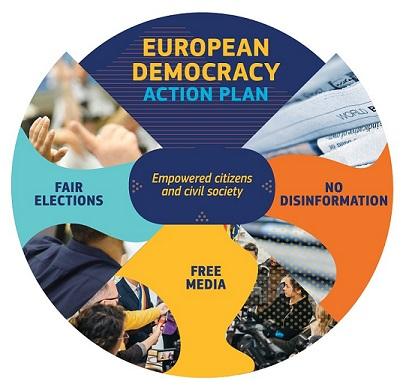
The European Democracy Action Plan is designed to empower citizens and build more resilient democracies across the EU by
- promoting free and fair elections
- strengthening media freedom
- countering disinformation
These measures will be implemented throughout this Commission’s mandate. In 2023, a year ahead of the next European elections, the Commission will review the implementation of the action plan.
Protecting free and fair elections
Safeguarding our European democracy requires more determined action to protect electoral processes. This means keeping elections free and fair, preserving open democratic debate, and updating digital safeguards.
Media freedom and pluralism
The European Media Freedom Act will ensure that media – public and private – can operate more easily across borders in the EU internal market, without undue pressure. It also takes the digital transformation of the media space into account.Strategic lawsuits against public participation are a particular form of harassment used primarily against journalists and human rights defenders to prevent or penalise speaking up on issues of public interest.
Countering disinformation
Democracies around the world are facing a proliferation of false information, which may have the potential to destabilise their democratic institutions, and undermine the trust of citizens. To address misinformation, disinformation and foreign interference, different policy responses are required. The European Democracy Action Plan sets out a comprehensive response, building on existing EU work and firmly rooted in European values and principles. It safeguards the freedom of expression and people’s right to access legal content.
Thursday, 27 April 2023
Wednesday, 26 April 2023
Euroscola work. May 4th 23
connection link for the upcoming Euroscola session on Thursday, 4th of May :
https://ep.interactio.eu/sjn7-pljp-b8nt
When connecting the day of the event, please note to indicate the information as follows:
Country (drop down menu, select your country)
School: Name of the school
Email: Your Email
INTERACTIO PLATFORM: https://ep.interactio.eu/join/gfej-i2ru-db8u
In order to validate the participation of all students, we kindly ask you to send this registration form to your students' parents via the following link:
https://ec.europa.eu/eusurvey/runner/Euroscola040523
PROGRAMME OF THE DAY
Euroscola combines both in-person attendance, directly in the European Parliament’s hemicycle in Strasbourg and online, via live-stream and interactive online platforms.
The morning programme of Euroscola includes an official opening by the President of the Parliament, a Q&A session with an Vice-President, and an "Innovation Lab" where students share their ideas with a European Parliament expert on the topic of the session, which will be put to a final vote. Special guests may also be invited. Participants are encouraged to ask questions, via live video on Interactio for online students, directly in the hemycycle for students present in the European Parliament in Starsbourg or in written form via Slido for all types of attendees. The morning session lasts from 10:00 am to 12:30 pm.
The afternoon programme will only be offered to face-to-face participants. This part will be dedicated to a simulation game on the legislative procedure of the European Union.
Check out the programme and further details to make the most of your Euroscola experience!
TOPICS
Defending democracy – at home and abroad

The trend of the past decade is clear: democracy is under severe threat. A recent Global State of Democracy Report confirmed that people are losing faith in democracy. We see everywhere a greater polarisation, often fuelled by disinformation, and deliberate efforts by non-democratic regimes to undermine the universal right of people to elect their own governments and choose their own future. When democracy is being attacked, we, as EU, stand strong in our convictions. We must and will continue to support democracy, both internally and externally.
Democracy remains the only approach that can tackle the enormous challenges societies face.
Democracy remains indeed the only approach that can tackle the enormous challenges societies face. At the beginning of the COVID-19 pandemic, some authoritarian regimes pretended they had more efficient policies than democracies. However, the rest of the story has proven exactly the opposite. The same applies to the fight against climate change: if citizens are not directly involved in the urgent choices to make, it will become more difficult to achieve carbon neutrality in time. I grew up in a dictatorship and I am well placed to appreciate the difference that democracy makes.
Supporting democratic elections is not imposing a Western model
Supporting participation in democratic elections is not about imposing any Western model, as some want to make-believe: it is nothing less than a universal right. Political participation goes hand in hand with trust in institutions. It is a fundamental right and a fundamental citizen responsibility as well. This is why re-establishing public confidence in democratic processes is essential. We must help our partners worldwide when a rising democracy struggles to build more robust institutions.
Political participation is a fundamental right and a fundamental citizen responsibility as well. We must help our partners worldwide when a rising democracy struggles to build more robust institutions.
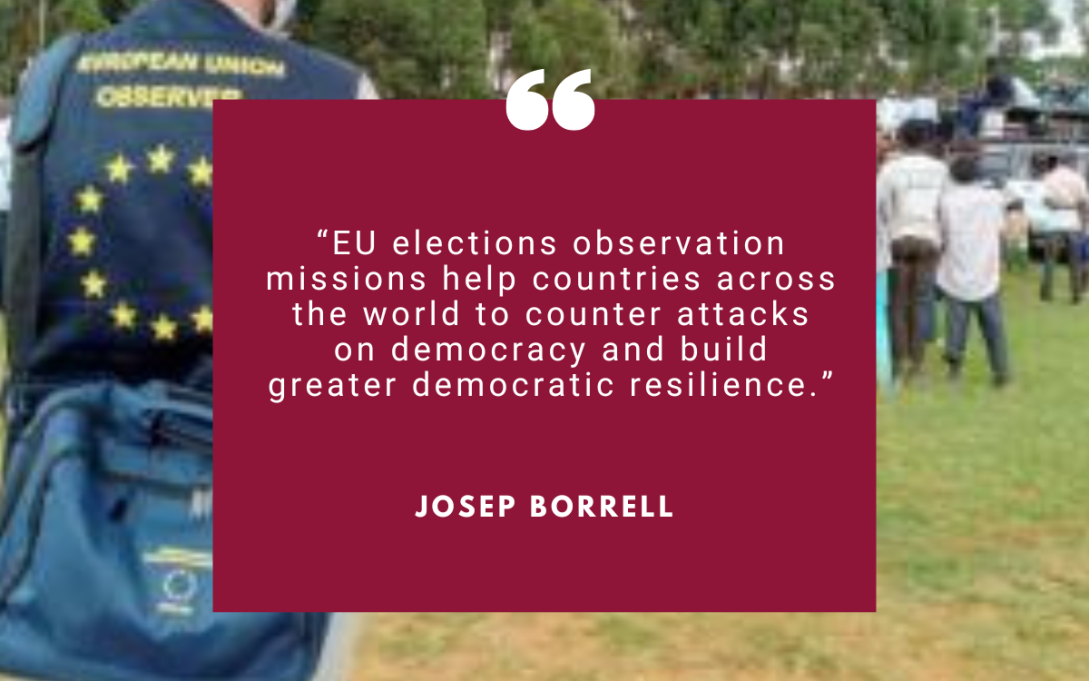
“To be or not to be a democracy” goes beyond elections. However, elections constitute a cornerstone of any democratic architecture. Without them, there is no democracy to talk about. This is why the EU, together with partners around the world, is putting a lot of effort into observing elections. Since the beginning of my mandate, despite the COVID-19 pandemic, the EU has sent 25 electoral observations and follow-up missions in 23 countries, 13 in Africa, 6 in Latin America, 2 in the Middle East, 1 in the Pacific and 1 in the Western Balkans. Since 1990, we have had in total no less than 170 EU missions.
Thanking the thousands of national and international election observers
However, before going further on this, I would like to thank the thousands of national and international election observers that serve worldwide: they embody democratic resilience. The increase in attacks against them is alarming. In the run-up to the 2019 elections in Mozambique, one of the country's most prominent citizen observers, Dr. Anastácio Matavel, was assassinated by the police. It is totally unacceptable. Electoral observers must be considered what they truly are: human rights defenders. The UN Special Rapporteur on the situation of human rights defenders, Ms. Mary Lawlor, called last October on states to take “all necessary steps” to allow election observers to carry out their work.
Our EU Electoral Observation Missions (EOM) do not interfere with national processes, as some want to make-believe: the organisation of elections is the sole responsibility of the country itself and EU missions are only deployed by invitation. Over the past decades, the EU has become one of the most respected election observation providers in the world, in particular because EU missions have demonstrated independence, professionalism and impartiality; they are seen therefore as being capable of assessing the electoral process and recommending reforms honestly.
Our efforts have proven their value
And our efforts have proven their value. In 2021, I have decided to send an EU mission to observe the regional and municipal elections in Venezuela. My decision was initially challenged in Europe, although being much awaited by civil society and political forces in Venezuela. Finally, the mission proved helpful. We have seen improvements in the electoral conditions compared to previous processes - these Venezuelan elections were marked by the return of the majority of political parties to the electoral arena. The mission report raised also a number of structural deficiencies and made many recommendations for reforms. This mission helped pave the way for the return to the negotiation process between Venezuelan conflicting parties in Mexico, which is currently taking place.
This year, the presence of an EU Election Observation Missions in Kenya and in Colombia helped to defuse political tensions.
I could mention other examples, as the EU mission last August, in Kenya. The situation around the presidential election was quite tense and fears of unrests following the results were high. The presence of an EU EOM and its evaluation of the election process helped to defuse these tensions and avoid major violence. In spring 2022, during the last presidential elections in Colombia, EU EOM presence, together with the prominent role of brave local observers, also served to defuse tensions in a country that has experienced a lot of political violence in recent years.
Most people may think that when observers have left the country this is the end of the mission – but this is actually when the real work should begin! To give one relevant example: in Nigeria, the Election Follow-up Mission deployed in February 2022 after the 2019 elections, concluded that significant progress had been made: out of the previous 30 recommendations, 13 had been implemented. The Nigerian National Assembly, the Independent National Electoral Commission and civil society had found a compromising ground for the new Election Act. The EU – together with member states and the larger international community – has provided financial and technical support to the process.
The new challenge of the digitalisation of the electoral process
We are working now to respond to new challenges such as the digitalisation of the electoral process, with elections increasingly moving online. We have also made progress when it comes to assessing social media and disinformation during elections. Citizens have the right to access truthful information and facts – their votes should not be distorted by propaganda from abroad or from within. There were among the issues discussed in Brussels this week with international partners who also adhere to the UN-sponsored “Declaration of Principles for International Election Observation”.
But, let’s be frank: making progress on democracy is often hard. The forces blocking democratic change are powerful. But democracy is too important – politicians shying away from doing the right thing should be met with clear demands. The EU will continue to advance the democracy agenda worldwide, with all relevant partners, including through our election observation missions.
https://app.sli.do/event/nA1xU1BXFpYwnLraV1uib4
SLI.DO: #2805 234
https://ec.europa.eu/info/law/better-regulation/have-your-say_en
https://www.facebook.com/euroscola/?locale=es_ES