Monday, 3 October 2022

Adverbs of degree.

 https://onlineteachersuk.com/adverbs-of-degree/

 Adverbs of degree can be split into two groups: adverbs that intensify the degree of something vs. adverbs that weaken the degree of something.

Adverbs that increase, or intensify, the meaning include words such as: verytotallycompletely, and absolutely. For example: I’m totally convinced Sam will quit his job.

Adverbs that decrease or weaken the degree of meaning include words such as: fairlyquiteslightly, and a bit. For example: I’m fairly certain it will rain tomorrow.
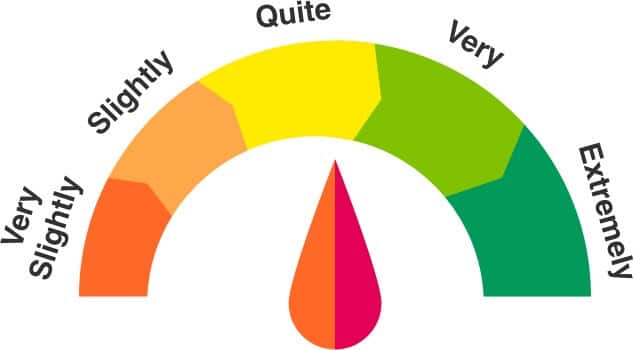

How do we use them?

An adverb of degree can modify an adjective, another adverb or a verb. Have a look at the following examples:

  • She is very tall. (Modifies the adjective)
  • He walked quite slowly. (Modifies the adverb)
  • really like that film. (Modifies the verb)

 Adverbs of degree can modify adjectives or adverbs:

Subject + main verb + adverb of degree + adjective
e.g. Jane is very happy.

Subject + main verb + adverb of degree + adverb
e.g. Tom walks extremely quickly.

Adverbs of degree can also modify verbs:

Subject + adverb of degree + main verb
e.g. The boys thoroughly enjoyed their trip to the theatre.


With modal verbs, the adverb of degree can appear before the modal verb or before the main verb, depending on the meaning.

For example:

Subject + adverb of degree + modal + main verb
e.g. You really should look where you are going!

Subject + modal + adverb of degree + main verb
e.g. You should really look at the instructions first.

With auxiliary verbs (e.g. have and is/are), the adverb usually goes before the main verb. For example:

Subject + auxiliary verb + adverb of degree + past participle
e.g. I have really enjoyed studying at this school.

Subject + auxiliary verb + adverb of degree + past participle
e.g. I have totally forgotten to bring my phone.

As we’ve mentioned above, we can separate adverbs of degree into two main types: adverbs that intensify the meaning or make it stronger (e.g. very), and adverbs that weaken the meaning, also called ‘downtoners’, (e.g. slightly).

1. Weakening the meaning

There are times in English when we want to specifically describe our use of an adjective or adverb. For instance, we may wish to express that we are quite nervous or a bit cold. This is more exact than just saying I’m nervous or I’m cold. The adverbs in this category are all used in the same way. The position of the adverb is before the adjective or adverb.
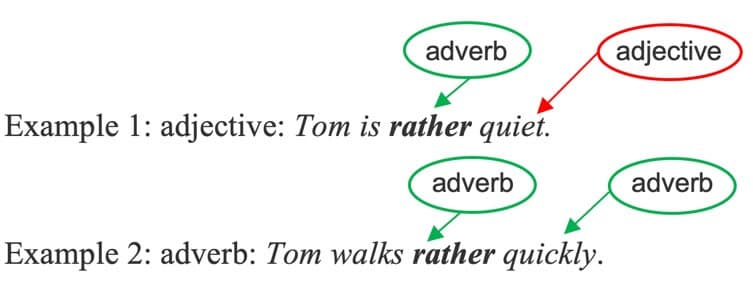

The following adverbs all weaken the adjective or adverb and all appear before the adverb or adjective in the sentence: a bit, fairly, pretty, quite, rather, slightly, and somewhat.

2. Intensifying the meaning (gradable adjectives)

There are many adverbs that intensify, or make the meaning stronger. For grammatical reasons, we need to separate these adverbs into two groups. Our choice of adverb depends on whether the adjective (which the adverb is intensifying) is gradable or ungradable.

For example, ‘hot’ is a gradable adjective, but ‘boiling’ is ungradable. So, we can say: It is very hot AND It is absolutely boiling, but NOT It is very boiling. The table below gives further examples of gradable and ungradable adjectives and the intensifiers used with them.

Intensifier + gradable adjectiveIntensifier + ungradable adjective
Very coldAbsolutely freezing
Extremely tiredCompletely exhausted
Really happyAbsolutely ecstatic
Very hungryTotally starving

 The adverbs in this group are always positioned in front of the adjective (which they intensify).

For example: He is extremely intelligent.

The following adverbs are intensifiers that can be used with ungradable adjectives: awfully, extremely, highly, perfectly, remarkably and terribly. These adverbs can also be used to modify an adverb.

For example: She climbed the mountain extremely quickly.

  1. Intensifying the meaning (ungradable adjectives)

Adverbs that intensify an ungradable adjective appear in the same position as other adverbs in this group. They nearly always go before the adjective. Note that this group of adverbs do not modify other adverbs.

Example: John was totally exhausted.

The following adverbs are intensifiers that can be used with ungradable adjectives: absolutelycompletelyentirelytotally and utterly.

How strongly adverbs of degree modify adverbs and adjectives
MildMediumStrongAbsolute
++++++++++
a little
a bit
slightly
fairly
pretty
quite
rather
somewhat
remarkably
awfully
extremely
highly
terribly
a lot
really
incredibly
particularly
deeply
enormously
greatly
incredibly
lots
most
remarkably
strongly
very
totally
utterly
completely
absolutely
entirely
perfectly
thoroughly


  1. Adverbs that behave differently

There are a few adverbs of degree that do not neatly fit into the three groups above. The following examples show the position and use of these adverbs.

  • A lot has a similar meaning to ‘very much’. It is used to modify verbs. For example: I like playing badminton a lot.
  • Too can be used as an intensifier, but it has a negative meaning. It means ‘more than is acceptable or needed’.For example: That costs too much.
  • Enough is positioned after an adjective or adverb, not before it. It means ‘to the degree that is necessary’. For example: Are you warm enough?
  1. Collocations

An additional issue with choosing which adverb to use is that some adverbs collocate better with some adjectives than others. In other words, some adverbs and adjectives are used frequently together in English and others just don’t ‘sound right’. Common adverbs usually collocate well. For example very collocates with most adjectives: very tall, very hungry, very beautiful. Other adverbs do not collocate with every adjective or adverb. For example, it is possible to be ‘highly intelligent’, but not ‘highly clever’!

The following are examples of common collocations with adverbs of degree:

highly intelligent       perfectly well      pretty good      remarkably well        terribly difficult

totally brilliant            utterly awful               absolutely amazing       perfectly simple

Sunday, 2 October 2022

EYE SANTANDER- OCT.22

 https://www.eyesantander.org/language/en/ 

This year Europe will come closer to its Youth and, especially, to the Spanish through a big event. Six youth pro-European organisations from Spain – Erasmus Student Network (ESN), Jóvenes del Consejo Federal del Movimiento Europeo (CFEME), Talento para el Futuro, Federación de Asociaciones Europeístas y Federalistas de España (JEF Spain), Equipo Europa and Consejo de la Juventud de España (CJE) – have come together to organise the European Youth Event Santander 2022 (EYE Santander), an event organised by the youth for the youth. 

This year, 2022, is special for the European Youth: we celebrate the European Year of Youth and the 35th anniversary of the Erasmus program. For this, it is the perfect occasion to celebrate the EYE Santander, where young people could raise their voices and express the concerns of their generation, exchange opinions and ideas with Members of the European Parliament (MEPs) and experts and collaborate on the construction and improvement of the European society, and fight for new and better opportunities for the European Youth.

https://www.eyesantander.org/faq/

Thursday, 29 September 2022

Language focus- Modals

 Modal verbs


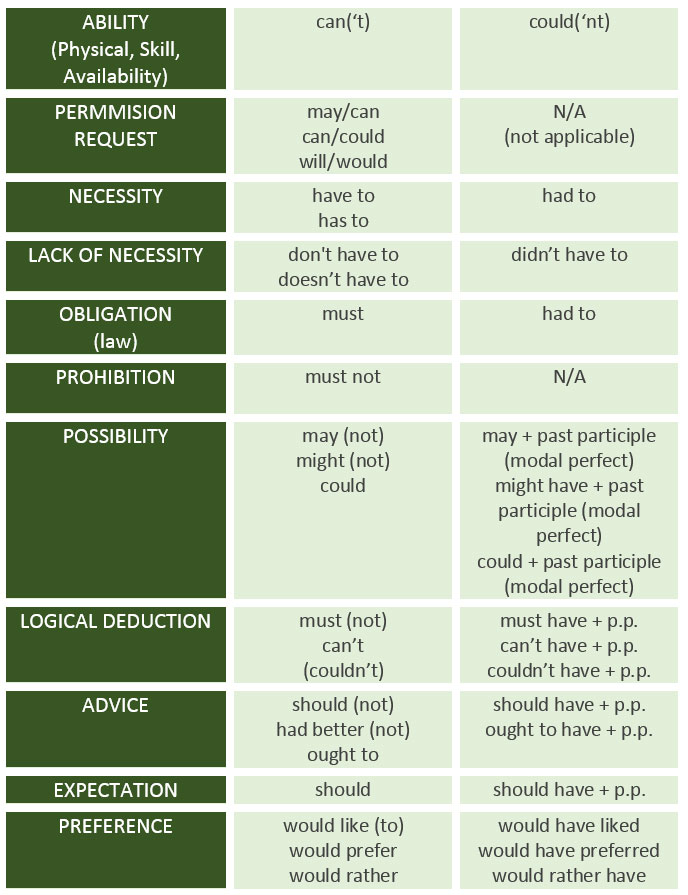
The modal verbs include can, must, may, might, will, would, should. They are used with other verbs to express ability, obligation, possibility, and so on. Below is a list showing the most useful modals and their most common meanings:

Modal
MeaningExample
canto express abilitycan speak a little Russian.
canto request permissionCan I open the window?
mayto express possibilitymay be home late.
mayto request permissionMay I sit down, please?
mustto express obligationmust go now.
mustto express strong beliefShe must be over 90 years old.
shouldto give adviceYou should stop smoking.
wouldto request or offerWould you like a cup of tea?
wouldin if-sentencesIf I were you, I would say sorry.

Modal verbs are unlike other verbs. They do not change their form (spelling) and they have no infinitive or participle (past/present). The modals must and can need substitute verbs to express obligation or ability in the different tenses. Here are some examples:
Past simpleSorry I'm late. I had to finish my math test.
Present perfectShe's had to return to Korea at short notice.
FutureYou'll have to work hard if you want to pass the exams.
InfinitiveI don't want to have to go.
Past simpleI couldn't/wasn't able to walk until I was 3 years old.
Present perfectI haven't been able to solve this problem. Can you help?
FutureI'm not sure if I will be able to come to your party.
InfinitiveI would love to be able to play the piano.

Modals are auxiliary verbs. They do not need an additional auxiliary in negatives or questions. For example: Must I come? (Do I must come?), or: He shouldn't smoke (He doesn't should smoke).
Important: The explanations and examples on this page are just an introduction to this extensive and complex area of English grammar. Students of English who want to learn more should consult a good reference work, such as Swan's Practical English Usage.

Here is a list of modals with examples:
Modal VerbExpressingExample
mustStrong obligationYou must stop when the traffic lights turn red.
logical conclusion / CertaintyHe must be very tired. He's been working all day long.
must notprohibitionYou must not smoke in the hospital.
canabilityI can swim.
permissionCan I use your phone please?
possibilitySmoking can cause cancer.
couldability in the pastWhen I was younger I could run fast.
polite permissionExcuse me, could I just say something?
possibilityIt could rain tomorrow!
maypermissionMay I use your phone please?
possibility, probabilityIt may rain tomorrow!
mightpolite permissionMight I suggest an idea?
possibility, probabilityI might go on holiday to Australia next year.
need notlack of necessity/absence of obligationI need not buy tomatoes. There are plenty of tomatoes in the fridge.
should
ought to
50 % obligationI should / ought to see a doctor. I have a terrible headache.
adviceYou should / ought to revise your lessons
logical conclusionHe should / ought to be very tired. He's been working all day long.
had betteradviceYou 'd better revise your lessons

Remember

Modal verbs are followed by an infinitive without "to", also called the bare infinitive.

Examples:

  • You must stop when the traffic lights turn red.
  • You should see to the doctor.
  • There are a lot of tomatoes in the fridge. You need not buy any.

Monday, 26 September 2022

Analysisng current affairs. A look at the European politics

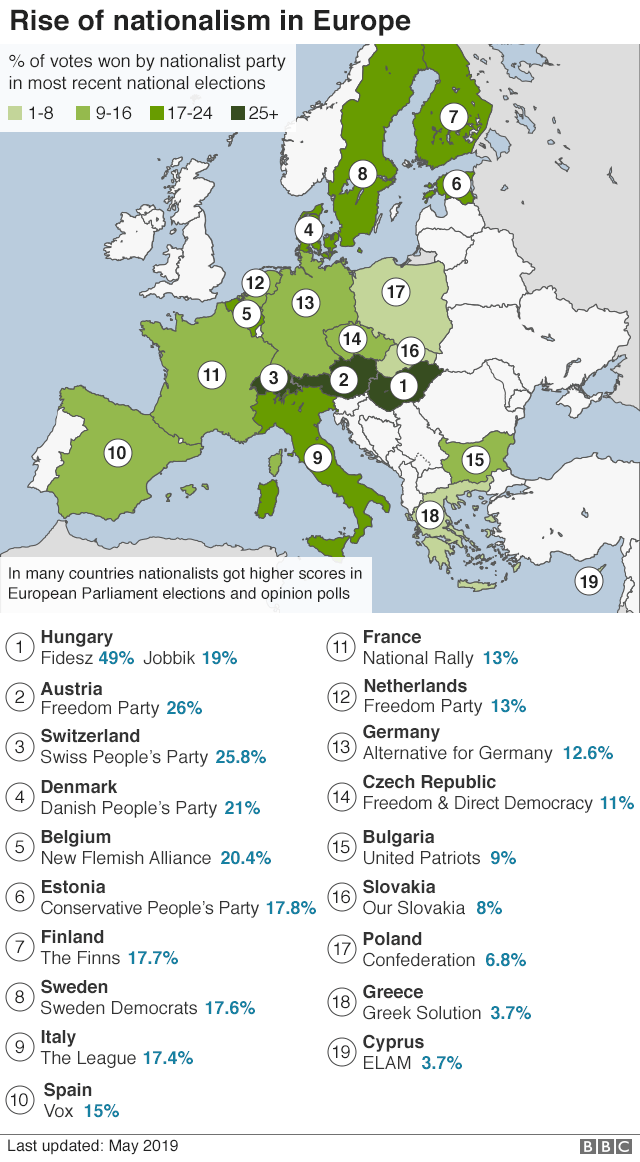
 Nationalism has always been a feature across Europe's political spectrum but there has been a recent boom in voter support for right-wing and populist parties.

It is visible from Germany, where the AfD has become the biggest opposition party in the Bundestag, to Spain, where Vox has become the third largest force in parliament. In part, voters are frustrated with the political establishment, but they also have concerns about globalisation, immigration, a dilution of national identity and the European Union. In the European Parliament, nine far-right parties have formed a new bloc, called Identity and Democracy (ID).

So where in Europe's political landscape do right-wing nationalists hold sway?

Europe nationalist parties - graphic
Presentational white space
line

Italy


Far-right leader Giorgia Meloni has claimed victory in Italy's election, and is on course to become the country's first female prime minister.

Ms Meloni is widely expected to form Italy's most right-wing government since World War Two. That will alarm much of Europe as Italy is the EU's third-biggest economy.

However, speaking after the vote, Ms Meloni said her Brothers of Italy party would "govern for everyone" and would not betray people's trust.

"Italians have sent a clear message in favour of a right-wing government led by Brothers of Italy," she told reporters in Rome, holding up a sign saying "Thank you Italy".

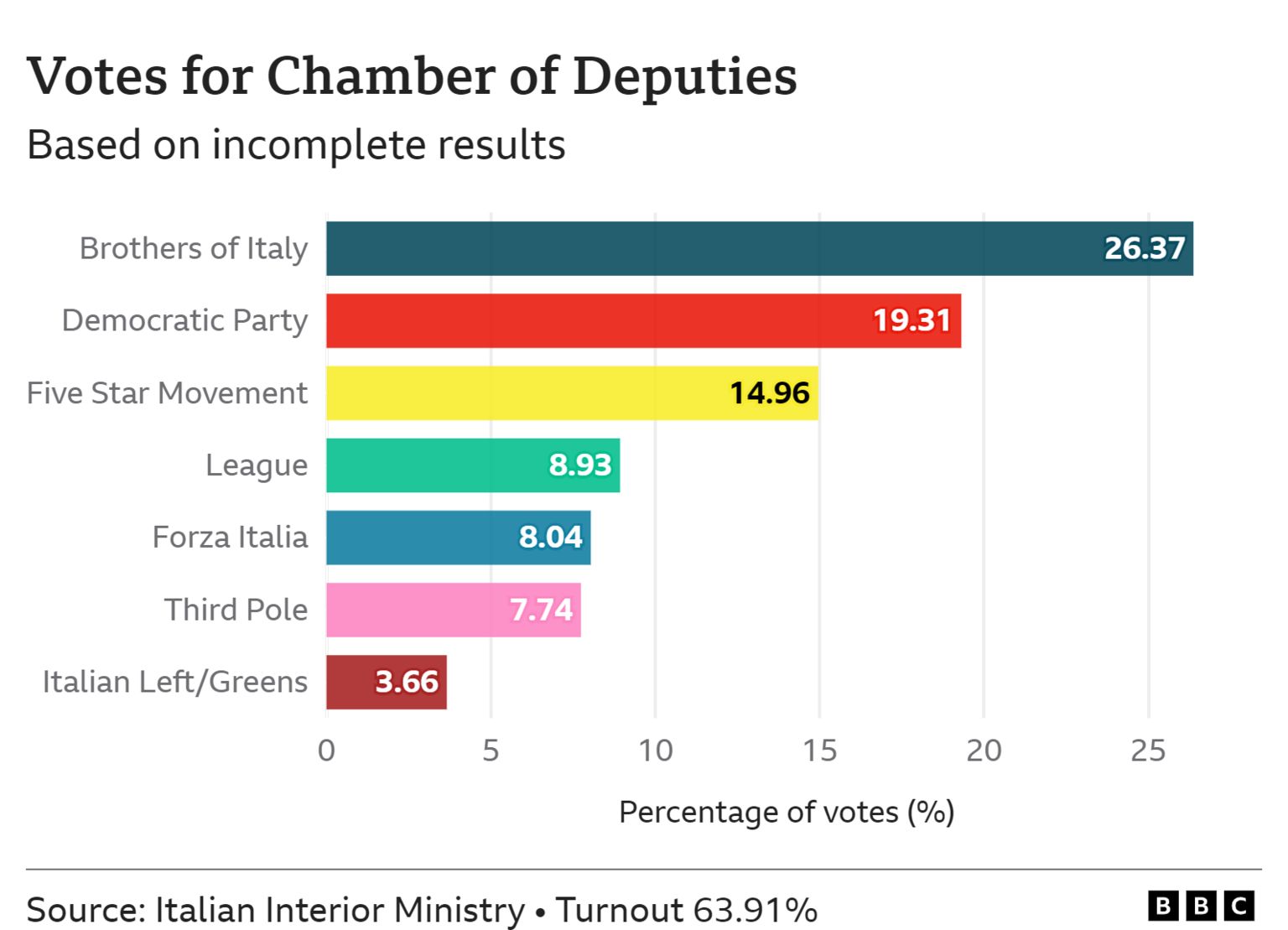
She is predicted to win up to 26% of the vote, based on provisional results, ahead of her closest rival Enrico Letta from the centre left.

Ms Meloni's right-wing alliance - which also includes Matteo Salvini's far-right League and former PM Silvio Berlusconi's centre-right Forza Italia - now looks to have control of both the Senate and the Chamber of Deputies, with around 44% of the vote.

Her own party's dramatic success in the vote disguised the fact that her allies performed poorly, with Mr Salvini's party slipping below 9%, and Forza Italia even lower. Four years ago, Brothers of Italy won little more than 4% of the vote but this time benefited from staying out of the national unity government that collapsed in July.

The decision on who becomes Italy's next leader is up to the president, Sergio Mattarella, and that will take time.

Although Giorgia Meloni has worked hard to soften her image, emphasising her support for Ukraine and diluting anti-EU rhetoric, she leads a party rooted in a post-war movement that rose out of dictator Benito Mussolini's fascists.

Earlier this year she outlined her priorities in a raucous speech to Spain's far-right Vox party: "Yes to the natural family, no to the LGBT lobby, yes to sexual identity, no to gender ideology... no to Islamist violence, yes to secure borders, no to mass migration... no to big international finance... no to the bureaucrats of Brussels!"

Chamber of Deputies graphic
1px transparent line

Wednesday, 21 September 2022

Describing changes. The world of statistics


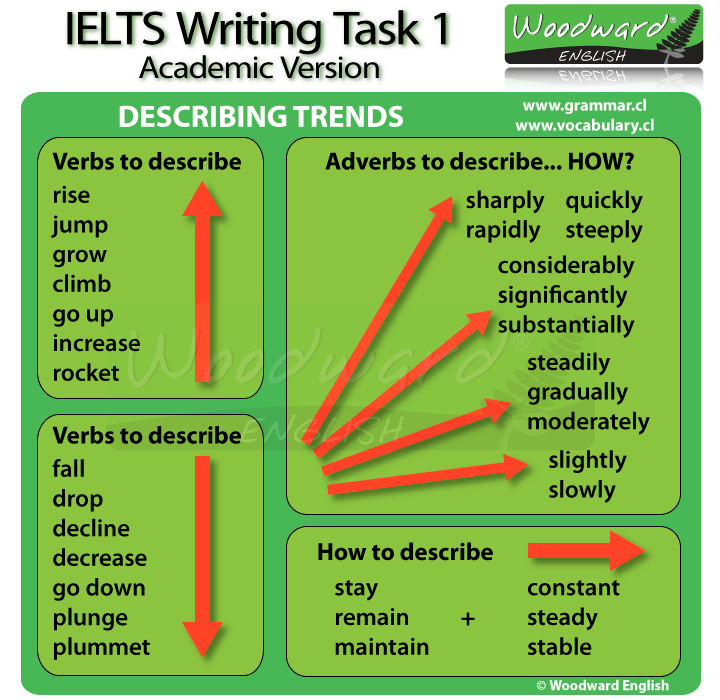
Verbs to describe an upward trend

The following verbs can be used to describe a trend or pattern that goes up.

  • climb (past: climbed)
  • go up (past: went up)
  • grow (past: grew)
  • increase (past: increased)
  • jump (past: jumped)
  • rise (past: rose)
  • rocket (past: rocketed)

Sentence examples using words that show an upward trend:

  • The number of enrolments increased significantly between 2005 and 2010.
  • Production rose from 800 units in May to 1000 units the following month.

Verbs to describe a downward trend

The following verbs can be used to describe a trend or pattern that goes down.

  • decline (past: declined)
  • decrease (past: decreased)
  • drop (past: dropped)
  • fall (past: fell)
  • go down (past: went down)
  • plummet (past: plummeted) = to fall or drop suddenly in amount or value
  • plunge (past: plunged) = to fall or drop suddenly in amount or value

Plunge and Plummet, when describing trends, have the same meaning.

Sentence examples using words that show a downward trend:

  • Prices of Model X dropped significantly once Model Y became available on the market.
  • Company profits decreased in 2013 by 15%.

Words and phrases used to describe a stable trend

To describe a more or less stable pattern, you can use the following expressions:

  • maintain (past: maintained)
  • remain (past: remained)
  • stay (past: stayed)
  • constant
  • stable
  • steady
  • unchanged

Adverbs used when describing trends

Adverbs describe HOW something happens. They usually come after a verb.

  • sharply, rapidly, quickly, steeply
  • considerably, significantly, substantially
  • steadily, gradually, moderately
  • slightly, slowly

Nouns used when describing trends

  • decline
  • decrease
  • dip (a momentarily small drop in the level of something)
  • drop
  • fall
  • fluctuation (= an irregular rising and falling in number or amount; a variation)
  • growth
  • increase
  • peak (= the highest point)
  • rise
  • slump (= a severe or prolonged fall in the price, value, or amount of something)
  • variation (= a change or difference in condition, amount, or level)

IELTS Academic Writing Task 1 - Describing Trends Vocabulary
Prepositions for graphs,trends and statistics 

Prepositions when they try to use statistics to describe graphs and trends. 

Prepositions for talking about graphs, trends and statistics

Prepositions for graphs and statistics (PDF)

Prepositions for graphs and statistics

Describing  graphs and trends: making sentences  worksheet 

This is  a worksheet to help  English language learners write and talk about graphs and trends. Students try to write appropriate sentences for the pictures using the vocabulary at the bottom of the page.

Describing graphs writing exericise

Describing graphs sentence writing (PDF)

Listen to the audio and fill in the missing words

Describing graphs vocabulary and personalized sentence writing activity.

Describing graphs vocabulary and sentence writing (PDF)

(see the video version on Youtube)

Describing graphs and sentence writing

Describing graphs and trends

Monday, 12 September 2022

Warming up. Getting to know each other


 All about me


Welcome back. Year 22-23


1st Bach. Year 2022-23
La Segunda Lengua Extranjera en la etapa de Bachillerato tiene como objetivo principal la adquisición de la competencia comunicativa en la lengua extranjera, de modo que permita al alumnado comprender, expresarse e interactuar en dicha lengua con eficacia, fluidez y corrección, así como el enriquecimiento y la expansión de su conciencia intercultural.

Specific competences:
  1.  Understanading and interpreting texts.
  2.  Text production (oral and written)
  3.  Active interaction and co-production (oral and written)
  4.  Language mediation (oral and written)
  5.  Luinguistic repertoire and plurilinguism
  6.  Diversity awareness (linguistic, cultural and artistic). Critical assessment
Criteria for evaluation.
  • Based on the specific competences and the development of the different skills: Listening, Reading, Speaking, Writing, Interaction (oral and written) and mediation (oral and written). Homework, tasks, attitude and participation.
Essential/key knowledge:
  • Communication
  • Plurilinguism and language reflection
  • Intercultural awareness
Ready for C1 Advanced.  STUDENTS BOOK WITHOUT KEY. Amanda French y Roy Norris.MacMillan. ISBN  9781380052445
1 Aiming high   
2 Times change 
3 Gathering information 
4 Work time 
5 Getting on 
6 All in the mind? 
7 Feeling good 
8 This is the modern world 
9 Going places 
10 House and home 
11 A cultural education 
12 The world about us 
13 Food for thought 
14 Money matters