OPCIÓN 1 JUNIO 2018. HOW TO COPE WITH AN EXCESS OF EMAILS
Question1:[2 POINTS] Indicate whether the following statements are TRUE or FALSE and write down which part of the text justifies your answer. 1. Email is radically different now from when it started.
FALSE “hasn’t changed that much since its invention”
2. One reason that causes people stress is that they find it difficult to take a break from emails.
TRUE “People either feel they can never completely disconnect”
So it’s hardly surprising that email overload is now a major cause of stress and disruption. People either feel they can never completely disconnect, or find they are incapable of answering all their new emails.
3. The author suggests you should simply not pay attention to certain messages.
TRUE “like simply ignoring unwanted messages”
Use your software to filter out all unimportant emails automatically
4. Emails have increased our ability to focus on things according to the Microsoft study.
FALSE “Distraction from emails has helped reduce our concentration to eight seconds”
Question 2:[2 POINTS] Answer the following questions in your own words according to the text.
1. What problems with email does the text mention?
Different problems:
·It takes over our lives ·It is an obstacle for face to face communication. ·It causes stress and disruption. ·It makes it difficult to disconnect from work. ·It is impossible to answer all your emails. ·It reduces power of concentration.
Model answer:
The main problems associated with email is that it makes it difficult for us to concentrate on other aspects of our lives, causing us to feel stressed and preoccupied with work all the time. It also discourages more personal forms of communication like speaking to people in person.
2. How does the author suggest people deal with their email problems?
Different suggestions:
·Turn off email alerts. ·Deal with your emails properly, setting aside quality time. ·Organize your email in different folders. ·Use an application to filter out unwanted emails. ·Think before you email. ·Consider other communication option, such as a face-to-face chat. ·Write appropriately- short, focused, making it easier for people to reply.
Model answer:
The author suggests planning time to deal with emails specifically instead of being constantly alerted to their arrival. He also says it is a good idea to organize messages appropriately and to use software to avoid receiving spam. When it comes to writing to people, you should make your messages logical and short, which means that people will answer you better.
3. Question 3:[1,5 POINTS]Find words or phrases in the text that correspond to the words given:
1. to allow (paragraph 1) letting, to let
2. each (paragraph 2) every
3. straightaway (paragraph 3) immediately
4. to suppose (paragraph 4) assume
5. correctly (paragraph 5) properly
Question 4:[1,5 POINTS]Choose the correct option, a, b, c or d for each question and COPY the sentence onto your answer sheet.
1. The text says that…
a. only a few people email colleagues who they work closely with.
b. a lot of people email colleagues who they work closely with.
c. some people never email colleagues who they work closely with.
d. most people rarely email colleagues who they work closely with.
2. If people are constantly looking at their emails,…
a. it might affect their health negatively.
b. it will definitely affect their health negatively.
c. it would have affected their health negatively.
d. it will always influence their health negatively.
3. The author suggests that people will find it easier to reply…
a. despite your answer being short and focused.
b. as long as your answer is short and focused.
c. although your answer is short and focused.
d. whether your answer is short and focused or not.
Question 5:[3 POINTS]Write a short essay (about 120-150 words) on the following topic:
·What are the advantages and disadvantages of communicating with your friends electronically?
Connectors: IF, EVEN IF, ONLY IF, AS LONG AS, PROVIDED, SUPPOSING, UNLESS, BUT FOR, IF NECESSARY, IF SO, IN CASE etc.
IF and WHEN
When can replace if in zero conditionals:
If you heat water to 100 degrees Celsius, it boils. When you heat water to 100 degrees Celsius, it boils.
In the other types of conditionals, we cannot use when instead of if.
EVEN IF
Even if emphasises that something will happen, would happen or would have happened whatever the condition:
Even if we leave right now, we still won't catch the train. I wouldn't go into the water even if I could swim. Even if we had booked our flight earlier, it wouldn't have been cheaper.
ONLY IF
Only if makes the condition more restrictive:
Acetaminophen is dangerous to children only if dosage is too high.
If the if-clause is first, the subject and the auxiliary in the main clause are inverted:
Only if you like classical music is it worth coming tonight.
SO/AS LONG AS, PROVIDING/PROVIDED (THAT)
So/As long as and providing/provided (that) can be used instead of if to express a condition. Note that providing/provided (that) is a bit formal:
You can stay here as long as you keep quiet. Provided/Providing (that) the bills are paid, tenants will not be evicted.
SUPPOSE/SUPPOSING, WHAT IF
Suppose/supposing and what if can replace if, mainly in everyday conversation, and are often used without a main clause:
Suppose/supposing you won the lottery, what would you do? Suppose/supposing you can't find a job? What if you are not accepted to university? What will you do then?
UNLESS
Unless is followed by an affirmative verb to express "if ... not":
My leg's broken. I can't stand up unless you help me. (I can't stand up if you don't help me.)
IF IT WEREN'T FOR / IF IT HADN'T BEEN FOR, BUT FOR
These expressions mean "without". They are used in second and third conditionals and are usually followed by a noun phrase:
If it weren't for Miguel, we wouldn't know what to do now. (Without Miguel...) If it hadn't been for your foolishness, we wouldn't have got lost. (If you hadn't been such a fool...) But for your help, I would have been in big trouble. (Without your help... / If you hadn't helped me...)
IF IN DOUBT, IF POSSIBLE, IF NECESSARY etc.
We can make the if-clause shorter by omitting the subject and the verb be:
If (you are) in doubt, consult a dictionary.
In certain idiomatic expressions, the subject and be are normally omitted:
If necessary, you can call Jake at home. I'd like a seat by the window if possible.
IF SO, IF NOT
If so and if not can stand for an if-clause which is understood from the context:
"According to the weather forecast, it might rain tomorrow." "If so, we'll go hiking another day." I hope Peter gets here soon. If not, we'll have to start without him.
IN CASE and IF
An in case-clause gives a reason while an if-clause describes a condition:
I'll buy a sandwich in case I get hungry. (I'll buy a sandwich because I may get hungry later.) I'll buy a sandwich if I get hungry. (I'll buy a sandwich when I get hungry.)
We can use should after in case:
Take an umbrella in case it should rain.
Conditionals and inversion
In formal English, the subject and the auxiliary can be inverted in the if-clause with if omitted:
Should you see Kate, say hi from me. (if you should see Kate) Were he to propose to you now, what would you say? (if he were to propose to you) Were I you, I would stop smoking. (if I were you) Were it not for Miguel, we wouldn't know what to do now. (if it weren't for Miguel) Had we booked our flight earlier, it would have been cheaper. (if we had booked our flight earlier).
Had it not been for your foolishness, we wouldn't have got lost. (if it hadn't been for your foolishness)
UNREAL TIME AND SUBJUNTIVE
The past tense is sometimes used in English to refer to an unreal situation. Although the tense is the past, we are usually talking about the present, e.g. in a Type 2 conditional sentence:
If dogs had wings, they would be able to fly.
Although had is in the past tense, we are not referring to the past - we are talking about a hypothetical situation. We call this the unreal past.
Other situations where this occurs are:
§After other words and expressions like ‘if’ (suppose/supposing, if only, what if, imagine)
§After the verb ‘to wish’
§After the expressions I’d rather; I’d prefer; It’s time….
It's (high) time
The above expression is followed by past simple or continuous, though the time referred to is unreal.
It’s time we left. It’s high time I was going.
It's high time you hung up your trainers and started exercising your mind, not your body.
Wishes
Present/Future time
The verb to wish is followed by an unreal past tense when we want to talk about situations in the present that we are not happy about and would want to change a present/future state.
I wish I had a motorbike. (I don’t have one now.)
I wish you weren’t leaving. (You are leaving.)
Would
Would is used when the speaker wants somebody or something else to change, or to describe an annoying habit.
I wish he would stop smoking.
I wish it would stop raining.
I wish you wouldn’t make such a mess.
Past time
As with present wishes, when we refer to situations in the past we are not happy about or about actions that we regret, the verb form after wish is one stage further back in the past, so we use wish followed by the past participle. Same is used after if only to express regrets.
I wish I hadn’t said that.(but I did)
If only I hadn’t eaten so much. (but I did)
Hope
Wishes about simple future events are expressed with hope.
I hope it doesn’t (won’t) rain tomorrow.
I hope you(‘ll) have a lovely time in Portugal (on your holiday next week).
I´d rather/I’d prefer (followed by a clause)
I’d rather is followed by past verb forms in the same way as wishes about the present. It expresses preference about actions.
I’d rather you didn’t smoke in here.
Both I’d rather and I’d sooner are used with normal verb forms when comparing nouns or phrases.
I’d rather be a sailor than a soldier. (present)
I’d rather have lived in Ancient Greece than Ancient Rome. (past)
I’d prefer can be used in the same way, but note that prefer in this type of sentence has an object it.
I’d prefer it if you didn’t go.
However, I’d prefer is not followed by an unreal verb form in other situations.
I’d prefer tea to coffee.
I‘d prefer you to go swimming (rather than go jogging).
As if, as though – Real and unreal
The verb form used with as if/as though depends on whether the situation is true or unreal.
You look as if you’re having second thoughts. (True. He is having second thoughts.)
He acts as if he were in charge. (Unreal. He isn’t in charge)
Note, however, that the more colloquial like does not require this verb form change. Compare:
You look like you have just seen a ghost.
You look as if you had just seen a ghost.
Suppose and imagine – Understood conditions
The conditional part of these sentences is often understood but not stated.
Imagine we won the lottery!
Suppose/supposing someone told you that I was a spy!
Imagine we had never met! (we have met)
As with conditional sentences, if the event referred to is a real possibility, rather than imaginary, a present verb form is possible:
Suppose it starts raining, what’ll we do?
Formal Subjunctives - Insisting, demanding, etc.
After verbs such as demand, insist, suggest, require which involve an implied obligation, the subjunctive may be used in formal style. This has only one form, that of the infinitive, and there is no third person –s, or past form. The verb be has be for all forms.
They demanded that he leave at once.
The school Principal suggested that he be awarded a scholarship.
Formulaic Subjunctives
These are fixed expressions all using subjunctive. Typical expressions are:
God save the Queen!
Be that as it may …
Come what may ….
Suffice it to say ….
Far be it from me …but
be that as it may: (formal) despite that. Synonymnevertheless. E.g. I know that he has tried hard; be that as it may, his work is just not good enough.
come what may: despite any problems or difficulties you may have. E.g. He promised to support her come what may.
suffice (it) to say (that)… used to suggest that although you could say more, what you do say will be enough to explain what you mean. E.g. I won't go into all the details. Suffice it to say that the whole event was a complete disaster.
Far be it from me to do something: something that you say when you are giving advice or criticizing someone and you want to seem polite. It is not really my place to do something. (Always followed by but, as in the example.) Far be it from me to tell you what to do, but don't you think you should apologize? Far be it from me to tell you what to do, but I think you should buy the book.
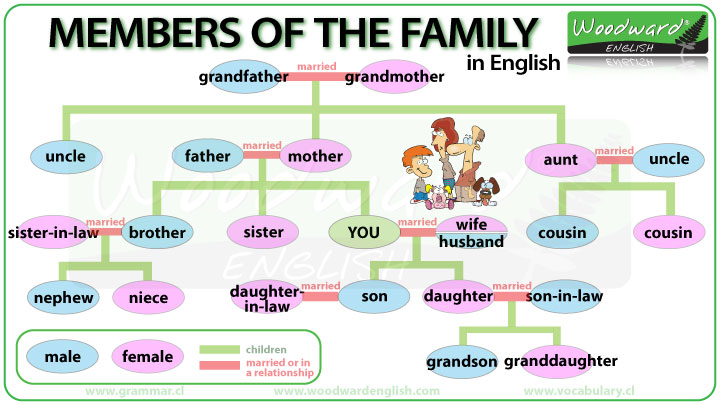
The people in your family are also called your relatives.
Your mother and your father are your parents.
You are the child of your mother and father. Brothers and sisters are also called siblings.
Your grandmother and grandfather are also called your grandparents.
Your spouse is your husband or wife.
If you end your marriage (get divorced), your spouse becomes your ex-husband or ex-wife.
If one of your parent remarries, their new spouse is your step-mother or step-father.
If your mother or father remarries and the person has children they are your step-brothers and step-sisters (they are not biologically related to you).
A half-brother or half-brother shares either a biologically related mother or father with you.
Check out this chart comparing the relationships between different members of the family: