Tuesday, 27 October 2020

The origins of a popular festival: All Hallows Eve-Halloween-All Saints Day

A big business in America and overseas...


Halloween’s origins date back to the ancient Celtic festival of Samhain (pronounced sow-in). The Celts, who lived 2,000 years ago in the area that is now Ireland, the United Kingdom and northern France, celebrated their new year on November 1st. This day marked the end of summer and the harvest and the beginning of the dark, cold winter. Celts believed that on the night before the new year, the oundary between the worlds of the living and the dead became blurred. On the night of October 31st they celebrated Samhain, when they believed that the ghosts of the dead returned to earth.

In the second half of the nineteenth century, America was flooded with new immigrants. These new immigrants, especially the millions of Irish fleeing Ireland’s potato famine of 1846, helped to popularize the celebration of Halloween nationally. Following Irish and English traditions, Americans began to dress up in costumes and go house to house asking for food or money, which eventually became today’s “trick-or-treat” tradition. Young women believed that onHalloween they could guess the name or appearance of their future husband by doing tricks with yarn, apple parings or mirrors.

In the late 1800s, there was a move in America to make Halloween into a holiday more about community and neighbourly get-togethers than about ghosts, pranks and witchcraft. At the
turn of the century, Halloween parties for both children and adults became the most common way to celebrate the day. These focused on games, foods of the season and festive costumes. Parents were encouraged by newspapers and community leaders to take anything “frightening” or “grotesque” out of Halloween celebrations. Because of these efforts, Halloween lost most of its superstitious and religious overtones by the beginning of the twentieth century.

By the 1920s and 1930s, Halloween had become a community-centered holiday, where parades and town-wide parties were the featured entertainment. Despite the best efforts of many schools and communities, vandalism began to plague Halloween celebrations in many communities at this time. By the 1950s, town leaders had successfully dealt with it and Halloween had evolved into a holiday directed mainly at the young. Due to the high numbers of young children during the fifties’ baby boom, parties were moved from town civic centers into the classroom or home, where they could be more easily accommodated. Between 1920 and 1950, the centuries-old practice of trick-or-treating was also revived. This was a relatively inexpensive way for an entire community to share the Halloween celebration. In theory, families could also prevent tricks being played on them by providing the neighborhood children with small treats. A new American tradition was born, and it has continued to grow. Today, Americans spend an estimated $6 billion annually on Halloween, which means that it’s the country’s second largest commercial holiday.


QUESTIONS
A
(1) Where did the Celts live 2,000 years ago?
(3) What did the Celts believe happened on the night of October 31st?
(5) What did immigrants help to do in the second half of the nineteenth century?
(7) What became the most common way to celebrate Halloween at the turn of the century?
(9) Why were parties moved to the classrooms or homes by the 1950s?
(12) How much do Americans spend on Halloween annually?
B
(2) What did November 1st mark for the Celts?
(4) When was America flooded with new immigrants?
(6) How did young women believe that they they could guess the name or appearance of their
future husband?
(8) What did Halloween lose by the beginning of the twentieth century?
(10) What was revived between 1920 and 1950?
(11) How could families also prevent tricks being played on them?


Halloween Flipped classroom Trivia:  


Watch the videos and look for the answers to these questions.

1. Where is the celebration of Halloween thought to have come from?
2.To commemorate the event, what did the Druids build?
3. What two other festivals were combined with ‘Samhain’?
4. After many changes due to the spread of Christianity, what new celebration was created
in 1000 AD?
5. What was "praying for dead relatives" called?

Monday, 26 October 2020

SPAIN IMPOSES NATIONAL CURFEW-BBC NEWS

Spain has declared a national state of emergency and imposed a night-time curfew in an effort to help control a new spike in Covid-19 infections.

Prime Minister Pedro Sánchez said the curfew, which came into force on Sunday night, would be in place between the hours of 23:00 and 06:00

Under the measures, local authorities can also ban travel between regions.

Mr Sánchez said he would ask parliament to extend the new rules, initially in force for 15 days, to six months.

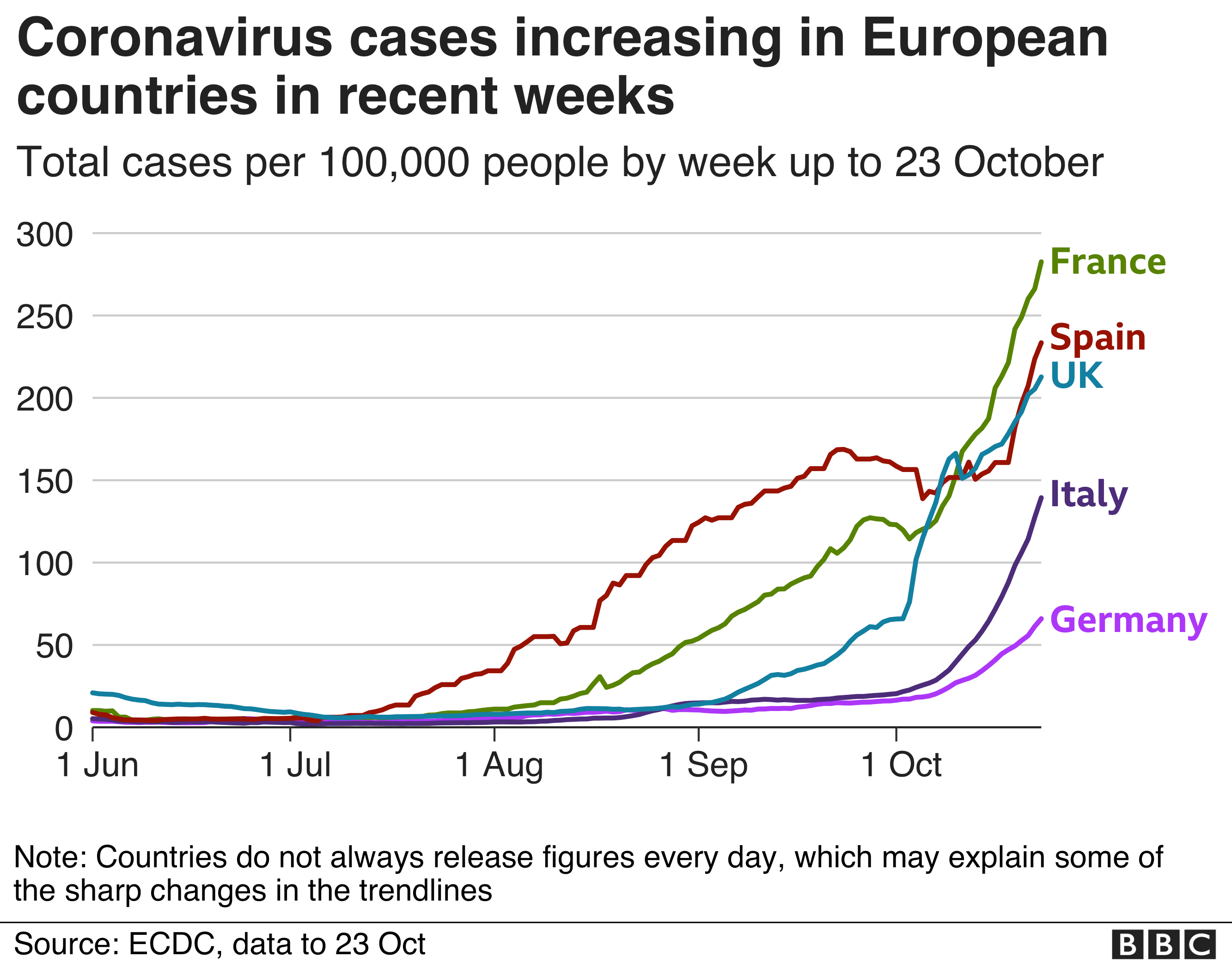
Spain was hit hard during the first wave of the pandemic earlier this year and at the time imposed a much more restrictive lockdown - one of the toughest in the world. Like many other European regions, however, it has been hit by a second wave of infections.


What are Spain's emergency measures?

Mr Sánchez said different regions would have up to an hour of flexibility if they wanted to modify the duration of the overnight curfew.

Restrictions on movement between districts would be determined by regional leaders and was likely to be dependent on work and medical needs, he added.

The new measures announced include a limit on public and private gatherings of different households to a maximum of six people.

"The situation we are going through is extreme," Mr Sánchez said in a televised address on Sunday, adding: "It is the most serious in the past half century."

More than half of Spain's 17 regions had been calling for tighter restrictions, and the latest measures will apply to all regions except the Canary Islands.

The same level of emergency was introduced during the first wave of the pandemic in April.

Spain has passed one million cases since it began and nearly 35,000 people have died.

Chart tracking cases in five major European countries
Presentational white space

Saturday, 24 October 2020

American elections 2020

COMPOSITION: OPINION ESSAY:

LOWERING THE VOTING AGE:

  • 16-year-olds are just as knowledgeable about civics and have the same ability to make good voting choices as older voters
  • Lowering the voting age to 16 increases voter turnout and develops lifelong voting habits.
  • At age 16, people should have a voice in the laws that affect their lives and a stake in the future of their country.
  • The vast majority of Americans of all ages and political views agree that 16-year-olds should not be given the right to vote.
  • The 18-29 age group has extremely low voter turnout numbers, suggesting that people aren't ready to vote until later in life.
  • Kids under the age of 18 aren't mature enough to participate in elections.
RETIRED PEOPLE BANNED TO VOTE:

How much do you know about politics and elections in the United States? Answer the questions.

1. There are two main political parties and they are called

a. Democrats and Conservatives

b. Democrats and Republicans

c. Liberals and Republicans

2. The people who work in the US Congress to make new laws are called

a. Ministers and Senators

b. Representatives and Secretaries

c. Senators and Representatives

3. The US Constitution is

a. the supreme law of the country

b. the highest court of the country

c. what politicians say they are going to do if they win the election

4. Presidential candidates run for office every

a. three years 

b. four years 

c. five years

5. When a new president is inaugurated and takes office, they have to

a. move into the WhiteHouse

b. throw a party for international leaders

c. promise to support the Constitution

6. A president is allowed to hold office for a total of

a. two terms

b. three terms 

c. there is no limit

What do you know about how American presidents are elected? 


The Electoral College (Adapted from usa.gov)

On Election Day in early November, people in every state cast their votes for their preferred candidates. But American voters are not voting directly for their president. They are actually voting for a group of people called electors. In the US, only presidential elections use the electoral college system.

The electoral college works like this: each state gets a certain number of electors, chosen by their political parties and based on the state’s Congressional representation. States with larger populations have more electors than those with smaller populations. The popular vote is counted state by state, rather than nationally. In mid- December, the electors from each state meet to officially select the candidate who won the most votes in that state. The candidate who has more than 270 electoral votes (out of 538) wins the national election.

In most states, it’s winner takes all: whichever candidate has the largest share of the vote captures all the electoral votes for that state.It is possible that a candidate can receive the most votes in the whole country, but still lose the electoral vote. This happened in 2016.

The electoral college system was written into the Constitution more than 200 years ago, intended as a compromise between a popular vote and a vote in Congress. To change this system, a Constitutional amendment would be required.

Wednesday, 21 October 2020

OPINION ESSAYS-WRITING

Structure of the Opinion Essay:

  • Introduction – introduces the topic and state your point of view clearly
  • Body - consists of two or three  paragraphs each presenting a separate viewpoint supported by reasons/examples
  • Conclusion – summarizes/restates your opinion using different words
Useful Language
То express opinion: I believe, In my opinion, I think, In my view, I strongly believe, I see it, It seems to me (that), As far as I am concerned, I am (not) convinced that..., In my opinion/view …My opinion is that …, I (firmly) believe …, I (definitely) feel/think that, I am inclined to believe that ……
То list points: In the first place, first of all, to start with, Firstly, to begin with
То add more points: what is more, another major reason, also, furthermore, moreover, in addition to this/that, besides, apart from this, not to mention the fact that
То introduce contrasting viewpoints: It is argued that, People argue that, There are people who oppose, Contrary to what most people believe,
As opposed to the above ideas
To introduce examples: for example, for instance, such as, in particular, especially
To conclude: To sum up, All in all, All things considered, Taking everything into account.

Paragraph outline: Examples:

Expressions and linking words:

Personal opinion:In my opinion/view, To my mind, To my way of thinking, I am convinced that, It strikes me that, It is my firm belief that, I am inclined to believe that, It seems to me that. As far as I am concerned, I think that the economic recession of the previous decade was foreseeable.
To list advantages and disadvantages:One advantage of, Another advantage of, One other advantage of, A further advantage of, The main advantage of, The greatest advantage of.The first advantage of riding a motorbike in a large metropolis is that of not getting caught in major congestion.
To list points:Firstly, First of all, In the first place, Secondly, Thirdly, Finally. To start/begin with, we have to address the inadequacies within the education system before we can tackle unemployment fully.
To add more points to the same topic:What is more, Furthermore, Apart from this/that, In addition (to this), Moreover, Besides (this),… not to mention the fact that your choice of career is a fundamental decision which will influence the rest of your life. Not only is your choice of career a fundamental decision, but it is also one that will influence the rest of your life.Your choice of career is both a fundamental decision and something that will influence the rest of your life.
To refer to other sources:With reference to, According to the latest scientific research, the use of mobile phones can be damaging to one's health in the long run.
To emphasise a point:Indeed, Naturally, Clearly, Obviously, Of course, Needless to say, the scheme was hound to fail due to insufficient funds.
To give examples:For instance, For example, by establishing day-care centres across the country, working mothers can he encouraged to resume their careers. By providing incentives such as, like day-care centres working mothers are encouraged to resume their careers. If working mothers are to resume their careers then the provision of incentives particularly, in particular, especially day-care centres is essential.
To state other people's opinion:It is popularly believed that, People often claim that, It is often alleged that, Some people argue that, Many argue that, Most people feel that, Some people point out that wealth will bring happiness. Contrary to popular belief, wealth does not necessarily bring happiness.
To conclude:Finally, Lastly, All in all, Taking everything into account/consideration, On the whole, All things considered, In conclusion, On balance, For the above mentioned reasons, Therefore I feel that, To sum up, it is unlikely that there will be peace in all the countries of the world concurrently.
Summarising:In short, Briefly. To put it briefly, his performance on stage was fantastic!

STRUCTURE:
INTRO
It is generally believed that_________________________________________ and I completely agree.
I really feel it is better___________________________________________ although some think ________________________________________. I personally prefer to _________________________.

BODY
There are several reasons why I think________________________________ is better. First of all, you ____________________________________. Most of people think ______________________________.
Secondly, ____________________________ gives you the opportunity to ________________________.
I´m absolutely convinced that __________________________________. Finally, and perhaps most importantly, ____________________ makes you learn__________________________ which is another positive/negative aspect.

CONCLUSION
It seems to me that ________________________ is far better. There are lots of reasons to
__________________. To sum up, from my point of view, _______________________________. Maybe in the future,____________________________


AN EXAMPLE:
It is clear that learning a foreign language brings children several advantages. However, learning a foreign language requires attention, perseverance, time and work. Besides, some scientists say it may also have some drawbacks.
Firstly, most of experts agree on the fact that young children learn a language faster as they are enthusiastic to explore and learn new things. In addition, they pick up the pronuciation better and enjoy copying and learning through games. Secondly, nowadays, foreign languages are just as impotant as maths. What is more, learning a foreign helps students have better education and job opportunities.
On the other hand, it is said that learning languages increases work for parents and this effort adds extra academic load. We should also consider the fact that children need to concentrate on learning their mother tongue rather than learning a foreign language, sometimes missing their own cultural identity. Furthermore, learning a new language at an early age may be confusing and a waste of time. As a result, this learning could even delay the development of the child’s first language.

In conclusion, studies show that there are many advantages to learn a foreign language. Nevertheless, in my opinion, we have to consider pros and cons of learning at a very young age. I  strongly feel languages always open doors, but, from my point of view, they should be learned once the first language has been developed.


Some people prefer watching films at the cinema rather than at home or there are people who just prefer the opposite. I believe both places have advantages and disadvantages.

There are two main reasons to go to the cinema. Firstly, the quality of the film will be probably better than at home due to the sound track and the special effects if you choose a three dimension movie. Secondly, you can watch the last movies which have recently been released at the theatres while at home you have to wait probably some months.

On the other hand, although there are discounts to encourage people go to the cinema, it is cheaper to download the films. Moreover, you can watch them whenever you want. And last, but not least you don’t have to hear the crunch of people eating crisps.

In my opinion, what matters is not the place, is the people who are watching the movie with you.

Watching movies is an amazing activity to relax for many people nowadays. Some people prefer staying at home while others enjoy going to the cinema.  Although I have many film DVDs at home and Netfix subscription, I still prefer watching films at cinemas.

One of the biggest factors that make me feel like watching films at cinemas is the bigger screen and realer sound I can enjoy there. The images and sound in cinemas are usually perfect, and I do not think that anyone can easily get such quality at home. Besides, this activity can be taken as an opportunity to go out. This is also a chance for me to get out of my house and enjoy a new wider space, interact with people and be more positive. Additionally, I can watch the film with many people. Moreover, when watching film in a cinema, one can laugh, cry and even be scared about the films with people all around him, we can talk freely with others about the film and the characters, which makes the films even more interesting and more attracting than at home.

In my opinion, watching films in cinemas is preferred than watching them at home. Today, cinemas are trying to improve the standard of their films, many technologies are developed to make the viewers feel as real as possible, and this makes watching films at cinemas an experience we can´t miss


Thursday, 15 October 2020

Saturday, 10 October 2020

Key issues to reflect... and record


Every EU country is a democracy, where rights are important. The European Union does not only work together in areas like the economy, security and the environment, but devotes considerable attention to upholding these values both within Europe’s borders and beyond. If a country wants to become a member of the EU, they also have to respect these values and implement them in their own country. Of course this applies to all of the countries that are already a member of the EU.

European values: Freedom & Equality 

All European citizens are free to travel, work and live anywhere in the EU. You are also free to say what you want, think or feel as long as you do not restrict other people’s freedom by discriminating against them. 

  • Would you want to live in a country where your religion, opinion or sexual orientation was discriminated against?

The Netherlands is the only country in the EU with bars where you can buy soft drugs legally, (‘coffee shops’). The other countries think this is a bad idea, but the EU has no say in this. Since 2005 in Spain men can get married to men and women to women. This is called a same-sex marriage. This regulation is not European law. The EU is of the opinion that every country should decide such matters for themselves.  

  • Would you want the EU to have a say on gender equality policy or not? Explain your view.

Everyone is different: in their language, culture, religion, appearance, opinion and origins. We want these differences to be respected within the European Union so that we can live, learn and work side by side, just like we do in school. We want to live in a society where there is mutual respect, where there is no discrimination and where everyone has the same opportunities. The European Treaty for Human Rights states that every EU citizen has equal rights. Which means that policemen, lawyers, teachers, farmers, carpenters, job seekers, or disabled people, in short all European citizens, must be treated equally. 

  • Do you think that everyone in Spain has the same rights? Give an example if you agree or disagree. 

You can regard Europe as one big society where countries and citizens, wherever they come from, try to respect the values of freedom, religion, equality, solidarity and democracy. 

  • Do you think this is possible or impossible? Explain why.
