Read the introduction to Christmas taken from history.com.
Christmas is both a sacred religious holiday and a worldwide cultural and commercial phenomenon. For two millennia, people around the world have been observing it with traditions and practices that are both religious and secular in nature. Christians celebrate Christmas Day as the anniversary of the birth of Jesus of Nazareth, a spiritual leader whose teachings form the basis of their religion. Popular customs include exchanging gifts, decorating Christmas trees, attending church, sharing meals with family and friends and, of course, waiting for Santa Claus to arrive. December 25 – Christmas Day – has been a federal holiday in the United States since 1870.
What did Europeans celebrate long before the birth of Jesus?
Why did people celebrate during the winter solstice?
Who celebrated Yule from 21 December in Scandinavia?
How did fathers and sons mark the return of the sun?
Up to how many days was it possible for the Yule feast to last?
What did the Norse believe that each spark of the fire represented?
Why was the end of December a good time for celebrating?
Why were German people terrified of the god Oden? How did they show their fear?
Santa Claus
The man we know as Santa Claus has a history all his own. Today, he is thought of mainly as the jolly man in red, but his story stretches all the way back to the third century. Find out more about the history of Santa Claus, from his earliest origins to the shopping mall favorite of today.
When do people think that St. Nicholas was born? In which modern-day country is his birthplace?
For what qualities was St. Nicholas most admired?
Was St. Nicholas born into a poor family?
Which two groups of people is he particularly associated with?
When is his feast day celebrated? What do people think it is lucky to do on that day?
Why was the way in which St. Nicholas was regarded in Holland different from other saints?
Sections entitled ‘Sinter Klaas comes to New York’ and ‘Shopping mall Santas’. Answer the following questions.
How did St. Nicolas first become popular in America?
Where did the name Santa Claus come from?
As Sinter Klaas’s popularity grew, did people agree about what he looked like?
What did the advertisements for shops feature by the 1840s?
What happened in 1841?
In the early 1890s what did the Salvation Army do to raise money?
Christmas around the world!
Christmas is a global celebration. You have already seen how the legend of Santa Claus varies greatly from country to country. For the following task, you will read about different traditions around the world celebrated at Christmas time. Take a look at the following traditions. As you read them, try to guess which of the countries in the box below these traditions come from. (Some countries are used more than once!)
El Salvador United States Great Britain Spain Japan Venezuela Canada Brazil Denmark Guatemala Estonia Poland Philippines Italy Armenia Germany Colombia
Twenty Christmas traditions from around the world
During the Christmas meal, Christmas crackers containing toys, jokes and a paper hat are pulled. ________________
A white sponge cake covered with cream and decorated with strawberries is often consumed. ________________
Children put their shoes in the window in the hope that the three wise men will deliver their presents. ________________
Christmas carols are heard as early as 1st September. ________________
On 6th January, female puppets are burned on a pyre to symbolize the death of the old year and beginning of the new year. ________________
They celebrate the Cavalcade of Lights Festival. ________________
The Christmas tree usually stands centrally in the home, decorated with ornaments, tinsel and lights, with an angel or star at the top. ________________
People dress up in an ornamental hat named a Puritina and dance in a line. ________________
Potato salad with frankfurters and wiener sausages is a popular meal in some families. ________________
Children take presents of fruits, nuts and other sweets to older relatives. ________________
In many cities, and even in small rural towns, neighbourhoods get together and decorate their whole neighbourhood or street, turning streets into ‘tunnels of light’. ________________
Neighbourhoods get together for night festivals where children play with skateboards, rollerblades and bicycles. ________________
On 6th December, Saint Nicholas puts goodies in children’s shoes. ________________
Rice pudding is traditionally served with whipped cream and lashings of black cherry sauce. ________________
Electric candles and glowing stars are placed in almost every window during the month of December. ________________
A traditional meal includes herring and beetroot soup with ravioli. ________________
It is a tradition for children to leave a glass of milk and plate of cookies for Santa. _______________
In some cities, judges decide on the most beautifully decorated house. ________________
Children are visited by Santa Claus on Christmas Eve and must sing songs or recite Christmas poems before they receive their presents. _______________
Children celebrate Christmas by playing with firecrackers and sparklers. ________________
Now, visit the following weblink https://en.wikipedia.org/wiki/Christmas_traditions and check your answers. Don’t try to read the whole article from top to bottom; instead, try to find the countries as quickly as you can.
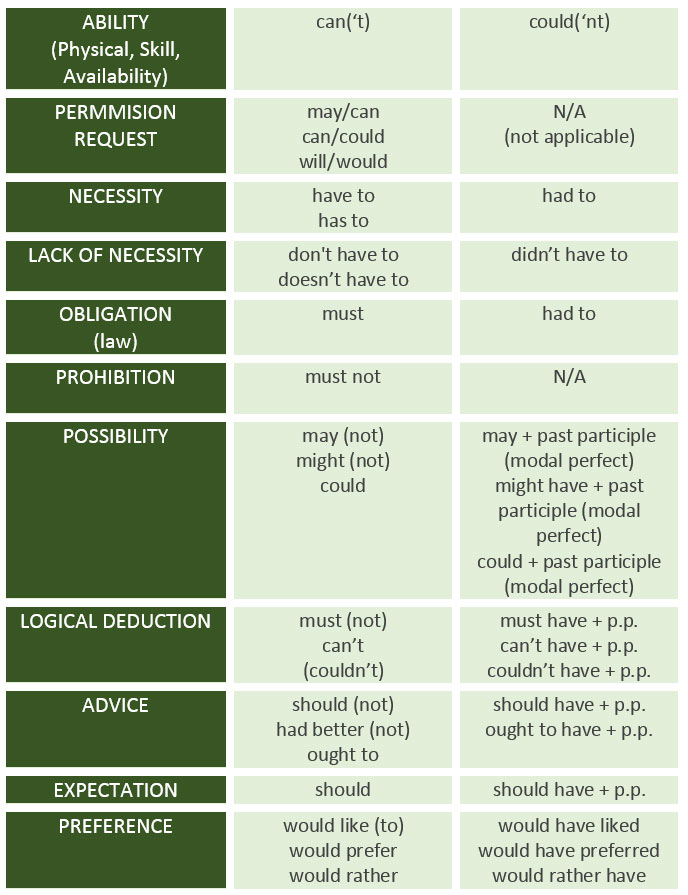
The modal verbs include can, must, may, might, will, would, should. They are used with other verbs to express ability, obligation, possibility, and so on. Below is a list showing the most useful modals and their most common meanings:
Modal
Meaning
Example
can
to express ability
I can speak a little Russian.
can
to request permission
Can I open the window?
may
to express possibility
I may be home late.
may
to request permission
May I sit down, please?
must
to express obligation
I must go now.
must
to express strong belief
She must be over 90 years old.
should
to give advice
You should stop smoking.
would
to request or offer
Would you like a cup of tea?
would
in if-sentences
If I were you, I would say sorry.
Modal verbs are unlike other verbs. They do not change their form (spelling) and they have no infinitive or participle (past/present). The modals must and can need substitute verbs to express obligation or ability in the different tenses. Here are some examples:
Past simple
Sorry I'm late. I had to finish my math test.
Present perfect
She's had to return to Korea at short notice.
Future
You'll have to work hard if you want to pass the exams.
Infinitive
I don't want to have to go.
Past simple
I couldn't/wasn't able to walk until I was 3 years old.
Present perfect
I haven't been able to solve this problem. Can you help?
Future
I'm not sure if I will be able to come to your party.
Infinitive
I would love to be able to play the piano.
Modals are auxiliary verbs. They do not need an additional auxiliary in negatives or questions. For example: Must I come? (Do I must come?), or: He shouldn't smoke (He doesn't should smoke).
Important: The explanations and examples on this page are just an introduction to this extensive and complex area of English grammar. Students of English who want to learn more should consult a good reference work, such as Swan's Practical English Usage.