Listen to the recording and fill in the gaps. Note the use of numerous passive sentences in this text.
Saint Patrick's Day is an celebration of the Saint of Ireland. It is on March 17, which is to be the date of Saint Patrick's . This day is a national holiday in Ireland, but it is by Irish communities and many in countries around the . The festival the time when Saint Patrick Christianity to Ireland in the . On this day, it is to wear green or shamrocks. This is because, according to , Saint Patrick a shamrock to explain the idea of the Holy Trinity to Irish .
Around the world there are Saint Patrick's Day . In Dublin, there's a parade that nearly a million people and it's five days long. But the parade is in New York City, which is by over two million people. Saint Patrick's Day is also for being a "drinking holiday". Drinking , especially Irish , has become an important part of the . And the colour green is not only on people's bodies. In Chicago, for example, the city authorities the river green. And famous around the world are in green lighting. Many people also celebrate the day green food and drinking green beer.
In recent , St Patrick's Day celebrations have been , particularly for association with drinking alcohol. And some people that the festivities have become too , and that the original idea of the festival has been .
•I
can't
believe the ___________
Oh, I can't close
____________
And make it ______
How long?
How long must we _____________ How
long, how long?
'Cause tonight, we can be as one
Tonight
•Broken
__________under children's ______
Bodies strewn across the dead end _______
But I won't heed the
___________
It puts my back up
Puts my back up against the wall
•And
mothers, children, brothers, sisters torn apart
•There's
many
lost, but tell me who has won
•And
the battle's just begun
•The
trench
is dug within our hearts
(Chorus)
Wipe
the tears from your eyes
Wipe your
tears away
Oh,
wipe your tears away
I'll,
wipe your tears away (Sunday, Bloody Sunday)
I'll,
wipe your blood shot eyes (Sunday, Bloody Sunday)
We use a 'reporting verb' like 'say' or 'tell'. (Click here for more about using 'say' and 'tell'.) If this verb is in the present tense, it's easy. We just put 'she says' and then the sentence:
Direct speech: I like ice cream.
Reported speech: She says (that) she likes ice cream.
We don't need to change the tense, though probably we do need to change the 'person' from 'I' to 'she', for example. We also may need to change words like 'my' and 'your'. But, if the reporting verb is in the past tense, then usually we change the tenses in the reported speech:
Direct speech: I like ice cream.
Reported speech: She said (that) she liked ice cream.
Tense
Direct Speech
Reported Speech
present simple
I like ice cream
She said (that) she liked ice cream.
present continuous
I am living in London
She said (that) she was living in London.
past simple
I bought a car
She said (that) she had bought a car OR She said (that) she bought a car.
past continuous
I was walking along the street
She said (that) she had been walking along the street.
present perfect
I haven't seen Julie
She said (that) she hadn't seen Julie.
past perfect*
I had taken English lessons before
She said (that) she had taken English lessons before.
will
I'll see you later
She said (that) she would see me later.
would*
I would help, but..”
She said (that) she would help but...
can
I can speak perfect English
She said (that) she could speak perfect English.
could*
I could swim when I was four
She said (that) she could swim when she was four.
shall
I shall come later
She said (that) she would come later.
should*
I should call my mother
She said (that) she should call her mother
might*
I might be late
She said (that) she might be late
must
I must study at the weekend
She said (that) she must study at the weekend OR She said she had to study at the weekend
* doesn't change.
Occasionally, we don't need to change the present tense into the past if the information in direct speech is still true (but this is only for things which are general facts, and even then usually we like to change the tense):
Direct speech: The sky is blue.
Reported speech: She said (that) the sky is/was blue.
So now you have no problem with making reported speech from positive and negative sentences. But how about questions?
Direct speech: Where do you live?
In fact, it's not so different from reported statements. The tense changes are the same, and we keep the question word. The very important thing though is that, once we tell the question to someone else, it isn't a question any more. So we need to change the grammar to a normal positive sentence. A bit confusing? Maybe this example will help:
Direct speech: Where do you live?
Reported speech: She asked me where I lived.
Do you see how I made it? The direct question is in the present simple tense. We make a present simple question with 'do' or 'does' so I need to take that away. Then I need to change the verb to the past simple.
Direct speech: Where is Julie?
Reported speech: She asked me where Julie was.
The direct question is the present simple of 'be'. We make the question form of the present simple of be by inverting (changing the position of)the subject and verb. So, we need to change them back before putting the verb into the past simple.
Here are some more examples:
Direct Question
Reported Question
Where is the Post Office, please?
She asked me where the Post Office was.
What are you doing?
She asked me what I was doing.
Who was that fantastic man?
She asked me who that fantastic man had been.
So much for 'wh' questions. But, what if you need to report a 'yes / no' question? We don't have any question words to help us. Instead, we use 'if':
Direct speech: Do you like chocolate?
Reported speech: She asked me if I liked chocolate.
There's more! What if someone asks you to do something (in a polite way)? For example:
Direct speech: Close the window, please
Or: Could you close the window please?
Or: Would you mind closing the window please?
All of these requests mean the same thing, so we don't need to report every word when we tell another person about it. We simply use 'ask me + to + infinitive':
Reported speech: She asked me to close the window.
Here are a few more examples:
Direct Request
Reported Request
Please help me.
She asked me to help her.
Please don't smoke.
She asked me not to smoke.
Could you bring my book tonight?
She asked me to bring her book that night.
Could you pass the milk, please?
She asked me to pass the milk.
Would you mind coming early tomorrow?
She asked me to come early the next day.
To report a negative request, use 'not':
Direct speech: Please don't be late.
Reported speech: She asked us not to be late.
Reported Orders
And finally, how about if someone doesn't ask so politely? We can call this an 'order' in English, when someone tells you very directly to do something. For example:
Direct speech: Sit down!
In fact, we make this into reported speech in the same way as a request. We just use 'tell' instead of 'ask':
Time Expressions with Reported Speech Sometimes when we change direct speech into reported speech we have to change time expressions too. We don't always have to do this, however. It depends on when we heard the direct speech and when we say the reported speech.
For example: It's Monday. Julie says "I'm leaving today". If I tell someone on Monday, I say "Julie said she was leaving today". If I tell someone on Tuesday, I say "Julie said she was leaving yesterday". If I tell someone on Wednesday, I say "Julie said she was leaving on Monday". If I tell someone a month later, I say "Julie said she was leaving that day".
So, there's no easy conversion. You really have to think about when the direct speech was said. Here's a table of some possible conversions:
now
then / at that time
today
yesterday / that day / Tuesday / the 27th of June
yesterday
the day before yesterday / the day before / Wednesday / the 5th of December
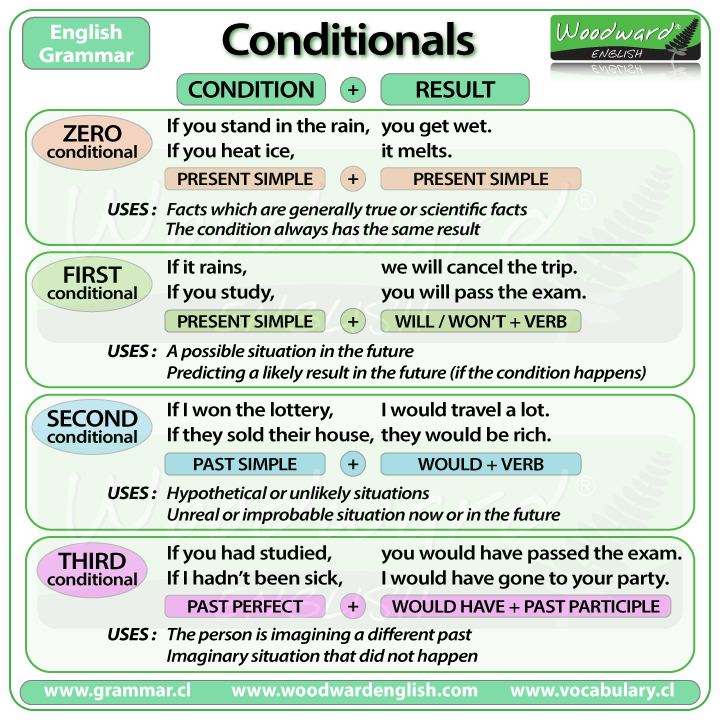
The Zero Conditional: (if + present simple, ... present simple) If you heat water to 100 degrees, it boils. Click here to learn more.
The First Conditional: (if + present simple, ... will + infinitive) If it rains tomorrow, we'll go to the cinema. Click here to learn more.
The Second Conditional: (if + past simple, ... would + infinitive) If I had a lot of money, I would travel around the world. Click here to learn more.
The Third Conditional (if + past perfect, ... would + have + past participle) If I had gone to bed early, I would have caught the train. Click here to learn more.
Extracto de la Resolución por la que se convocan becas para la participación en un programa intensivo de inmersión lingüística en inglés en España, a desarrollar durante el mes de julio, destinado a estudiantes de Bachillerato, Enseñanzas Profesionales de Música y Danza, Grado Medio de Formación Profesional, Grado Medio de Artes Plásticas y Diseño, Grado Medio de Enseñanzas Deportivas y de Enseñanzas de Idiomas (Nivel Intermedio o Avanzado) para el año 2019.
Son requisitos generales:
Haber nacido entre el 1 de enero de 1999 y el 31 de diciembre de 2002 y estar matriculado en el curso 2018-2019 en cualquier curso de alguno de los niveles indicados anteriormente.
Haber obtenido en el curso 2018-2019 la condición de becario del Ministerio de Educación y Formación Profesional.
Tener totalmente aprobado el curso inmediato anterior, con una nota final mínima de 7,50 puntos en la asignatura de inglés.
El resto de requisitos, así como la convocatoria, pueden consultarla en las siguientes direcciones:
Las solicitudes deben cumplimentarse obligatoriamente en la Sede Electrónica del Ministerio y Formación Profesional. https://sede.educacion.gob.es/sede/
El plazo de presentación se inicia el día 07/03/2019 y finaliza el 10 de abril de 2019.
International
Women's Day (IWD) is celebrated around the world on March 8 every year. It
began was / as a campaign for better
working conditions by women in New York at the turn / turnedof the 20th century. The first official IWD was on
February 28, 1909. No one knows for shore
/ surewhy the date changed to March 8, but this is the date when thousands
of women started annual / annually
marches in New York’s streets. The first international women’s conference took place / placedin 1910, in Denmark.
Since then, IWD has spread around the world. Today it is an importance / important day to highlight
the economic, political and social contributions women have made to / of our world. Women can now be
happier that things are moving in the right
/ left direction.
IWD is an official / officially holiday in many
countries, including Algeria, China, Cuba, Italy, Poland, Vietnam, and Zambia.
All cross / across the world, men
give flowers and other gifts to the women in their lives - mothers, wives,
girlfriends, sisters, teachers, etc. In Portugal and Romania, women celebrate to / by having "women-only"
dinners. IWD is a big events / event
in India, where people hold celebrations throughout the day. Indian men want to
show / showinghow important women
are to their society. All around the world women are becoming more power / powerfulin business, entertainment,
politics and other areas / area.
There are over a dozen nations today with women leaders. However, IWD is still
necessary to highlight the inequality millions of women still face / head.
RECOMMENDED LINKS AROUND THE TOPIC
OF INTERNATIONAL WOMEN'S DAY:
Mardi Gras is a Christian holiday and popular cultural phenomenon that dates back thousands of years to pagan spring and fertility rites. Also known as Carnival, it’s celebrated in many countries around the world—mainly those with large Roman Catholic populations—on the day before the religious season of Lent begins. Brazil, Venice and New Orleans play host to some of the holiday’s most famous public festivities, drawing thousands of tourists and revelers every year.
What Is Mardi Gras?
Mardi Gras is a tradition that dates back thousands of years to pagan celebrations of spring and fertility, including the Roman festivals of Saturnalia and Lupercalia. When Christianity arrived in Rome, religious leaders decided to incorporate these popular local traditions into the new faith, an easier task than abolishing them altogether. As a result, the excess of the Mardi Gras season became a prelude to Lent, the 40 days of fasting between Ash Wednesday and Easter Sunday. Along with Christianity, Mardi Gras spread from Rome to other European countries, including France, Germany, Spain and England.
Watch the movie and complete the sentences with the missing information.
1. For many people of the Christian faith, Easter is
_________________ holiday of the year. 2. It's the culmination of the religious season of
_________________. 3. Easter is also a _________________ holiday. 4. Early Christians adapted Easter from a _________________
festival. 5. The goddess consorted with a _________________. 6. Rabbits are an ancient symbol of _________________ and new
life. 7. It was probably brought to America by _________________ 8. In different parts of Germany kids wait for the Easter
_________________, _________________, rooster or stork. 9. Eggs also symbolize _________________ and
_________________. 10. For centuries the Christian Church banned
_________________ along with
other _________________ during lent. 11. _________________ eggs is one of the oldest Easter costumes. 12. For most Americans, however, Easter is about the
_________________
stuff, _________________. 13. US candy makers produce _________________ chocolate
bunnies and
_________________ jelly beans for Easter each year. 14. Today, more candy is _________________ for Easter than any
other
holiday, except for _________________. 15. Easter ranks among the most _________________ celebrated
holidays. 16. This spring, sweeten up your celebration with a little
_________________. For many people of the Christian faith Easter is the most important holiday of the year. It is the culmination of the religion season of lent. And the day on which Christians celebrate the resurrection of Jesus. In addition to its religious importance Easter is also a popular secular holiday. Thanks to its association with the Easter Bunny, colorful decorated eggs and of course all that candy. The first recorded celebration of Easter was back on the 2nd century. But it probably goes back even further than that. According to one popular theory early Christians adopted Easter from a pagan festival celebrating Eostre (the Anglo-Saxon goddess of spring and fertility). The Goddess consorted with a hare which as the theory goes was the original inspiration for today’s Easter Bunny. But it appears at little evidence exist to support this story. So where did the Easter Bunny actually come from? Rabbits are an ancient symbol of fertility and new life. Two ideas are strongly associated with spring and with Easter. The connection between rabbits and Easter aroused in Europe in the 17th century and was probably brought to America a century later by German emigrants. But we bet you didn’t know that the Easter Bunny isn’t the only animal associated with the holiday. In Switzerland a cuckoo delivers the Easter Eggs. While in different parts of Germany kids wait for the Easter Fox, Chick, Rooster or Stork. The Eggs also symbolize the fertility and renewal. They may’ve become popular on Easter for some practical reason. For centuries the Christian church banned eggs along with other food during lent. And it became a special treat to eat them again on Easter. Decorating eggs is one of the oldest Easter customs. One of history’s most lavish Easter traditions developed in late 19th century in Russia. When royalty and other members of high society began giving each other jewel crossed eggs as Easter gifts. The man behind this created valuable eggs as jewel goldsmith Mr. Peter Carl Fabergé. Who was comissioned by Czar Alexander 3rd to create jewel Easter eggs for his wife. For most Americans however Easter is about the sweet stuff. Candy! The US candy makers produce about 90 million chocolate Bunnys and 16 billion jelly beans for Easter each year. Jelly Beans were invented in the 17th century, but they only became an Easter Candy in 1930s. After merchants pointed at how much they look like eggs. Today more candies are sold for Easter than on any other holiday (except for Halloween). And more of 88% of American parents prepare Easter Baskets for their kids. From its powerful religious significants to its popular customs Easter ranks among one of the most widely celebrated holidays. This spring sweeten up your celebrations with a little history.
Spain is the world’s healthiest nation, according to Bloomberg index
Country takes the crown from Italy, while Japan ranks fourth, Britain comes in 19th, and the US takes 35th place, five spots below Cuba.
After climbing six rungs from 2017 and pushing Italy from first spot, Spain now ranks at the top of the Bloomberg Healthiest Country Index, which considers several factors that contribute to overall health, such as life expectancy at birth, sanitation and health services.
Four other European countries made it into the top 10: Iceland (third), Switzerland (fifth), Sweden (sixth) and Norway (ninth). France was 12th, Britain 19th, Portugal 22nd, Germany 23rd and Belgium 28th. Japan, which ranks fourth globally, is the healthiest nation in Asia.
The index classifies nations according to variables such as life expectancy, tobacco use and obesity. Environmental factors like access to clean water and sanitation are also taken into account.
Spain has the highest life expectancy at birth among European Union nations, and trails only Japan and Switzerland globally, United Nations data show. Spain by 2040 is forecast to have the longest lifespan, at almost 86 years, followed by Japan, Singapore and Switzerland, according to the University of Washington’s Institute for Health Metrics and Evaluation.
The Bloomberg index underscores the impact of the Spanish public health system and Spanish eating habits.
Spain has the highest life expectancy at birth among European Union nations
“Primary care is essentially provided by public providers, specialized family doctors and staff nurses, who provide preventive services to children, women and elderly patients, and acute and chronic care,” according to the European Observatory on Health Systems and Policies 2018 review of Spain, noting a decline the past decade in cardiovascular diseases and deaths from cancer.
Researchers say eating habits may provide clues to health levels enjoyed by Spain and Italy, as a “Mediterranean diet, supplemented with extra-virgin olive oil or nuts, had a lower rate of major cardiovascular events than those assigned to a reduced-fat diet,” according to a study led by the University of Navarre Medical School.
Meanwhile in North America, Canada’s 16th-place ranking far surpassed the US and Mexico, which both dropped slightly to 35th and 53rd position respectively.
Cuba placed five spots above the US, making it the only nation not classified as “high income” by the World Bank to be ranked that high. Sub-Saharan economies accounted for 27 of the 30 unhealthiest nations in the ranking. Haiti, Afghanistan and Yemen were the others.