Sunday, 9 October 2016

Columbus Day

Questionnaire:
  1. When and where did Columbus arrive with his explorations?
  2. How many trips did he do?
  3. When did the first inhabitants live in America?
  4. Who was Leif Erickson?
  5. What were the names of the ships in the expedition?
  6. When and who declared it a national holiday in America?
  7. Where and why did he want to go with his voyage?

Columbus Day

Here's a tip - discover some new land. That's the reason Columbus Day is celebrated. The holiday is in honor of the explorer who first came to the New World on October 12, 1492. Since 1920, it has been an annual holiday.President Franklin Roosevelt set aside October 12th as Columbus Day in 1937. Later, President Richard Nixon declared Columbus Day a national holiday to be celebrated on the second Monday in October. In 2014 Columbus day is October 13th

Columbus Day: Holiday with Many Names

In the States there's always a parade down New York's Fifth Avenue. Smaller towns and cities also have parades and put on plays. In the last several years, the holiday has been rejected by many people. Columbus wasn't the first person to visit America and because of this, some places call the holiday Native America Day. Many Latin American countries call it Dia de la Raza - Day of the Race. Another name for it is Indigenous Peoples Day.

Columbus Day: A Very Brief History Lesson

On August 2, 1492, Christopher Columbus set out from Palos, Spain to find India. He went in search of spices, silks and wealth. Columbus took three boats with him, the Santa Maria - the biggest one, was 80 feet long and carried 40 men. The Pinta carried 26 men and the Nina had 24 men.  After stopping at Canary Islands, Columbus and his men didn't see land for a many months. When they did, they sailed along the shoreline for a while. They established some camps along the way and met the natives - some friendly, some not. Columbus thought he had discovered India but it was really North America. The "newly discovered" land became known as the New World.

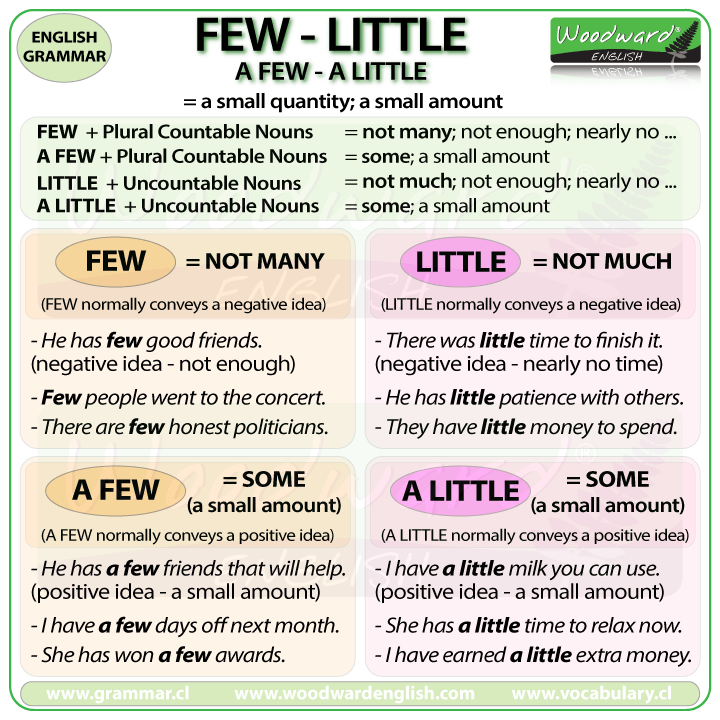
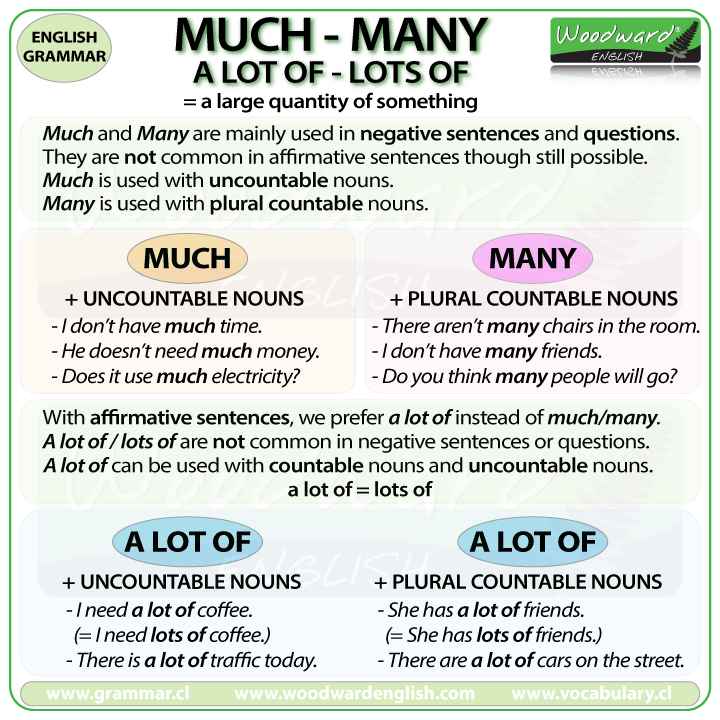
Quantifiers


Monday, 3 October 2016

Present Perfect vs Progressive

Present Perfect Simple – Present Perfect Progressive

Form

Present Perfect SimplePresent Perfect Progressive
irregular verbs: form of 'have' + 3rd column of irregular verbs
Example:
I / you / we / they have spoken
he / she / it has spoken
regular verbs: form of 'have' + infinitive + ed
Example:
I / you / we / they have worked
he / she / it has worked
form of 'have' + been + verb + ing
Example:
I / you / we / they have been speaking
he / she / it has been speaking
Exceptions
Exceptions when adding 'ed' :
  • when the final letter is e, only add d
    Example:
    love - loved
  • after a short, stressed vowel, the final consonant is doubled
    Example:
    admit - admitted
  • final l is always doubled in British English (not in American English)
    Example:
    travel - travelled
  • after a consonant, final y becomes i (but: not after a vowel)
    Example:
    worry - worried
    but: play - played
Exceptions when adding 'ing' :
  • silent e is dropped. (but: does not apply for -ee)
    Example: come - coming
    aber: agree - agreeing
  • after a short, stressed vowel, the final consonant is doubled
    Example: sit - sitting
  • after a vowel, the final consonant l is doubled in British English (but not in American English).
    Example: travel - travelling
  • final ie becomes y.
    Example: lie - lying
Use
Both tenses are used to express that an action began in the past and is still going on or has just finished. In many cases, both forms are correct, but there is often a difference in meaning: We use the Present Perfect Simple mainly to express that an action is completed or to emphasise the result. We use the Present Perfect Progressive to emphasise the duration or continuous course of an action.

Result or duration?

Do you want to express what has happened so far or how long an action has been going on yet?
Present Perfect SimplePresent Perfect Progressive
Result (what / how much / how often)
I have written 5 letters. / I have been to London twice.
Duration (how long)
I have been writing for an hour.

Certain verbs

The following verbs are usually only used in Present Perfect Simple (not in the progressive form).
  • state: be, have (for possession only)
    Example: We have been on holiday for two weeks.
  • senses: feel, hear, see, smell, taste, touch
    Example: He has touched the painting.
  • brain work: believe, know, think, understand
    Example: I have known him for 3 years.

Emphasis on completion or duration?

Do you want to emphasise the completion of an action or its continuous course (how has somebody spent his time)?
Present Perfect SimplePresent Perfect Progressive
Emphasis on completion
I have done my homework. (Meaning: My homework is completed now.)
Emphasis on duration
I have been doing my homework. (Meaning: That's how I have spent my time. It does not matter whether the homework is completed now.)

Result or side effect?

Do you want to express that a completed action led to a desired result or that the action had an unwanted side effect?
Present Perfect SimplePresent Perfect Progressive
desired result
I have washed the car. (Result: The car is clean now.)
unwanted side effect
Why are you so wet? - I have been washing the car. (side effect: I became wet when I was washing the car. It does not matter whether the car is clean now.)

Time + negation: last time or beginning of an action?

In negative sentences: Do you want to express how much time has past since the last time the action took place or since the beginning of the action?
Present Perfect SimplePresent Perfect Progressive
since the last time
I haven't played that game for years. (Meaning: It's years ago that I last played that game.)
since the beginning
I haven't been playing that game for an hour, only for 10 minutes. (Meaning: It's not even an hour ago that I started to play that game.)

Permanent or temporary?

If an action is still going on and we want to express that it is a permanent situation, we would usually use the Present Perfect Simple. For temporary situations, we would prefer the Present Perfect Progressive. This is not a rule, however, only a tendency.
Present Perfect SimplePresent Perfect Progressive
permanent
James has lived in this town for 10 years. (Meaning: He is a permanent resident of this town.)
temporary
James has been living here for a year. (Meaning: This situation is only temporary. Maybe he is an exchange student and only here for one or two years.)

Signal words

Present Perfect SimplePresent Perfect Progressive
  • how often
  • ... times
  • how long
  • since
  • for

Exercises on Present Perfect Simple and Present Perfect Progressive

Tests on Present Perfect Simple and Present Perfect Progressive

Friday, 30 September 2016

STARTING OFF- GRAMMAR- VERBAL TENSES

Form

Simple PresentPresent Progressive
infinitive
(3rd person singular: infinitive + 's')
I speak
you speak
he / she / it speaks
we speak
they speak
form of 'be' and verb + ing
I am speaking
you are speaking
he / she / it is speaking
we are speaking
they are speaking
Exceptions
Exceptions when adding 's' :
  • For can, may, might, must, do not add s.
    Example: he can, she may, it must
  • After o, ch, sh or s, add es.
    Example: do - he does, wash - she washes
  • After a consonant, the final consonant ybecomes ie. (but: not after a vowel)
    Example: worry - he worries
    but: play - he plays
Exceptions when adding 'ing' :
  • Silent e is dropped. (but: does not apply for -ee)
    Example: come - coming
    but: agree - agreeing
  • After a short, stressed vowel, the final consonant is doubled.
    Example: sit - sitting
  • After a vowel, the final consonant l is doubled in British English (but not in American English).
    Example: travel - travelling (British English)
    but: traveling (American English)
  • Final ie becomes y.
    Example: lie - lying

Use

In general or right now?

Do you want to express that something happens in general or that something is happening right now?
Simple PresentPresent Progressive
in general (regularly, often, never)
Colin plays football every Tuesday.
present actions happening one after another
First Colin plays football, then he watches TV.
right now
Look! Colin is playing football now.
also for several actions happening at the same time
Colin is playing football and Anne is watching.
Signal words
  • always
  • every ...
  • often
  • normally
  • usually
  • sometimes
  • seldom
  • never
  • first
  • then
  • at the moment
  • at this moment
  • today
  • now
  • right now
  • Listen!
  • Look!
Note: The following verbs are usually only used in Simple Present:
be, have, hear, know, like, love, see, smell, think, want

Timetable / Schedule or arrangement?

Do you want to express that something is arranged for the near future? Or do you refer to a time set by a timetable or schedule?
Simple PresentPresent Progressive
action set by a timetable or schedule
The film starts at 8 pm.
arrangement for the near future
I am going to the cinema tonight.

Daily routine or just for a limited period of time?

Do you want to talk about a daily routine? Or do you want to emphasis that something is only going on for a limited (rather short) period of time?
Simple PresentPresent Progressive
daily routine
Bob works in a restaurant.
only for a limited period of time (does not have to happen directly at the moment of speaking)
Jenny is working in a restaurant this week.

Certain Verbs

The following verbs are usually only used in Simple Present (not in the progressive form).
  • state: be, cost, fit, mean, suit
    Example: We are on holiday.
  • possession: belong, have
    Example: Sam has a cat.
  • senses: feel, hear, see, smell, taste, touch
    Example: He feels the cold.
  • feelings: hate, hope, like, love, prefer, regret, want, wish
    Example: Jane loves pizza.
  • brain work: believe, know, think, understand
    Example: I believe you.
  • Introductory clauses for direct speech: answer, ask, reply, say
    Example: “I am watching TV,“ he says.

Monday, 26 September 2016

European Day of Languages-26th Sept


http://www.macmillanenglish.com/uploadedFiles/wwwmacmillanenglishcom/Content/Campaigns/EU_Languages_Day/EU%20Languages%20Day%20QUIZ2.pdf

Did you know this about... English?


01The spelling of William Shakespeare's name has varied over time. Sources from William Shakespeare’s lifetime spell his last name in more than 80 different ways, ranging from “Shappere” to “Shaxberd”. In the handful of signatures that have survived, the Bard never spelled his own name “William Shakespeare,” using variations or abbreviations such as “Willm Shakp,” “Willm Shakspere” and “William Shakspeare” instead. However it’s spelled, Shakespeare is thought to derive from the Old English words “schakken” (“to brandish”) and “speer” (“spear”), and probably referred to a confrontational or argumentative person.
02In the English language the combination "ough" may be pronounced in nine different ways. The following sentence contains them all: "A rough-coated, dough-faced, thoughtful ploughman strode through the streets of Scarborough; after falling into a slough, he coughed and hiccoughed."
03There is a completely unique English dialect spoken only on Tangier Island, Virginia. It is said to be almost the same as when the island was settled in 1686 and can be unintelligible even to native English speakers.
04According to the US company Global Language Monitor (GLM) a new word in the English language is created about every 98 minutes.
The English language is likely to contain the most words of all languages, according to the Oxford English Dictionary, and estimates for the number of words range from one to two million.
05Before the year 1000, the word “she” didn’t exist in the English language. The singular female reference was the word "heo," which also was the plural of all genders. The word "she" didn't appear until the 12th century, about 400 years after English began to take form. "She" probably derived from the Old English feminine "seo," the Viking word for feminine reference. 
06The word “impossible” dropped in literary use by 50% over the course of the 20th century
07“The sixth sick sheik’s sixth sheep’s sick” is listed by the Guinness Book of Records as the hardest tongue twister in the world.
08The word “like” can be used as a noun, verb, adverb, adjective, preposition, particle, conjunction, hedge, interjection, and quotative.
09Aoccdrnig to a rscheearch at Cmabrigde Uinervtisy, it deosn’t mttaer in waht oredr the ltters in a wrod are; the olny iprmoatnt fatcor is taht the frist and lsat ltteres be at the rghit pclae. The rset can be a total mses and you can sitll raed it wouthit a porbelm. Tihs is bcuseae the huamn mnid deos not raed ervey lteter by istlef, but the wrod as a wlohe.
Or
According to a research at Cambridge University, it doesn’t matter in what order letters in a word are written;. the only important factor is the the first and last letters be in the right place. The rest can be a total mess and you can still read it without a problem. This is because the human mind does not read every letter by itself but the word as a whole.
10For more than a century, the English aristocracy couldn’t speak English. William the Conqueror tried to learn English at the age of 43 but gave up. He didn’t seem especially fond of the land he had conquered in 1066, spending half of his reign in France and not visiting England at all for five years when in power. Naturally, French-speaking barons were appointed to rule the land.
Within 20 years of the Normans taking power in England, almost all of the local religious institutions were French-speaking. The aristocrats brought with them large retinues and were followed by French tradesmen, who almost certainly mixed bilingually with the English tradesmen. In turn, ambitious Englishmen would have learned French to get ahead in life and mix with the new rulers. Around 10,000 French words entered English in the century after the Norman invasion. There is little to suggest that aristocrats themselves spoke English. It isn’t until the end of the 12th Century that we have evidence of the children of the English aristocracy with English as a first language. In 1204, the English nobility lost their estates in France and adopted English partly as a matter of national pride.
11One man is credited as being largely responsible for the differences between American and British spelling. Noah Webster, born in West Hartford, Connecticut in 1758, believed that a great emerging nation such as the USA needed a language of its own: American English. Webster found the English in the textbooks of the time to be corrupted by the British aristocracy, with too much French and Classical influence. He was to write American books for American learners, representing a young, proud and forward-thinking nation. Between 1783 and 1785, he produced three books on the English language for American schoolchildren. During his lifetime, 385 editions of his Speller were published.
The modern US spelling of color was initially spelt in the British way, colour, but this changed in later editions. Other differences include the US spelling of center as opposed to the British centre, and traveler instead of traveller. Webster wanted to make spelling more logical, as befitting a nation that was founded on progressive principles. This is a rare example of a dictionary writer trying to lead the English language instead of describe it.

Thursday, 22 September 2016

New course 2016-17. New wxpectations

Qualifying criteria:

  • Assessing tasks: Skills
  • Grammar-Vocabulary-Rephrasing-Translation
  • Projects-Assignments-Attitude-Participation


Thursday, 8 September 2016

EXPRESSING CHANGES

News Review

Major problem with world's oceans

A new report into the rising temperatures of the world's oceans has discovered that this problem is more serious than we originally thought. 
Language challenge
Two of these verbs mean 'rise quickly' and one of these verbs means 'fall quickly'. Which verb do you think means 'fall quickly'? 

a) rocket
b) surge
c) plunge
You'll hear the answer in the programme.

The story

A report compiled by 80 scientists from 12 countries says the global impact of ocean warming has been severely underestimated.
The study launched by the International Union for Conservation of Nature suggests that climate change is pushing plankton, jellyfish, turtles and seabirds into waters previously too cold to support them.
Dan Laffoley - BBC News
This warming has real consequences for us and our livelihoods. One of the things which is different with this report than anything we've done before is taking this comprehensive view.
One of the priorities should be actually to build on this report, to have a discussion around the evidence that we're showing and actually then to work to, to plan for the future with the information that we know we'll need to be able to cope when we see [a] progressive changes from a warming ocean.

Key words and phrases

underestimated(here) thought to be lower than it really is
livelihoodsways of earning money in order to live
soaring
rising quickly
plummeting
falling quickly and suddenly
staggering
very shocking and surprising
bear the brunt of
suffer the worst part or effect of something bad or harmful