The Boston Tea Party was a political protest in Boston Harbor on December 16, 1773, where American colonists, disguised as Native Americans, dumped 342 chests of British tea into the water. It was a protest against the British Parliament's "taxation without representation," specifically the Tea Act of 1773, which gave the British East India Company a monopoly and still maintained a tax on tea. The event escalated tensions between Great Britain and the colonies, leading to the Coercive Acts (Intolerable Acts) and fueling the movement toward the American Revolution.
Thursday, 6 November 2025

Tuesday, 4 November 2025
Writing. Lowering the voting age
 Should voting be lowered to 16?
A citizen in Spain can only cast their vote if they are 18 or over. Debate regarding age limit in voting resurfaced recently as some political parties want to attract people to get more representation. Another argument which has been made against lowering the age limit on voting is that voting is not the only form of political participation. Those under the age of 18 can take part in democratic society through various methods which range in the amount of involvement needed. Some of these form of participation are listed below;

WRITING TASK
1. Introduction
2. Arguments in favour of Lowering the Voting Age
2.1. Increased Civic Engagement
2.2. Young People's Stake in the Future
2.3. Consistency with Other Rights and Responsibilities
3. Arguments against Lowering the Voting Age
3.1. Maturity and Decision-Making Abilities
3.2. Lack of Life Experience
3.3. Potential for Manipulation and Influence
4. Conclusion
SETTING AN EXAMPLE.

OPINION ESSAY.
In different countries around the world, the voting age varies, with some nations allowing citizens as young as 16 to cast their ballots, while others maintain a higher threshold of 18 or older.
One notable advantage of reducing the voting age is the potential for fostering political engagement among youth. By granting young individuals the right to vote, they may become more inclined to take an active interest in political matters, ultimately leading to a more politically literate and engaged generation. Furthermore, the inclusion of younger voices in the electoral process ensures that their concerns and interests are adequately represented, thereby promoting a more inclusive and diverse political landscape.
However, there are also drawbacks to lowering the voting age. Critics contend that younger individuals may lack the maturity and life experience necessary to make well-informed decisions regarding complex political subjects. Therefore, this could result in voting patterns that do not accurately reflect the best interests of society as a whole. Additionally, young voters may be more vulnerable to manipulation by politicians seeking to exploit their relative inexperience for political advantage.
In conclusion, the advantages of a lower voting age, including enhanced political engagement and representation of younger demographics, must be weighed against the disadvantages, such as potential immaturity and vulnerability to manipulation. In my opinion, maintaining a voting age of 18 provides a more appropriate balance, ensuring that voters have the necessary maturity and understanding to participate effectively in the electoral process.
Monday, 3 November 2025
Speaking and discussion. Gen Z protests
Young people across the globe are taking to the streets in protest against their governments. From Madagascar, to Peru, to Indonesia, Generation Z is rising to express their growing discontent with their leaders. Gen Z consists of people born roughly between 1996 and 2010. They share a common perception of a world of increasing inequality, corruption, nepotism, corporate greed, and a bleak outlook regarding career prospects. This week in Madagascar, a group of protesters dubbed "Gen Z Madagascar" helped oust the country's president. Young Indonesians took part in deadly demonstrations over lawmakers' pay. In Morocco, people marched to call for better healthcare and education.
The protesters have two things in common. One is a growing exasperation about the state of the world; the other is the use of a flag from a Japanese manga called "One Piece". The flag depicts a skull with a straw hat and crossed bones. In the manga, a group of pirates fly the flag and fight against oppressive governments and injustice. In real life, the flag has appeared on banners and social media, and seen in graffiti worldwide. Al Jazeera reported that in protests in Nepal, the flag was painted on murals, hung from vehicles, and was displayed in place of national flags. It added: "It is used partly in satire, partly as a statement: rejecting the status quo, calling out what protesters see as failures of governance."


Stating an opinion
- In my opinion...
- The way I see it...
- If you want my honest opinion....
- According to Lisa...
- As far as I'm concerned...
- If you ask me...
Asking for an opinion
- What's your idea?
- What are your thoughts on all of this?
- How do you feel about that?
- Do you have anything to say about this?
- What do you think?
- Do you agree?
- Wouldn't you say?
Expressing agreement
- I agree with you 100 percent.
- I couldn't agree with you more.
- That's so true.
- That's for sure.
- (slang) Tell me about it!
- You're absolutely right.
- Absolutely.
- That's exactly how I feel.
- Exactly.
- I'm afraid I agree with James.
- I have to side with Dad on this one.
- No doubt about it.
- (agree with negative statement) Me neither.
- (weak) I suppose so./I guess so.
- You have a point there.
- I was just going to say that.
Expressing disagreement
- I don't think so.
- (strong) No way.
- I'm afraid I disagree.
- (strong) I totally disagree.
- I beg to differ.
- (strong) I'd say the exact opposite.
- Not necessarily.
- That's not always true.
- That's not always the case.
- No, I'm not so sure about that.
Interruptions
- Can I add something here?
- Is it okay if I jump in for a second?
- If I might add something...
- Can I throw my two cents in?
- Sorry to interrupt, but...
- (after accidentally interrupting someone) Sorry, go ahead. OR Sorry, you were saying...
- (after being interrupted) You didn't let me finish.
Settling an argument
- Let's just move on, shall we?
- Let's drop it.
- I think we're going to have to agree to disagree.
- (sarcastic) Whatever you say./If you say so.
Monday, 20 October 2025
Breaking news. Israeli/Palestinian conflict
Around half a million Palestinians are returning to Gaza City following the start of a ceasefire between Israel and Hamas. The truce followed extensive efforts and negotiations between Israel, Hamas, the USA, and Arab nations. The deal was orchestrated by US President Donald Trump, who hopes to bring peace to the region. The first phase of his peace deal involved the withdrawal of Israeli military from a large section of Gaza, and for Hamas to release the 48 hostages remaining in captivity. The laying down of arms has allowed hundreds of thousands of Palestinians to head north to Gaza City, most of which is in ruins after two years of being bombarded and reduced to rubble.
Emotions have been running high in recent days among Israelis and Palestinians. Alongside the release of the Israeli hostages, nearly 2,000 Palestinian prisoners and detainees are expected to be freed. The brother-in-law of hostage Omri Miran told the New York Post: "I have yet to process it all. I am naturally happy that this nightmare may soon be over." Gaza City residents are relieved to be able to return home, despite the widespread destruction, almost no infrastructure, no electricity, and no running water. One resident said: "I pray that God relieves our sorrow and distress, and that people return to their homes." Another man was more cautious after being displaced 20 times in the past two years.https://breakingnewsenglish.com/2510/251013-gaza-ceasefire-a.html
Paragraph 1
| 1. | truce | a. | Broken pieces of stone, brick, or buildings. |
| 2. | extensive | b. | An agreement to stop fighting for a time. |
| 3. | negotiations | c. | The act of moving back or leaving a place. |
| 4. | orchestrated | d. | Very big or covering a large area. |
| 5. | withdrawal | e. | Carefully planned and organized. |
| 6. | captivity | f. | Talks between people or groups to reach an agreement. |
| 7. | rubble | g. | The state of being kept as a prisoner or not free. |
Paragraph 2
| 8. | detainees | h. | People kept by the police or army and not free to leave. |
| 9. | nightmare | i. | Forced to leave home and live somewhere else. |
| 10. | relieved | j. | A very bad or scary dream. |
| 11. | destruction | k. | A strong feeling of sadness. |
| 12. | infrastructure | l. | Feeling happy or calm after worry or fear. |
| 13. | sorrow | m. | Great damage; when something is ruined or broken. |
| 14. | displaced | n. | The basic systems a country needs, like roads and power. |
1. TRUE / FALSE: Read the headline. Guess if 1-8 below are true (T) or false (F).
- Half a million people live in Gaza. T / F
- The first stage of the ceasefire involves Israel's army leaving all of Gaza. T / F
- Hamas must release 48 hostages as part of the ceasefire. T / F
- The article says Gaza City has been hit by bombs for the past two years. T / F
- The ceasefire requires Israel to release almost 2,000 prisoners. T / F
- An Israeli man said he is happy the nightmare might soon be over. T / F
- Only half of Gaza City has electricity. T / F
- A Gaza City resident has moved 20 times in the past two years. T / F
Sunday, 19 October 2025
Halloween quiz
This exercise is based on the information provided in the video "Halloween History" by National Geographic [
📝 Halloween History Comprehension Exercise
I. True or False Questions (10 points)
Determine whether the following statements are true (T) or false (F) based on the video.
Halloween's roots date back to a people called the Celts. _____
The Celts celebrated the end of the harvest season on November 1st. _____
The Celtic festival of Samhain was considered a time when the veil between death and life was supposed to be at its thinnest. _____
Villagers lit huge bonfires on Samhain to attract spirits and ghosts. _____
The Catholic Church began to merge the pagan rituals of Samhain with a church-sanctioned holiday in the 19th century. _____
All Saints Day was designated on November 1st to honor martyrs and the deceased faithful. _____
The English translation of the word "hallow" is roughly "scary." _____
The holiday customs were brought to America by Irish immigrants during the Potato Famine of the 1840s. _____
Trick-or-treating originated in America as a non-violent, organized charity event. _____
In the 1930s, the tradition of harmless tricks eventually grew into outright vandalism. _____
II. Comprehension Questions (5 points)
Answer the following questions based on the video:
What was the name of the Celtic festival that marked the end of the harvest season and the Celtic New Year?
When did the Catholic Church first designate November 1st as All Saints Day?
According to the video, what was the calculated move on the part of the Church in merging the pagan and Christian holidays?
What two specific customs did Irish immigrants bring with them to America?
How was "trick-or-treating" originally described before it became an established holiday greeting?
III. Fill in the Gaps (5 points)
Complete the following sentences with the missing information from the video.
Halloween is a _____________ holiday stitched together with cultural, religious, and occult traditions that span centuries.
On Samhain, the ghost of the _____________ walked the Earth.
The night before All Saints Day was All Hallow's Eve, which gradually morphed into _____________.
All Saints Day had to do with the afterlife and about _____________ after death.
By the late 1930s, storekeepers and neighbors began giving treats or _____________ to stop the tricks and troublemaking.
IV. Multiple Choice Questions (5 points)
Choose the best answer for each question.
What does the word "hallow" in All Hallows Day mean? a) Scary b) Holy or saintly c) New Year d) Ghostly
The Celts' festival of Samhain was celebrated on which date? a) October 18th b) October 31st c) November 1st d) December 31st
According to the video, the tradition of harmless tricks grew into outright vandalism by which decade? a) The 1840s b) The 1930s c) The 1950s d) The 2000s
Which group of people brought the original Halloween customs to America? a) English Settlers b) Scottish Traders c) German Artisans d) Irish Immigrants
What was one of the early customs brought to America by the immigrants? a) Carving pumpkins b) Trick-or-treating c) Bobbing for apples d) Watching scary movies
Monday, 13 October 2025
Use of English. Inversion.
What is an inversion with a negative adverbial?
In formal English, we can use a negative or restrictive adverb at the beginning of a sentence to make it more emphatic or dramatic. When we do this, the adverb is then followed by an inversion: auxiliary verb + subject (+ verb). See the example below:
- I could find my keys nowhere. ⇒ Nowhere could I find my keys.
When there is no auxiliary verb, we use do/does (present) or did (past) as auxiliary.
- I understand the true meaning only now. ⇒ Only now do I understand the true meaning.
- I didn’t say anything until she arrived. ⇒ Not until she arrived did I say anything.
Common adverbs used with this structure
In the table below, you can see some of the most common negative or restrictive adverbials that are sometimes used at the beginning of the sentence for emphasis.

Download full-size image from Pinterest
Hardly, barely, scarcely, no sooner
We normally use hardly … when, barely … when, scarcely … when, and no sooner … than in narratives with past perfect in the inversion.
We use no sooner … than (NOT that, or when)
Adverbial + clause + inversion
❗ Note that after some adverbials, such as only if and only when we use a subordinate clause (subject + verb), and that the inversion is never in the subordinate clause but in the main verb of the sentence. Check the sentence below:
- Only when do I sleep I can forget about the accident.

- Only when I sleep can I forget about the accident.

The same happens with other adverbials, such as not since and not until; we use a subordinate clause (subject + verb), and the inversion is never in the subordinate clause but in the sentence’s main verb. Check the sentence below:
- Not since was I a child I have had such a great time.
- Not since I was a child have I had such a great time.
If you are in doubt, it’s always useful to look at the sentence without the negative adverbial at the beginning.
- I can forget about the accident only when I sleep.
- I haven’t had such a great time since I was a child.
The main subject and verb are at the beginning of the sentence, and this is the element that must be in the inversion.
Not
We must always use not followed by another element before the inversion.
- Not can we see such great expressions of art often.
- Not often can we see such great expressions of art.
Adverbs of frequency
We can also use inversion after the negative or restrictive adverbs of frequency, such as seldom, rarely, or never.
We often use never to talk about experiences. In that case, we normally use present perfect or past perfect.
Wednesday, 8 October 2025
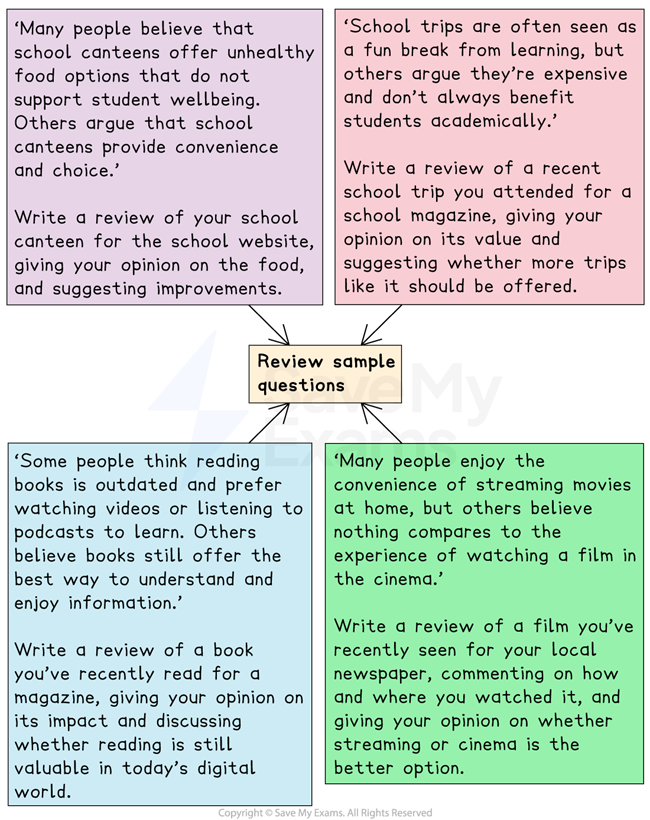
Writing (Practice makes perfect). A review
Learning Objective: To understand what a review is, what they are used for and how to create a successful one.
What is a Review? What are they used for?
- A review is a written assessment of something, someone or an experience. It is there to inform people, to advise them, to analyse something or describe it.
- They can be written with a positive view in order to give praise, with a negative perspective to criticise, or simply just offer an opinion and balanced view of something for others to read.
- A review should always give your opinion but also be as accurate as possible. The purpose of a review is often to help other people so giving accurate information is useful. For example if you are reviewing a product such as a mobile phone accurate details allow other people who read your review to understand it.
- Here are some examples of things that typically get reviewed:
- A book
- A film
- A CD
- A holiday
- A place you visited – museum, theme park
- An experience – paintballing, swimming, flying, massage
- A product you have bought/used – mobile phone, clothes, shoes, toys, crafts,
- recipe book
- A play
- A sporting event
.png)
Subscribe to:
Posts (Atom)