A) DIRECT SPEECH: words actually spoken; quotation marks. B) REPORTED SPEECH: we only give the meaning of what was said; no quotation marks.
C) TELL or SAY?
TELL + IO + DO
SAY + DO / SAY + TO + IO+ DO
TELL always has an indirect object, except in some expressions like tell the time, tell the truth ...
Changes in Reported Speech
A) Changes of PERSON, TIME and PLACE depend on changes in the situation. The most important changes are:
Pronouns
I / we...................................
he, she / they
Time
tomorrow ............................
the next / following day
yesterday ...........................
the day before
now ....................................
then
today / tonight .....................
that day / night
this morning ........................
that morning
on / next Tuesday ...............
the following Tuesday
last Tuesday .......................
the previous Tuesday
the day after tomorrow..........
in two days time
ago......................................
before
Place
here ....................................
there
Demonstratives
this / that ............................
the
B) TENSE CHANGE: Tense change depends on whether the introductory verb is present or past.
- If the introductory verb is present, there is no tense change.
- If the introductory verb is past, there is often a tense change. If the statement is up to date when we report it, we can leave the same tense or change it. We change the tense if we think the statement may be untrue. In news reports, the tense usually changes.
Direct Speech
Reported Speech
Direct Speech
Reported Speech
Simple Present .........
Simple Past
WILL ......................
WOULD
Present Continuous ..
Past Continuous
CAN .......................
COULD
Simple Past .............
Past Perf/S. Past*
MAY ......................
MIGHT
Past Continuous ......
Past Perf/Past Cont.*
MUST ....................
HAD TO
Present Perfect ........
Past Perfect
WOULD
NO CHANGE
Past Perfect ............
Past Perfect
COULD
MIGHT
SHOULD
OUGHT TO
A) Reporting verbs: SAY, TELL, ANNOUNCE, EXCLAIM,...
Reported statements
B) Introduced by THAT (it can be omitted)
C) Pronoun, verb and adverb change
Reported questions
A) Reporting verbs: ASK, WONDER, WANT TO KNOW
B) WH-QUESTIONS: introduced by an INTERROGATIVE PRONOUN (it cannot be omitted)
C) YES/NO QUESIONS: introduced by IF or WHETHER (they cannot be omitted)
D) Pronoun, verb and adverb change.Word order changes
E) EMBEDDED QUESTIONS: Could you tell me ...? Do you know ...?
1. 'What do you think of the college?' She asked ......................................... . 2. 'I'll call you later tonight,' Keith promised. Keith promised that ................................................ .
3. 'I didn't break the window,' said the boy. The boy denied.....................................................
4. 'Why don't you come this evening?' She suggested........................................................ .
5. 'You look really tired,' he told her. He said ....................................................... .
6. 'You must do your homework tonight.' the teacher said. The teacher told ...................................................... .
7. 'What's your name?' he asked. He asked ........................................................ . 8. 'I might be late for work.' he told me. He told ........................................................ .
9.‘Please don’t smoke in here!’ the waiter said to the customers.
The waiter told......................................................
10. ‘Will it be alright to come over tomorrow?’ he wanted to know.
He wanted........................................................................
11. ‘What has she been doing while I was out?’ asked Susan
Susan asked.........................................................................
12. ‘Who ate the last piece of cake?’ Sue asked.
Sue asked............................................................................................
13. ‘The students were standing outside the classroom, waiting for the teacher to arrive.’ commented Graham.
Graham commented............................................................................
1 "I can't believe what you're saying," Paul told me. 2 "Would you like a cup of tea? she said to the girls. 3 "What time did you arrive in London?" he asked.
4 "I'm sorry to be late, but I missed the bus" she said.
5 "Thank you for the postcard you sent me," she said to Jane.
6 "What were you doing last night at 9.30?" he asked.
7 "I'll show you when I finish," he said.
8 "The film had already started when Peter arrived," she said.
9 "I was having a shower when the phone rang," she said.
10 "You must finish the report today," my boss told me.
How old were you when you went on your first flight?
Where did you go?
Do you like to travel by airplane?
What was the longest flight you have ever taken?
What seat do you prefer: window, center or aisle?
What are three things you're supposed to do before the flight takes off?
What do you like to do during the flight?
Does the plane provide anything to do to pass the time?
What are some movies you remember seeing on the plane?
What do you do when you experience turbulence?
Have you ever met anyone or established any relationships during a flight?
What should be done with obese people who practically take up two seats?
Can you sleep during the flight?
Have you ever seen a female pilot?
Why do you think that most pilots are men?
Would you like to be a flight attendant?
What are the benefits and /or downfalls?
Are most flight attendants female?
Is being a flight attendant considered a good job in your country?
What do you think are the qualifications?
Are planes really safer than cars? ( A British study shows that flying is 176 times safer than walking, 15 times safer than driving and 300 times safer than a motorbike.)
Would you rather have a younger, more beautiful/handsome flight attendant or an older, more experienced one?
What are the advantages of traveling by airplane?
What are the disadvantages?
Do you know someone who is afraid of flying in an airplane?
What questions should you ask when buying airplane tickets?
What is a group rate?
What is a charter flight?
What arrangements should you make for pick-up at the airport?
What things can you see in an airport?
What questions do they ask you when you check-in at the airport?
What questions do they ask you when going through immigration and customs at the airport?
Have you ever seen an airplane crash?
Have you ever seen terrorists on the plane?
Have you ever met an annoying person during a flight?
Have you ever had an accident during a flight?
Have you ever work as a flight attendant?
Do you only fly one airline?
Do you think budget airlines are safe?
Do you like to fly? Why or why not?
What is the smallest airplane you have ever been on? How small was it?
Do you prefer to fly in big planes or small planes? Why?
Would you like to learn how to fly? Why or why not?
Do you think being a pilot is a good job? Why or why not?
Have you ever gone sky-diving? Why or why not?
Have you or someone you know ever been in a plane crash?
What would you do if you were on a plane that was crashing?
Do you like to watch movies or TV about airplane crashes? Why or why not?
Do you enjoy the foods on airplane?
What arrangements should you make for pick-up at the airport?
What things do you see in an airport?
What questions do they ask when you check-in at the airport?
What questions do they ask when going through immigration/customs at the airport?
How much baggage do you take with you?
What items should not be included in your hand baggage?
What documents do you need for international travel?
What airline do you prefer using?
How was the service on your last flight?
Do you like airline food?
Would you pay money for airline food?
Do you enjoy talking with strangers on an airplane?
Do you enjoy takeoff / landing?
What are some airplane disaster movies?
Why do you think they are popular?
How do the pilot and the co-pilot navigate their planes?
What is a boarding pass?
When do you pay for airport tax?
Where can you hang your coats after boarding an airplane? 5. What do you do when you get blocked ears during take off / landing?
What do you do before take off / landing?
Where can you smoke while traveling by plane?
What do you do when you need a flight attendant's assistance?
How can passengers reduce the risk of deep vein thrombosis?
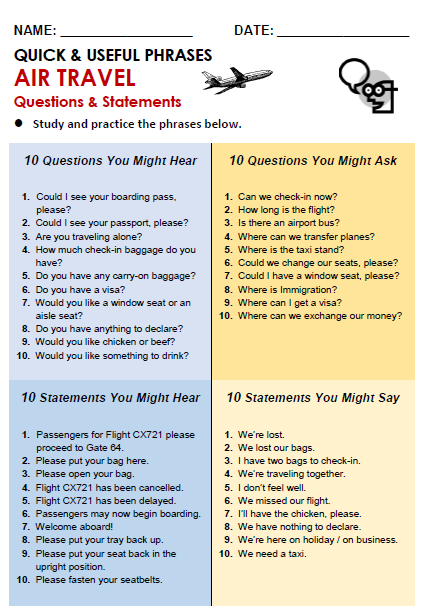
SUGGESTION Before handing out these phrases, consider dividing the board into a similar four-section grid and eliciting as many of the phrases that your learners can think of on their own.
International Women’s Day takes place every year on 8 March to celebrate the achievements of women all over the world. It started with a protest that took place in New York City in 1908 where women went out onto the streets to demand the right to vote, shorter working hours and better pay. Since then it has taken many forms and today it’s a global event that is supported by lots of charities, NGOs, governments and academic institutions. In some countries, March 8 is an official holiday and in other countries it’s an official holiday but only for women.
Why do we need an International Women’s Day?
In today's world it may appear that women have all the same opportunities as men. If you watch the news you will see women astronauts, women prime ministers and women leaders in business. However, if you look at the statistics you realise there’s still a long way to go. The BBC did a report a few years ago that showed that in the UK women occupied only 30.9% of the most senior positions across a range of jobs in areas like politics, business and policing. So, although progress has been made since 1908, there is still a lot to do before we see an equal number of men and women in the top jobs and receiving equal pay.
How is IWD celebrated?
A lot of special events take place in towns and cities to celebrate International Women’s Day. There are exhibitions, theatre shows, talks, discussions, walking tours, films, workshops, fun runs and so much more. All the events are designed to celebrate the role of women in society and to make us all take a step back and think about the progress that has been made, but also about the changes that still need to take place to ensure the world is a fair and equal place for all its citizens. To find out what is happening in your country have a look on the events page of the International Women's Day website.
Think globally and act locally
The message for women around the world is to ‘think globally and act locally’. This means to learn about some of the key issues that women face around the world and then to try to take action close to home. Emma Watson, the actress who played Hermione in the Harry Potter films, is a great example of someone who is doing something to raise awareness about the issues that women face globally. She has launched a campaign called HeForShe, which aims to get people talking at all levels about gender equality. The aim is to create a ‘gender-equal world’. The HeForShe campaign makes it very clear that it’s the role of men as well as women to make changes in all areas of their lives, both at work and in the family, to help make this possible. With the support of UN Women, the United Nations organisation to support women, Emma’s campaign is surely going to make a big impact.
The future
Can you imagine a future where there’s no need at all to even have an International Women’s Day? Where there is total equality for men and women? Hmmm … something to think about but perhaps in your lifetime this could happen!?
Plastics are important for our economy. In the EU, industry figures indicate that the plastics sector employs 1.5 million people and generates a turnover of 340 billion EUR. However, today around 25.8 million tonnes of post-consumer plastic waste are generated in Europe every year, and of this less than 10% is actually re-injected into the economy. According to estimates, 95% of plastic packaging material value, i.e. up to 105 billion euros annually, is lost after a very short first-use cycle. Globally, up to 10 million tons of plastics leak into the environment every year, generating significant economic and environmental damage. According to the often quoted estimate, by 2050 there will be more plastic waste than fish in the oceans. Economic costs for coastal and beach cleaning across the EU were assessed to reach almost 630 million EUR per year. So, what's next for the EU? Design & Production: more durability, reuse and high-quality recycling, all plastic packaging designed to be recyclable by 2030, and promotion of alternatives to single use plastic items. Recycling: more sorting, better recycling, and 200,000 new jobs in Europe. From waste to resource-improve cooperation between different players in the plastics value-chain: products to be designed for recycling and re-use, infrastructure for collection and sorting improved, plus new quality and safety standards.
Commission to provide travel opportunities
with educational and cultural value for young people
The European Commission has today taken first steps to implement the
European Parliament's proposal for a "Free Interrail pass for Europeans
turning 18" by adopting a Financing Decision. With a budget of EUR 12
million in 2018, this action is expected to give an estimated 20,000-30,000
young people a travel experience that would help foster a European identity,
reinforce common European values and promote the discovery of European sites
and cultures. This proposal fits well with the EU's ambitions to promote
learning mobility, active citizenship, social inclusion and solidarity of all
young people. Commissioner for Education, Culture, Youth and Sport, Tibor Navracsics, said: "It is important that we offer all our
young people the opportunity to broaden their horizons by experiencing other
countries. Education is not only about what we learn in the classroom, but
what we discover about the cultures and traditions of our fellow
Europeans." The action will seek to offer young people,
regardless of social or educational background and including people with
reduced mobility, a chance to travel abroad. A promotion campaign to inform
young Europeans turning 18 about this new opportunity will be organised and may
include an open competition to select the first young people who will be
travelling. The first participants are expected to travel this summer. They
will do so by rail as a general rule, but alternative modes of transport should
be available where necessary, taking into account environmental considerations,
as well as time and distance. (For
more information:Nathalie
Vandystadt – Tel. +32 229 67083; Joseph
Waldstein – Tel. +32 229 56184
 Commission to provide travel opportunities
with educational and cultural value for young people
Commission to provide travel opportunities
with educational and cultural value for young people
